What Is the Waste of Motion in the Toyota Production System?
Motion waste in the Toyota Production System is any operator body movement during a work cycle that does not directly advance the process or add value to the product — distinguished from transportation, which moves materials.
Motion waste (動作のムダ, dōsa no muda) is any operator body movement during a work cycle that does not advance the process or add value to the product. Walking to retrieve a part, reaching across a bench, turning to find a tool, bending to pick up stock from the floor — all are motion. None advance the product toward completion.
Toyota draws a sharp line between motion and work. The Japanese terms are 動く (ugoku — to move) and 働く (hataraku — to work). The characters themselves encode the distinction: 働く adds the radical for “person” (人) to 動く, implying that motion becomes work only when human purpose is applied to advance the process. An operator can move continuously for an entire shift and accomplish nothing. Motion without value is waste.
This is not a minor taxonomy point. It is the foundation of how Toyota analyzes and improves every operation on the production floor. The complete framework for work versus waste starts here, and motion is one of Toyota’s seven categories of waste.
Where did the concept of motion waste come from?
Motion waste is one of only two categories Toyota added beyond what already existed in Industrial Engineering tradition. Five of the seven wastes map directly to ASME flow process chart symbols standardized in 1947: Operation, Transport, Inspection, Delay, and Storage became Processing, Transportation, Defects, Waiting, and Inventory. Toyota added Overproduction (from the just-in-time pillar) and Motion.
The motion addition came from a specific source. Shigeo Shingo began teaching Industrial Engineering courses at Toyota in 1955 — Operation Analysis, Process Analysis, Time Study, and Motion Studies. The Motion Studies course used Therblig symbols, a classification system developed by Frank and Lillian Gilbreth in the early twentieth century that breaks operator motion into 18 fundamental elements.
Of those 18 Therbligs, only three are value-added: Assembly, Use, and Disassembly. The other fifteen — Search, Find, Select, Grasp, Position, Hold, Inspect, Transport Loaded, Transport Empty, Pre-Position, Release, Unavoidable Delay, Avoidable Delay, Plan, and Rest — add no value to the product. They are, by definition, waste.
動作のムダ (dōsa no muda) — waste of motion. One of two waste categories Toyota added beyond the five ASME Industrial Engineering process chart symbols. Rooted in Therblig analysis from Shingo’s IE courses at Toyota starting 1955.
The standard ASME flow process chart treats the “Operation” symbol as atomic — a single circle on the chart representing a processing step. Toyota, influenced by Shingo’s motion studies, opened that box and looked at what the operator actually does inside the operation. That is the origin of motion waste as a distinct category.
There is also a Training Within Industry (TWI) lineage. The TWI Job Methods course, widely taught in postwar Japan, used the ECRS framework (Eliminate, Combine, Rearrange, Simplify) to attack unnecessary details in work methods. Taylor and Gilbreth’s motion study tradition fed into TWI, which fed into Toyota’s standardized work practice. Motion waste elimination sits at the end of this chain.
How does Toyota identify motion waste?
The diagnostic instrument is the work combination sheet (標準作業組合せ票, hyōjun sagyō kumiawase hyō). This is one of the three core standardized work documents at Toyota, and it is the one that makes motion visible.
The work combination sheet plots three types of time against a horizontal timeline for each step in an operator’s cycle:
- Manual time (手作業時間) — drawn as a solid line. The time the operator spends doing hand work at a machine or station.
- Walking time (歩行時間) — drawn as a wavy line. The time the operator spends moving between machines or stations.
- Machine time (自動送り時間) — drawn as a dashed line. The time a machine runs automatically while the operator moves to the next step.
Walking time is the motion audit. Every wavy line segment on the work combination sheet represents operator movement that adds no value. The sheet makes it visible, measurable, and comparable against takt time.
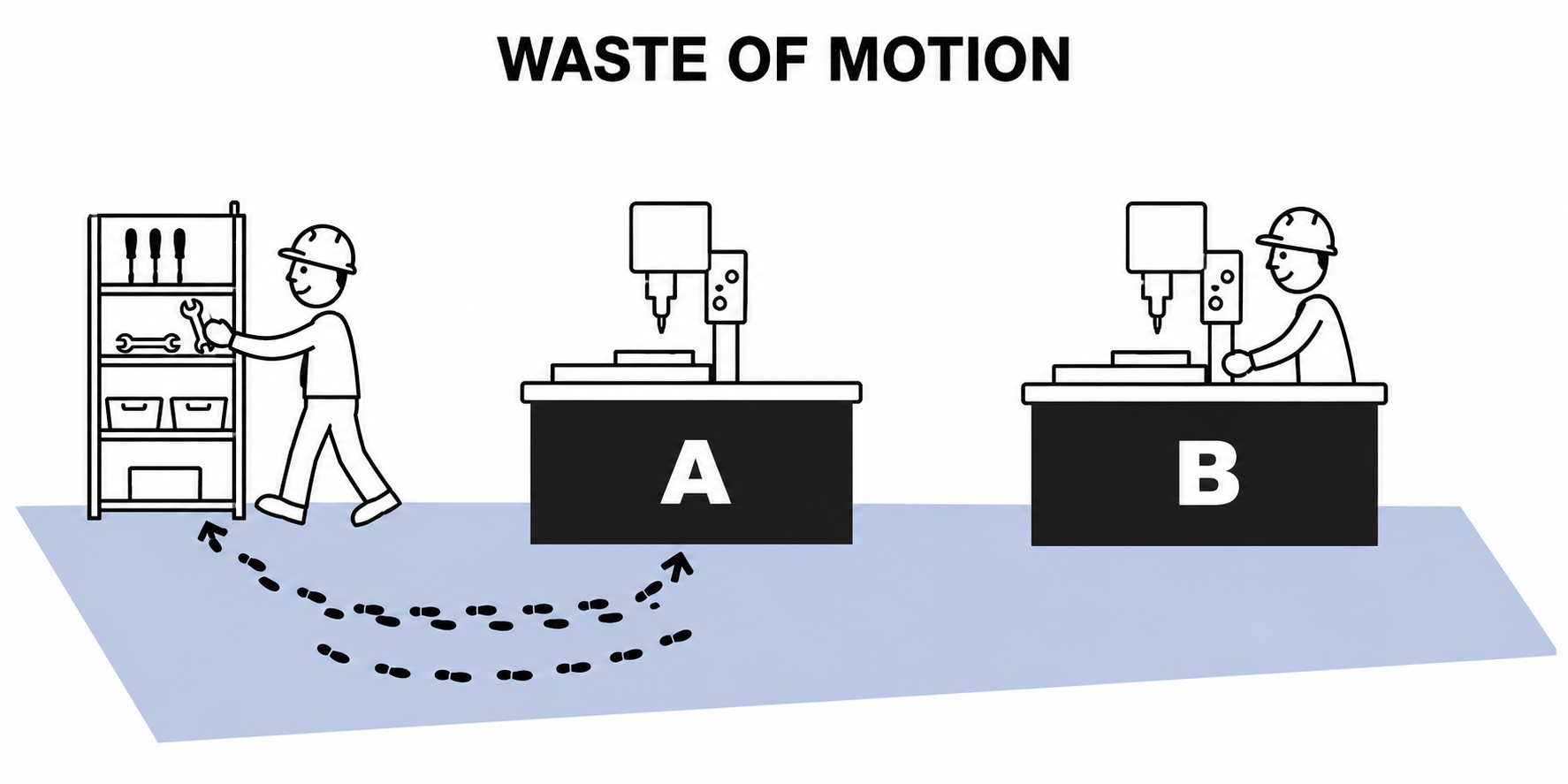 Motion waste: the operator leaves Station A to walk to a tool rack several steps away. The machine sits idle while the operator’s body moves without adding value.
The supervisor records takt time as a red vertical line, then plots each work element in sequence across the timeline. When the total comes back to the starting point, the sheet shows immediately where walking consumes the cycle and whether the combination fits within takt.
What is the analysis sequence for eliminating motion waste?
Motion waste exists at multiple levels. Work breaks down from job to task to steps to elements to individual motions. Most people stop at the element level — they document what the operator does at each station. That is necessary but insufficient. The real waste becomes visible only when you observe at the motion level, where the 15 non-value-added Therbligs live.
Toyota’s analysis operates at two levels, macro and micro, and both are required:
Level 1 — Macro: the work combination sheet. This captures walking between stations, manual time at each station, and machine auto-cycle time. It answers: how much of the cycle is the operator walking versus working? A supervisor can point to a specific wavy line segment and say: this walk takes four seconds per cycle. At 400 cycles per shift, that is 1,600 seconds — nearly 27 minutes — of pure waste. The work combination sheet makes walking waste visible and quantifiable.
Level 2 — Micro: Therblig observation inside each element. The work combination sheet shows a block of “manual time” at each station but does not reveal what happens inside that block. An element recorded as “install bolt” on the sheet might contain Search (looking for the right bolt), Select (choosing between similar parts), Position (rotating the bolt to align), Grasp, Transport Loaded, and finally Assembly. Only the Assembly is value-added. The rest are waste — but they are invisible at the element level. You must observe at the motion level to see them.
The sequence for elimination:
- Document the macro picture — complete the work combination sheet. Separate manual time, walking time, and machine time for each element. Identify the walking waste between stations.
- Observe each element at the motion level — watch the operator perform multiple cycles and identify which of the 18 Therbligs occur inside each manual-time block. The 15 non-value-added Therbligs are the waste targets.
- Redesign at both levels — change layout, machine spacing, and work sequence to eliminate walking (macro). Change part presentation, fixture design, and tool placement to eliminate non-value-added Therbligs inside each element (micro).
- Confirm — run the new combination, verify it fits within takt, and update the standardized work documents.
Toyota’s internal TPS instruction manuals instruct supervisors to check whether “the material staging area and tool positions are appropriate for easy work” and whether “machines are spaced too far apart.” These are motion waste questions — the first targets micro-level waste inside elements, the second targets macro-level walking waste between stations.
How does part presentation eliminate motion waste?
One of the most effective structural countermeasures for motion waste is part presentation — delivering parts to the operator’s hands at the point of use, in the correct orientation, at the right height.
The supermarket and kanban loop serves this function. When a small container of parts sits within arm’s reach at each station, the operator never leaves the cell to retrieve material. The material comes to the operator. Walking time on the work combination sheet drops toward zero.
This connects directly to Toyota’s transportation waste countermeasure. The training materials describe the material transfer chain: warehouse to factory, factory to machine side, machine side to operator’s hands. Each transfer is a waste event. The final link — getting the part into the operator’s hands without reaching, bending, or walking — is where transportation waste elimination and motion waste elimination overlap.
作業=働き+ムダ (sagyō = hataraki + muda) — Operation = Working + Waste. Toyota’s foundational equation. The goal of motion analysis is to increase the working share and shrink the waste share of every operator’s cycle.
Why do Therbligs matter for standardized work and point kaizen?
The Therblig vocabulary is what makes point kaizen possible. Without it, the observer sees only “the operator is working.” With it, the observer sees that of a 45-second cycle, perhaps 15 seconds is Assembly, Use, and Disassembly — and the other 30 seconds is Search, Grasp, Position, Transport Loaded, and walking. That 30 seconds is where point kaizen lives.
Point kaizen targets a single operation — one operator, one cycle, one set of motions. The supervisor watches the cycle and identifies the 15 non-value-added Therbligs happening in real time. A “Search” as the operator looks for the right bolt. A “Select” as the operator chooses between similar-looking parts. A “Position” as the operator rotates a component to fit the fixture. A “Hold” while the other hand reaches for a tool.
Each is a concrete improvement target with a specific countermeasure. Eliminate the Search by presenting parts in sequence. Eliminate the Select by color-coding or separating part types. Eliminate the Position by redesigning the fixture to accept the part in any orientation. Eliminate the Hold by adding a clamp.
This is the trained skill behind standardized work observation — the ability to decompose what looks like “working” into its constituent motions and separate the three that add value from the fifteen that do not. The work combination sheet tells you where to look (which elements consume the most time). The Therblig vocabulary tells you what to see when you look there.
What is the difference between motion waste and transportation waste?
This distinction causes persistent confusion. The rule is simple:
- Motion = operator body movement. Walking, reaching, bending, turning, searching.
- Transportation = material or product movement. Forklifts, conveyors, carts, pallet transfers.
When an operator walks across the shop to get a part, that is motion waste — the operator’s body moved without adding value. When a forklift carries a pallet of parts from the warehouse to the line, that is transportation waste — the material moved without value being added.
The categories have different causes and different countermeasures. Motion waste is solved through cell design, work sequence, and part presentation. Transportation waste is solved through layout, lot size reduction, and staging elimination.
What is the difference between motion waste and ergonomics?
Ergonomics and motion waste share surface similarity but differ in purpose. Ergonomics aims to reduce physical strain and injury risk. Motion waste analysis aims to eliminate non-value-added movement to reduce cost.
They often produce the same recommendations — lower the shelf, move the bin closer, reduce the reach distance. But they diverge when an ergonomic improvement adds cycle time (powered lift assist) or a motion reduction increases repetitive load on one joint.
Toyota addresses both through different channels. Motion waste is the supervisor’s domain through standardized work. Ergonomics is an engineering and safety function. Conflating them obscures the analytical rigor of motion waste analysis and reduces it to a workplace comfort exercise.
Frequently asked questions
What is the simplest definition of motion waste in TPS? Motion waste is any operator body movement during a work cycle that does not advance the process or add value to the product. It is distinct from transportation waste, which involves the movement of materials. The Japanese term is 動作のムダ (dōsa no muda).
Why is motion one of Toyota’s additions to the standard IE waste categories? The five ASME flow process chart symbols — Operation, Transport, Inspection, Delay, Storage — treat the Operation symbol as a single unit. Toyota, influenced by Shingo’s Therblig-based motion studies starting in 1955, opened the Operation box and analyzed what happens inside. Of 18 Therblig elements, only 3 are value-added. The other 15 became the basis for the motion waste category.
What tool does Toyota use to find motion waste? The work combination sheet (標準作業組合せ票). It plots manual time, walking time, and machine auto-cycle time on a horizontal timeline for each step in an operator’s cycle. Walking time — drawn as wavy lines — is the motion audit. Every wavy line segment is non-value-added movement.
How does Toyota distinguish between moving and working? Through two Japanese terms: 動く (ugoku — to move) and 働く (hataraku — to work). Motion becomes work only when it advances the process and adds value. An operator can be in constant motion for an entire shift without doing any work, in Toyota’s definition.
Is searching for tools a form of motion waste? Searching is technically motion — the operator’s body is moving without adding value. But Toyota typically treats searching as a 5S and management problem rather than a motion waste problem in the standardized work sense. Motion waste proper concerns the kinematics of the work cycle itself: reaching, walking between stations, bending, turning. If tools are missing, that is a workplace management failure, not a standardized work problem.
Does 5S solve motion waste? Partially. 5S addresses tool placement, material organization, and workplace arrangement, which reduces searching and some reaching. But the bulk of motion waste — walking patterns, work sequence, machine spacing, part presentation height — requires standardized work analysis, cell design, and fixture engineering. 5S is necessary but not sufficient.
Can motion waste ever be zero? Not practically. Some incidental motion — picking up a part, pressing a start button, walking one step between adjacent machines — is necessary to perform the value-added work under current conditions. Toyota classifies this as incidental work (付随作業, fuzui sagyō), not waste. The target is to minimize non-value-added motion, not to eliminate all movement. Of 18 Therbligs, 3 are value-added and the other 15 are targets for reduction — but some amount of Grasp, Transport Loaded, and Release will always remain as the minimum necessary to handle materials.
Art Smalley is President of Art of Lean, Inc. This article draws on Toyota’s internal TPS instruction manuals (トヨタ生産方式 教育部) and Shingo’s IE course materials taught at Toyota. AI was used in the editing of this article and production of graphics.