What Is the Waste of Defects in the Toyota Production System?
Defects waste in TPS is any output not made right the first time — rework, scrap, and the inspection and correction activity they generate. Toyota treats it as a process design failure, not a worker error, and eliminates it by building quality into each step rather than inspecting it in at the end.
Defects waste in the Toyota Production System is any output not produced correctly the first time — rework, scrap, and all the inspection, sorting, and correction activity that defects generate. In Japanese: 不良品のムダ (furyōhin no muda). It maps to the Inspection symbol (the square) in the ASME flow process chart tradition that influenced Toyota’s waste categories.
Toyota treats every defect as a failure of process design, not worker attention. The countermeasure is not more inspection. It is redesigning the process so that defects cannot occur — or are caught immediately at the point of origin.
- Sub-types: rework, scrap, anything not made right the first time
- Pillar connection: Jidoka (自働化) — automation with a human touch
- Countermeasure direction: build quality in at each step; eliminate end-of-line inspection
For broader context on all seven waste categories, see What Are the Seven Wastes in the Toyota Production System?. For the foundational concept of work versus waste, see What Is the Relationship Between Work and Waste in the Toyota Production System?.
What does “build quality in at the process” mean?
Original Japanese: 工程で品質を作り込む (kōtei de hinshitsu o tsukurikomu) — build quality into the process
Toyota’s internal TPS instruction manuals state the principle directly: eliminate dedicated inspectors and have each worker check their own output as part of the work cycle. Every piece is verified before it moves to the next step — by the person who made it.
The logic is straightforward. Inspecting finished goods after the fact does not produce good quality. It only sorts good from bad after the cost has already been incurred. Even if sampling inspection passes a lot, one defect in several thousand units means one customer receives a defective product. From the customer’s standpoint, “one in several thousand” is not acceptable. The manual states that every product must receive some form of 100% verification — by the person who made it, not by a downstream inspector.
What is the “next process is your customer” principle?
Original Japanese: 後工程はお客さん (ato-kōtei wa okyaku-san) — the next process is your customer
This is the operational rule that makes build-in quality work on the floor. Each worker treats the downstream station exactly as they would treat an external customer: no defective item passes forward.
When a downstream process discovers a defect, it immediately notifies the upstream process. The upstream process stops, investigates the cause, and implements a countermeasure. Speed matters — delayed notification means more defective parts continue to be produced.
Rework must be performed by the process that created the defect. If a downstream station quietly fixes a minor problem, the originating process never learns and the defect rate climbs. Rework responsibility stays with the source — always.
Why does Toyota teach new workers to stop the line first?
Original Japanese: くどいほどラインを止めることを教えている — “[Toyota] teaches stopping the line insistently, to the point of being tiresome”
The training materials describe a specific priority sequence: the first thing taught to new workers is how to stop the line. Not the work sequence, not the quality checks — how and when to stop.
When workers feel pressure to keep up with takt time, they skip steps. A worker who falls behind may omit a fastener or skip a check rather than halt the line. The resulting defect is caused by a system that punishes stopping, not by carelessness.
Toyota inverts this. The manual states that takt time and headcount are unrelated from the worker’s perspective.
Original Japanese: タクトと人数は無関係 — takt and headcount are unrelated
Each worker performs all required work at their own pace. If the cycle takes longer than takt, the worker finishes completely and stops the line for the overage. Making the work fit within takt is the job of supervisors and engineers — through waste elimination, walking distance reduction, and process redesign. It is not the worker’s problem to solve by cutting corners.
The manual gives a concrete example: a worker whose five-step sequence takes 70 seconds against a 60-second takt stops the line for 10 seconds every cycle and produces good quality. Engineers then improve the process to eliminate the gap. Only after that improvement does the line stop disappear. Pressuring the worker to rush is explicitly prohibited.
Why is inspection the most non-value-added work?
Original Japanese: 検査工による工程外の検査という仕事は、もっとも付加価値を生まない — “End-of-line inspection by dedicated inspectors is the most non-value-added work”
This statement from Toyota training materials inverts the assumption most factories operate under. Toyota’s position is that every inspector added is a direct increase in cost with zero increase in value.
Inspection does not improve the product. It only discovers what has already gone wrong. The customer does not pay more because a product was inspected ten times. Every inspector, every rework station, every sorting operation lowers the factory’s value-added ratio and raises unit cost.
The manual draws the connection to cost reduction explicitly. Even if direct operations successfully eliminate waste and reduce labor-hours, producing defects negates those gains. Inspection and rework labor-hours increase, and the net result is zero improvement — or worse. The countermeasure direction is to eliminate the conditions that produce defects so that inspection becomes unnecessary.
What are the six types of poka-yoke?
Original Japanese: ポカヨケ (poka-yoke) — error-proofing devices built into the process
Most English sources define poka-yoke as a single concept: “mistake-proofing.” Toyota’s internal training materials define six categories:
-
Work error → part won’t fit the jig. If the operator makes an error in prior steps, the part physically cannot be loaded into the fixture for the next operation.
-
Defective part → machine won’t start. If the incoming part has a defect, the machine detects it and refuses to begin the cycle.
-
Work error → machine won’t start. If the operator performs the setup incorrectly, the machine will not activate.
-
Auto-correction. The device automatically corrects a work error or motion error and continues processing.
-
Current process checks prior process. The fixture or tooling for the current step is designed so that defects from the upstream process are detected as part of normal loading.
-
Forgotten step → next process won’t start. If an operation is skipped, the downstream process physically cannot begin.
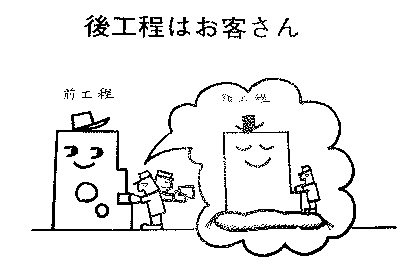 “後工程はお客さん” (The next process is your customer) — from an early Toyota TPS training manual. The front process hands good parts to the next process as if serving a valued customer. This principle is the foundation of Toyota’s approach to defect prevention.
The manual also identifies three implementation methods: visual indicators (lamps, color-coding), jig-based methods (fixtures that reject wrong parts), and machine-stop methods (automatic halt on abnormality). The goal of poka-yoke is zero defects — not reduced defects, not statistically acceptable defects. Each device addresses the most controllable point in the process where the cost of catching the error is lowest.
Why do defects increase after kaizen?
The manual addresses a common complaint: “We did kaizen and defects went up.” The manual calls this reasoning backwards and classifies it into two cases:
Case one: workers skip steps. When cycle content increases after kaizen, a worker may omit a required operation — not from laziness, but because the system discourages line stops. This is a line-stop discipline problem, not a kaizen problem.
Case two: hidden defects surface. Before kaizen, excess inventory and labor-hours provided a cushion. Downstream stations quietly reworked upstream errors without formal feedback. Overproduction compounds this — large batches delay defect discovery. When kaizen removes that cushion, defects that were always present become visible.
The manual’s position: case two is proof that kaizen is working. The defects were always there, consuming labor-hours and raising cost. Kaizen exposed them. The correct response is to trace each defect to its root cause and demand a permanent fix. The manual’s analogy: absorbing defects through rework is like icing down chronic appendicitis. Root-cause elimination is the surgery.
What should an inspector actually do?
Original Japanese: 家庭教師 (katei-kyōshi) — tutor, private teacher
Toyota’s manual redefines the inspector’s role. The conventional inspector judges: pass or fail, stamp the paperwork, hand the tally to the quality department.
An inspector should function as a tutor — a 家庭教師. When a defect is found, the inspector goes to the process, analyzes why it occurred, identifies the root cause, and teaches the worker or engineering team how to prevent recurrence.
The manual gives an example: a surface-level finding might be “wrong part assembled.” The root cause is not “the worker wasn’t paying attention.” It may be that parts were not in assembly sequence, the line-stop button was too far away, or instructions were hard to read. The inspector identifies systemic causes and drives correction.
The inspector’s performance metric is not the number of defects found. It is the rate at which defects reach zero. An inspector who systematically eliminates root causes until there are no defects left to find has succeeded — and has made their own role unnecessary.
How does defects waste connect to jidoka?
Original Japanese: 自働化 — note the 人 (person) radical in 働, distinguishing it from simple 自動化 (automation)
Defects waste connects directly to jidoka, one of the two pillars of TPS alongside just-in-time. The character 働 in Toyota’s 自働化 contains the radical for “person” (人), distinguishing it from ordinary automation (自動化). Machines stop automatically when an abnormality occurs, but humans judge the situation and determine the response.
Jidoka is not a technology. It is a management philosophy. When a machine detects an abnormality, it stops. When a worker cannot complete the required work correctly, the worker stops the line. When a downstream process finds a defect, the upstream process stops and investigates. The pattern is the same at every level: stop, find root cause, fix permanently, resume.
The waste of defects is what jidoka prevents. Without the discipline of stopping at the point of abnormality, defects propagate downstream, rework stations multiply, inspection headcount grows, and cost structure degrades. Jidoka is the structural countermeasure. Build-in quality is the principle. Poka-yoke is the mechanism. Line-stop discipline is the behavior.
Frequently asked questions
What counts as defects waste in TPS? Any output not produced correctly the first time — scrap, rework, and all associated inspection, sorting, and correction activity. The waste includes every labor-hour consumed in dealing with the defect, not just the defective part itself.
Is inspection value-added work? No. Toyota’s training materials state that end-of-line inspection by dedicated inspectors is the most non-value-added work in the plant. The goal is to eliminate the need for inspection by building quality into each process step.
How does Toyota handle a worker who cannot finish within takt time? The worker completes all required work and stops the line for the overage. Making the work fit within takt is the responsibility of supervisors and engineers. Cutting corners to maintain line speed is explicitly prohibited.
Why do some factories see more defects after lean improvements? Because the improvement removed the cushion — excess inventory and rework capacity — that was hiding defects. The defects were always present. This is a signal to pursue root causes, not to reverse the improvement.
What is the ASME connection to defects waste? Defects waste maps to the Inspection symbol (a square) in the ASME flow process chart standard, adopted in 1947 and taught in Japan. Five of Toyota’s seven waste categories trace to these Industrial Engineering symbols.
Art Smalley is President of Art of Lean, Inc. This article draws on Toyota’s internal TPS instruction manuals (トヨタ生産方式 教育部, Chapter 1 Section 3: 工数低減と品質). AI was used in the editing of this article.