What Is the Waste of Inventory in the Toyota Production System?
Inventory waste in the Toyota Production System is stock beyond the minimum required to sustain production — Toyota targets right-sized inventory controlled by kanban, not zero inventory.
Inventory waste in the Toyota Production System is stock held beyond the minimum required to sustain production. The Japanese term is 在庫のムダ (zaiko no muda). Toyota’s position is not zero inventory. It is right-sized inventory — the correct quantity, of the correct items, in the correct locations, controlled by a disciplined system.
This distinction matters because most descriptions of inventory waste imply that all inventory is bad and less is always better. Toyota’s actual practice includes deliberately maintained inventory as a structural element of production. Standard in-process stock is one of the three required elements of standardized work. A kanban system operating correctly has inventory in every supermarket loop. The waste is not inventory itself — it is inventory beyond what the system requires.
- Right-sized inventory is a design decision, not a compromise
- Kanban is a card-count control discipline that authorizes a maximum — it does not eliminate inventory
- Three categories — raw materials, work-in-process, and finished goods — have different causes and different countermeasures
- Inventory reduction is a diagnostic method for exposing problems, not a goal in itself
Inventory maps to the “Storage” symbol (▽, a filled triangle) in the ASME flow process chart standard adopted in 1947. It is one of five waste categories that trace directly to Industrial Engineering process analysis, predating Toyota’s production system. Toyota retained the category and developed specific mechanisms — kanban, heijunka, and lot size reduction — to control it.
Why is Toyota’s target right-sized inventory, not zero inventory?
Every production system requires some inventory to function. Raw materials must be on hand before processing can begin. Work-in-process stock between operations allows each station to work without interruption. Finished goods buffer against the mismatch between production cycles and shipping schedules.
Toyota’s internal TPS instruction manuals define standard in-process stock (標準手持ち, hyōjun temochi) as one of three elements of standardized work, alongside cycle time and work sequence. All three must be present — standardized work is incomplete without any one of them. The manual is explicit: this is inventory the process needs.
標準手持ち (hyōjun temochi): Standard in-process stock — the minimum work-in-process inventory required between operations for a worker to perform the standardized work sequence without interruption. One of three required elements of standardized work at Toyota.
The question Toyota asks is not “how do we get to zero?” but “what is the minimum inventory required given current conditions?” Those conditions include equipment reliability, changeover times, supplier lead times, and demand variability. When conditions improve, the required minimum drops — and inventory is reduced accordingly.
Zero inventory is not a target because it is not achievable in a physical production system. Pursuing it as a goal leads to starvation, line stoppages, and expediting — all of which add cost. Right-sized inventory, maintained through disciplined control, is the actual practice.
What is standard in-process stock and why is it required?
Standard in-process stock is the minimum number of pieces between operations that allows a worker to complete the standardized work sequence without waiting. It is calculated based on the work combination — the relationship between manual work time, machine cycle time, and walking time.
If a worker operates three machines in sequence, each machine needs a part loaded and cycling while the worker moves to the next. The parts sitting in those machines, plus any pieces required at handoff points, constitute the standard in-process stock. Remove them and the worker cannot complete the cycle. The process stops.
This is the concept that most inventory waste discussions miss entirely. They treat all work-in-process as waste to be eliminated. Toyota treats a defined minimum as a structural requirement — and documents it on the standardized work combination table.
The distinction between required in-process stock and excess in-process stock is the threshold that separates work from waste. Below the minimum, the process cannot function. Above it, the excess is waste.
How does kanban control inventory?
Kanban is a card-count control discipline. Each kanban card authorizes the production or movement of a specific quantity of a specific part. The number of cards in circulation, multiplied by the container quantity, equals the authorized maximum inventory for that part in that loop.
Kanban math: Number of cards × container quantity = authorized maximum inventory
A kanban system operating correctly has inventory at every supermarket point. Parts sit on shelves between processes, each with a kanban card attached. When a downstream process withdraws a container, the card returns upstream and authorizes replenishment. The system is full by design. The discipline is in the card count — not in the absence of stock.
This is the opposite of how kanban is commonly described. Most sources present kanban as an inventory reduction tool. It is an inventory control tool. Reduction happens not by removing kanban cards arbitrarily but through a specific sequence of improvements that make fewer cards sufficient.
The Toyota training materials dedicate an entire section to the “spirit of kanban” (かんばんの精神). The first prerequisite it names is not a calculation method or a card design. It is thorough shop floor observation — standing at the process, watching without preconceptions, understanding the actual conditions before changing anything. The manual states that supervisors who believe they understand the shop floor based on brief visits are usually wrong about where the real problems lie.
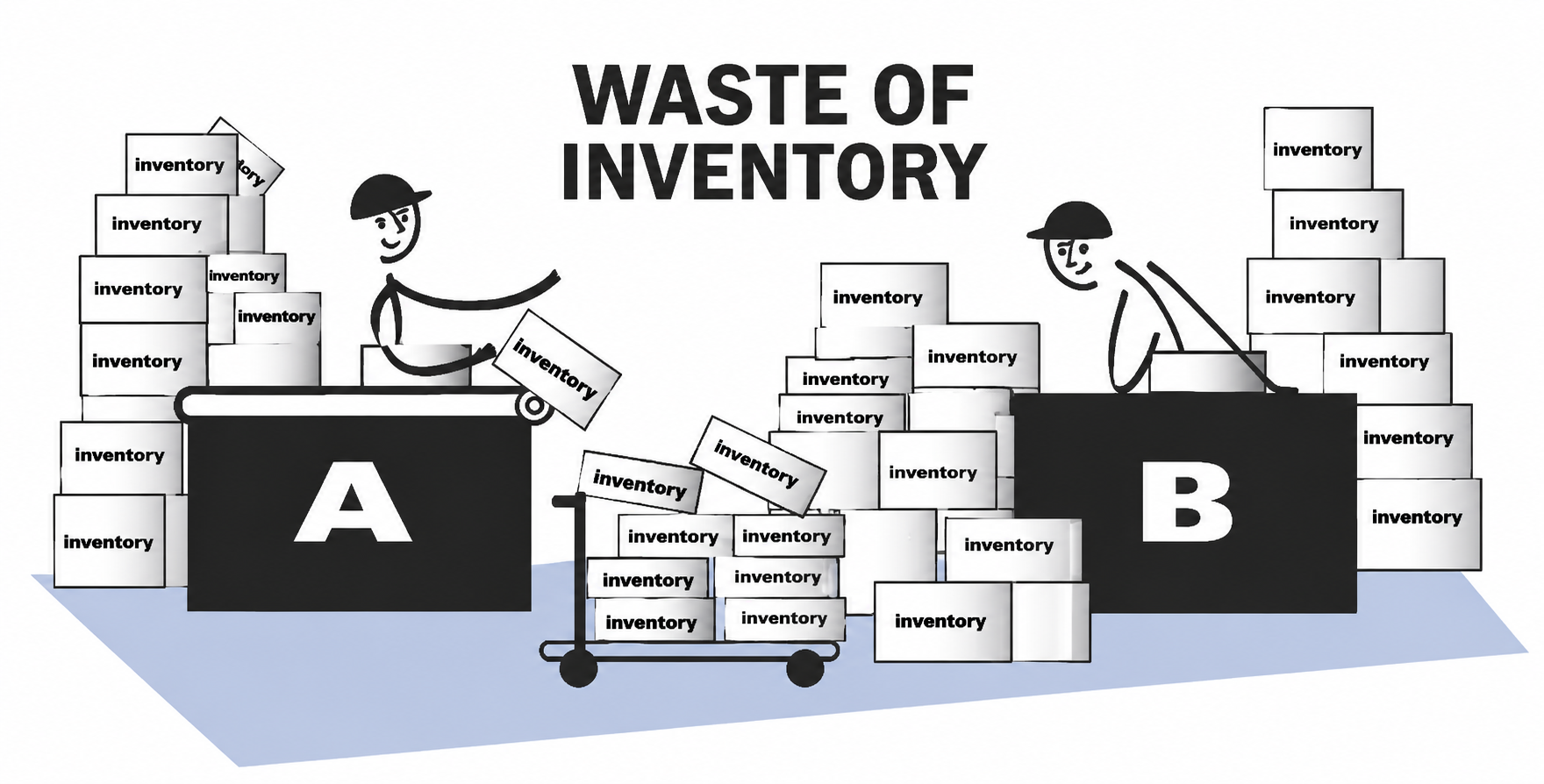 Inventory waste: far more material sits between processes A and B than is needed to sustain flow. The excess ties up capital, hides problems, and consumes floor space.
What are the three categories of inventory waste?
Inventory waste divides into three categories with distinct causes and distinct countermeasures. Treating inventory as a single problem leads to single-tool thinking. Each category requires its own analysis.
Raw materials (原材料, genba zairyō). Excess raw material inventory results from purchasing in quantities larger than production requires — driven by volume discounts, long supplier lead times, or unreliable delivery. Countermeasures focus on supplier development: shorter lead times, smaller delivery lots, more frequent deliveries, and reliable quality that eliminates the need for safety stock against incoming defects.
Work-in-process (仕掛品). Excess WIP accumulates between operations when lot sizes are large, changeover times are long, processes are imbalanced, or equipment is unreliable. Countermeasures are internal: reduce changeover time (enabling smaller lots), improve equipment reliability, balance work content across operations, and establish flow where possible. Standard in-process stock sets the minimum; anything above it is waste.
Finished goods (完成品, kansei-hin). Excess finished goods result from producing ahead of customer demand — overproduction. Long production lead times force early starts, which means forecasting further into the future, which means larger forecast errors, which means more safety stock. Countermeasures center on lead time reduction and level scheduling (heijunka) to match production rhythm to demand rhythm.
What is the correct sequence for reducing inventory?
Inventory cannot be reduced by decree. Removing stock without addressing the conditions that require it creates shortages, expediting, overtime, and higher costs. Toyota follows a specific sequence.
First: heijunka (平準化). Level the production schedule. Convert lumpy, batch-oriented production orders into a smooth, repeating pattern. This stabilizes demand on upstream processes and makes smaller lot sizes feasible.
Second: lot size reduction. With a leveled schedule, reduce production lot sizes. Smaller lots mean less WIP between changeovers. This requires shorter changeover times — which is why SMED (quick changeover) is a prerequisite, not a standalone initiative.
Third: kanban quantity reduction. With stable, leveled production running in smaller lots, the number of kanban cards in circulation can be reduced. Each card removed lowers the authorized maximum inventory in that loop. But the reduction is deliberate and conditional — cards come out only when the system can sustain production at the lower level.
This sequence matters because it is the reverse of what many companies attempt. They start by cutting inventory (pulling cards, reducing safety stock) and then scramble to fix the problems that surface. Toyota builds the conditions first, then reduces inventory as those conditions allow.
How does reducing inventory expose problems?
The analogy commonly used is “lowering the water level to expose the rocks.” A river with high water flows smoothly over hidden obstacles. Lower the water and rocks appear — the boat runs aground. In production, inventory is the water and problems are the rocks: equipment breakdowns, quality defects, long changeovers, imbalanced processes, unreliable suppliers.
The analogy is well known. What is less understood is the purpose. The point is not that rocks are bad and water is bad. The point is that high inventory hides problems that add cost. A process with three hours of WIP buffer between stations can absorb a 30-minute breakdown without anyone noticing. Reduce the buffer to 30 minutes and the breakdown shuts down the downstream process immediately. The problem becomes visible. Now it must be solved.
This is a diagnostic method, not a goal. Toyota does not reduce inventory to achieve low inventory. Toyota reduces inventory to make problems visible, solves the problems, and then sustains production at the lower inventory level. If the problems cannot be solved, the inventory stays. Removing inventory without solving the exposed problems is not lean — it is reckless.
What are the sub-types of inventory waste?
Inventory waste appears in three forms that apply across all three categories:
Too much. More stock than the process requires — the most obvious form. Pallets stacked in aisles, overflowing supermarkets, warehouses rented for overflow. Causes include large lot sizes, poor demand signals, overproduction, and long lead times.
Wrong types. Inventory of parts or materials that are not needed — or not needed soon. A supermarket stocked with last month’s part numbers while this month’s parts are on back order. Causes include poor production sequencing, inaccurate demand information, and engineering changes not reflected in inventory plans.
Wrong locations. Stock stored far from the point of use — in a central warehouse when it should be at the line, or at the wrong station within a cell. Each misplacement generates transportation waste to move the material where it is actually needed. Causes include layout decisions that prioritize storage efficiency over production flow.
Frequently asked questions
Is all inventory waste? No. Standard in-process stock is a required element of standardized work at Toyota. The waste is inventory beyond the minimum the process requires. That minimum depends on current conditions — equipment reliability, changeover times, supplier performance, and demand variability.
What is the difference between kanban and just-in-time? Just-in-time is the principle: produce and deliver the right items, in the right quantity, at the right time. Kanban is one mechanism for achieving it — a card-based system that authorizes production and movement in controlled quantities. JIT is the goal; kanban is a tool within the system.
Can you have too little inventory? Yes. Inventory below the required minimum causes line stoppages, missed shipments, and expediting costs. Toyota’s target is not minimum possible inventory — it is minimum necessary inventory given current conditions. The distinction is operational, not semantic.
Why do some companies fail when they try to reduce inventory? They remove inventory without first improving the conditions that require it. Cutting kanban cards without reducing changeover times, improving equipment reliability, or leveling the schedule exposes problems the system cannot absorb. The result is not lean production — it is production in crisis.
How does inventory waste relate to overproduction? Overproduction is the primary cause of excess finished goods and a major contributor to excess WIP. Every unit produced ahead of need becomes inventory. This is why Toyota considers overproduction the worst of the seven wastes — it directly generates inventory, transportation, and storage costs.
Art Smalley is President of Art of Lean, Inc. This article draws on Toyota’s internal TPS instruction manuals and Toyota’s standardized work documentation. AI was used in the editing of this article.