What Is the Waste of Overproduction in the Toyota Production System?
Overproduction waste in the Toyota Production System means producing more than needed or earlier than needed — and it is considered the worst waste because it triggers every other form of waste while disguising itself as productive work.
Overproduction waste (造りすぎのムダ, tsukurisugi no muda) in the Toyota Production System means producing more than the next process needs or producing it earlier than the next process needs it. Toyota considers overproduction the worst of the seven wastes — not as a matter of opinion, but because overproduction triggers a measurable cascade of every other waste category while disguising itself as productive work.
The mechanism is specific. When an operator finishes ahead of takt time and starts working on the next piece rather than waiting, parts accumulate between stations. Those excess parts require space, containers, transport, counting, and management attention. They hide defects by buffering feedback between processes. They consume materials ahead of schedule. And because the operator appears busy — and is, in fact, working hard — neither supervisors nor the operator can easily see that anything is wrong.
This is why Toyota’s internal training materials treat overproduction differently from other wastes. It is not simply one item on a list. It is the waste that makes all other wastes invisible.
Why did Ohno call overproduction the worst waste?
Most sources assert that overproduction is the worst waste and move on. Almost none explain why. The reason is structural, not philosophical.
Overproduction triggers a cascade. When a process produces more than the next process needs, the excess becomes inventory. That inventory must be stored, which consumes floor space and requires containers. Moving that inventory requires transportation. Storing and moving parts that may sit for days or weeks increases the chance of damage and defects. Sorting through excess inventory adds unnecessary motion. Managing the excess adds processing steps — counting, tracking, scheduling around the surplus.
Each downstream waste creates its own costs and its own secondary effects. The total cost of overproduction is not the labor spent making the extra parts. It is the sum of all the waste the extra parts generate across the entire system.
But the cascade is only half the problem. The other half is concealment.
How does overproduction create the illusion of working?
Toyota’s internal TPS instruction manuals describe a specific failure mode: overproduction looks like work. A worker producing parts ahead of schedule appears productive. The station is active. Parts are moving. No one is standing idle.
From Toyota’s training materials: 造りすぎのムダは自工程だけにとどまらず、はかりしれない他のムダをも引き起こし、あたかも働いているかのように錯覚さえしてしまう
“The waste of overproduction does not stay within one’s own process — it generates immeasurable other wastes, and even creates the illusion that one is working.”
This is the critical distinction. Waiting waste is visible — an idle operator is obvious. Overproduction waste is invisible because it masquerades as effort. The operator is genuinely working. The supervisor sees activity and output. The problem is that the output was not needed.
Toyota’s training materials address this directly: all wastes should be converted to visible waiting, because waiting is the easiest waste to see. If an operator has one minute of slack in a three-minute cycle, that minute is easy to identify when the operator stands and waits. But if the operator fills that minute by starting the next piece early, or by stacking and unstacking parts, or by moving materials that do not need moving — no one sees the waste. It has been converted from visible waiting into invisible overproduction, transportation, or motion.
The instruction is explicit: do not let operators fill slack time with unauthorized work. Make the waiting visible so it can be addressed through proper improvement.
What causes overproduction on the shop floor?
The training materials identify four specific causes:
1. Slack time filled with unnecessary work. When an operator has spare time within the cycle — or when there is a gap between tasks — the natural tendency is to work ahead. The operator starts the next piece or batch before the downstream process needs it. This is the most common mechanism: work getting ahead at the boundary between operators or between processes.
2. Machine capacity used to build stock. When equipment has available capacity, the temptation is to run it. A machine sitting idle looks wasteful to a supervisor. So parts are produced to “keep the machine busy,” creating inventory that no one ordered.
3. SPH targets pursued at the expense of overall efficiency. SPH (strokes per hour, or units per hour) measures individual process output. When a supervisor optimizes for SPH — rewarding higher individual throughput — operators push parts faster than the overall system needs them. The individual station’s numbers look good. The system absorbs extra inventory, transport, and handling cost.
4. Depreciation-driven utilization thinking. When expensive equipment is justified by its utilization rate — “we must run it to amortize the investment” — production is driven by the machine’s cost, not by customer demand. This is particularly common with large, high-capital equipment where managers feel pressure to demonstrate return on investment through high operating hours.
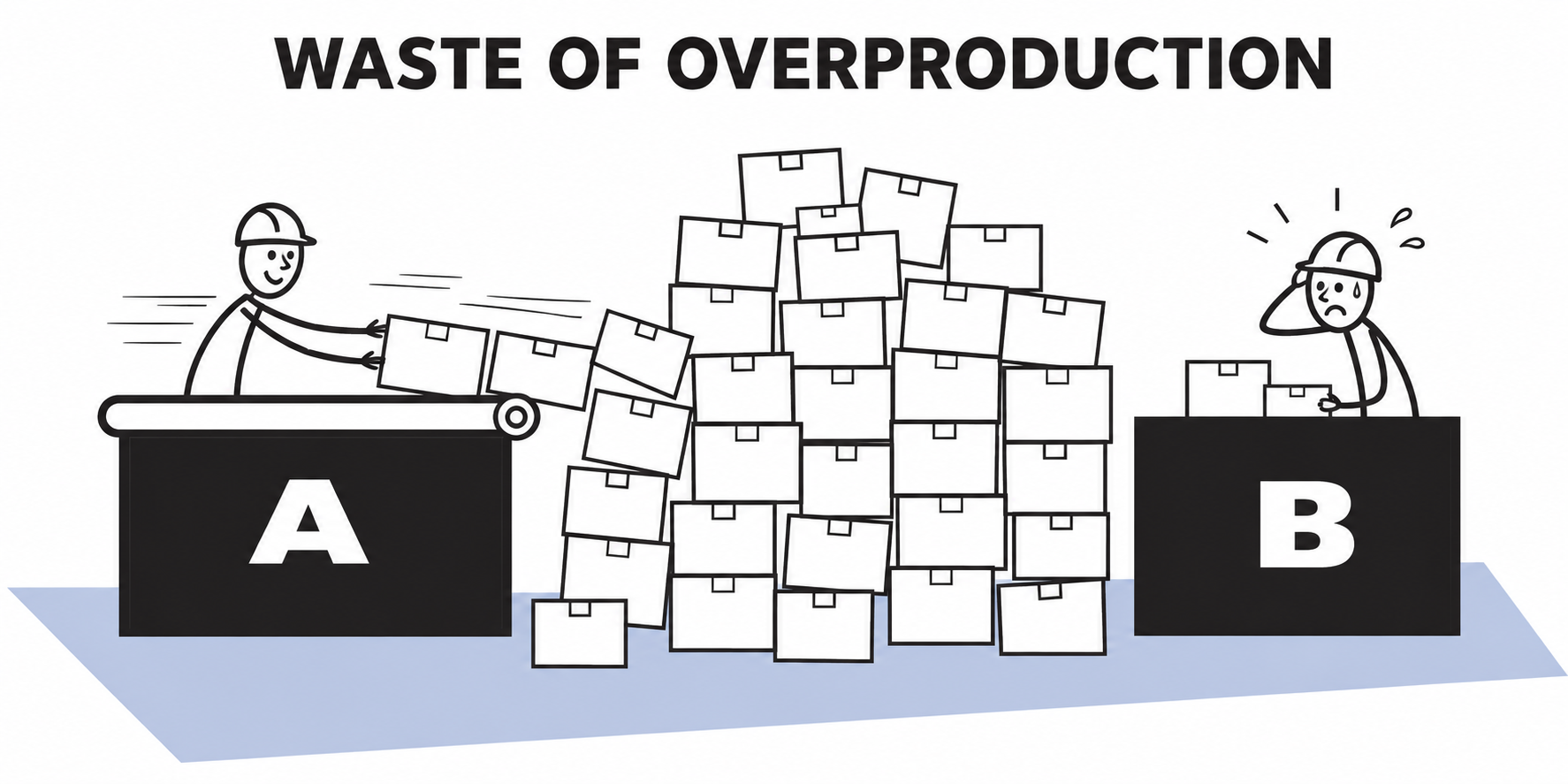 Overproduction waste: one process produces far more than the next process can consume, creating piles of excess inventory between stations.
All four causes share a common pattern: local optimization. Each one makes sense from the perspective of the individual operator, the individual machine, or the individual cost center. Each one damages the system.
What are the sub-types of overproduction?
Overproduction takes two forms:
Too much — producing a greater quantity than the next process requires. Making 120 units when 100 are needed.
Too soon — producing the right quantity but ahead of when the next process needs it. Making Tuesday’s parts on Monday.
Both forms generate the same downstream cascade of inventory, transportation, and concealment. The distinction matters for countermeasures. “Too much” points to quantity controls — standard work-in-process limits, kanban quantities. “Too soon” points to timing controls — production sequencing, leveled scheduling, and the discipline of not starting work before its designated time.
The converse failures — too little, too late — are also waste, but they fall under different categories (waiting, stockouts) and have different countermeasures.
How does kanban prevent overproduction?
Kanban is commonly described as a scheduling system. It is better understood as a structural prevention mechanism against overproduction.
A kanban card authorizes production of a specific part in a specific quantity. No card, no production. The number of cards in circulation sets the maximum inventory the system can hold between processes. An operator who finishes work and has no kanban waiting does not produce. The operator waits — and that waiting becomes visible, triggering improvement activity.
This is the mechanism by which Toyota converts overproduction into visible waiting. Kanban removes the operator’s authority to decide what to produce next based on individual judgment. Production authority comes from the downstream process pulling the card, not from the upstream process pushing parts forward.
Without kanban or an equivalent structural control, the four causes identified in the training manual will reassert themselves. Operators will fill slack time. Supervisors will keep machines running. Individual productivity targets will drive local overproduction. The discipline has to be built into the system, not left to individual behavior.
What is the difference between individual efficiency and system efficiency?
The overproduction problem is, at its root, a conflict between individual efficiency and system efficiency. This distinction runs through all of Toyota’s thinking about work and waste.
Individual efficiency measures how productive a single operator or machine appears in isolation. An operator producing 12 parts per hour instead of 10 has improved individual efficiency by 20%.
System efficiency measures whether the total production system is producing the customer-required quantity at lower cost. If only 10 parts per hour are needed and one operator produces 12, the extra 2 parts are overproduction. The individual improvement is real. The system impact is negative.
Toyota’s training materials use the analogy of an eight-person rowing crew. Every rower must match the coxswain’s cadence. If one rower pulls at 60 strokes per minute while everyone else rows at 40, the oars collide, the boat sways, and speed drops. Individual effort went up. System performance went down. Going faster than the pace is as harmful as going slower.
This is why Toyota measures true efficiency (真の能率) — producing the required quantity with fewer resources — rather than apparent efficiency (見かけの能率) — producing more output with the same resources. Apparent efficiency is overproduction dressed up as improvement.
How does overproduction connect to Toyota’s JIT pillar?
Overproduction is one of the two waste categories that Toyota added beyond the five derived from ASME Industrial Engineering flow process chart symbols. The five ASME-derived wastes — processing, transportation, defects, waiting, and inventory — were standard IE categories taught in Japan from the postwar period. Overproduction and motion were Toyota’s additions.
Overproduction connects directly to the Just-in-Time pillar of TPS. Ohno’s challenge in the 1950s was specific: Toyota’s processes were producing too much of the wrong parts at the wrong time. The JIT concept — make only what is needed, when it is needed, in the amount needed — is fundamentally an anti-overproduction discipline. Kanban was the mechanism Ohno developed to enforce it at the process level.
This is why overproduction appears first in every Toyota listing of the wastes. It is not alphabetical. It is not arbitrary. It is the waste most directly connected to Toyota’s core operating principle.
Frequently asked questions
What is the simplest definition of overproduction waste? Overproduction waste is producing more than needed or sooner than needed. In the Toyota Production System, it is considered the worst waste because it triggers all other waste categories — excess inventory, unnecessary transportation, hidden defects, added motion, and extra processing — while appearing to be productive work.
Why is overproduction considered worse than defects? Defects are visible. A rejected part on the line gets attention immediately. Overproduction is invisible — it looks like work. A station producing parts ahead of schedule appears efficient. The waste only becomes apparent when the downstream effects accumulate: parts stacked in aisles, forklifts running extra routes, defects discovered days after production. By the time overproduction’s effects are visible, they have multiplied across the system.
Can you have zero overproduction? In practice, no. Every real production system has variation. The goal is to minimize overproduction through structural controls — kanban, standardized work, level scheduling — and to make any remaining overproduction visible so it can be addressed through continuous improvement.
How do you identify overproduction on the shop floor? Look for parts accumulating between processes. Look for operators who never wait — if an operator is continuously busy through every cycle without any idle time, the standardized work may not match takt time, or the operator may be working ahead. Look for inventory in locations that are not designated storage points. Look for parts being produced before their kanban cards have returned.
Is overproduction the same as overstock? Not exactly. Overproduction is the act of producing more or sooner than needed. Excess inventory (overstock) is one of the downstream consequences. An organization can also have excess inventory from purchasing too much raw material, which is an inventory waste problem, not an overproduction problem. Overproduction specifically refers to the production process creating more output than the next process or customer requires.
Art Smalley is President of Art of Lean, Inc. This article draws on Toyota’s internal TPS instruction manuals (トヨタ生産方式 教育部). AI was used in the editing of this article.