Ask Art
"Does Toyota practice Toyota Kata?"
Does Toyota Practice Toyota Kata?
Short answer: Many people get value from practicing Toyota Kata as a coaching and improvement method. That said, Toyota does not practice “Toyota Kata” as described in the book. The term is not used inside Toyota. Some of the practices described do relate to real Toyota practices, but they are not called Kata — they go by different, more specific Japanese terms. Confusingly for English speakers, there are many forms of the word kata in Japanese — all with specific meanings — but none of them exactly match what the book describes. If you want to know what Toyota actually does for coaching, instruction, and improvement, look at Toyota Leadership Training Methods, the Floor Management Development System (FMDS), and 3 Pillar Activity.
Does Toyota Have Kata?
Yes and no. This is where it gets confusing.
The word “kata” maps to many different kanji in Japanese, each with a distinct meaning:
- 形 (kata) — form, appearance, visible shape
- 型 (kata) — mold, model, type, pattern
- 方 (kata) — way, direction, how to do something (verb conjugation)
- 肩 (kata) — shoulder
- 潟 (kata) — lagoon
All of these are common Japanese words. Several are widely used inside Toyota with specific meanings.
For example, TWI job instruction in Japanese was called sagyo no oshiekata (作業の教え方) — how to teach work. Problem solving was called mondai kaiketsu no yarikata (問題解決のやり方) — how to do problem solving. But this meaning of kata (方) is very explicit: it means to follow exact steps, key points, and reasons why we do it this way.
In manufacturing, kanagata (金型) — metal die or mold — uses the 型 kanji directly. A die is the definition of a rigid, exact form: the metal goes in and comes out one way. Anyone in Toyota’s stamping, casting, or plastics shops would use this word daily.
In everyday Japanese, kata also appears in conversations about “shape” or “form” versus content. The word is embedded in the language far more broadly than any single English translation suggests.
Kata in Martial Arts — and Why It Matters
In martial arts, kata (型 or 形) means self-practice of choreographed forms to build upon the kihon (基本) — the basic movements — in a precise series of events. Korean Taekwondo and Japanese Karate take this to another level where steps, motions, and even when and how you breathe and vocalize (kiai in Japanese, kiap in Korean) are specified. My own kids competed in Taekwondo poomsae — the judges grade every movement against a defined standard. Kata in this context is extremely strict and rigid. For an example of what kata looks like in practice, watch the 2012 World Team Kata Finals — Japan vs. Italy. Every movement is graded, judged, and exacting. It is the opposite of open-ended questions.
In fact, one of the self-criticisms within Japanese culture is the expression kata ni hamaru (型にはまる) — to get stuck in the form. The concern is that if you become too fixated on kata, you stop improving. This is the classic form-versus-content problem: just practicing a form alone does not make you better. Practicing the form is a method for developing skill, but it does not guarantee mastery.
Even within martial arts, kata is not universally respected as a vehicle for improvement. Solo kata practice is sometimes mocked as “fighting air.” Jiu-Jitsu and Judo, for example, emphasize paired practice with grappling — real resistance — built in through kumite (sparring). Karate also does paired practice but emphasizes solo kata to such an extent that it is sometimes criticized in the modern mixed martial arts community for exactly this reason.
However, none of these meanings — the rigid martial arts form, the explicit step-by-step method, or the general “way of doing” — match what is described in the book Toyota Kata.
Comparing Toyota Kata to Actual Toyota Methods
The 2009 book Toyota Kata: Managing People for Improvement, Adaptiveness and Superior Results defines kata as “structured routines that you practice deliberately, especially at the beginning, so their pattern becomes a habit and leaves you with new skills.” It describes two interlocking practices — an “improvement kata” and a “coaching kata” — centered on what the book calls “scientific thinking”: a continuous cycle of predicting, observing, and adjusting. There are some notable gaps when you compare the book’s claims to what Toyota actually practices.
Teaching and Development
The book frames kata as deliberate practice — structured routines repeated until they become habit. But in every recognized form of deliberate practice — martial arts, music, TWI, and Toyota’s own methods — an instructor explains, demonstrates, and corrects against a defined standard. In Toyota, this is done in Skills Dojo environments where learners practice against defined time, quality, and safety standards before ever touching a production line.
The book’s coaching kata replaces this with five open-ended questions, leaving the learner to discover through experimentation. That is a form of coaching, but it removes the demonstration and grading that define kata in every other context. Some advocates describe this as the Socratic method, but the Socratic method requires an expert who already understands the answer and crafts situation-specific questions to guide the student toward it. Five fixed questions applied identically regardless of context is a checklist, not Socratic dialogue.
In Toyota’s actual system, as described in Toyota Leadership Training Methods, leaders develop people along a continuum: for less experienced people, the method is more prescriptive — think Job Instruction. You do not fumble around experimenting or waste time discovering what is already known as best practice. You learn the Toyota Way. As you evolve, you are taught and held accountable to a standard. Gaps occur, and you learn to problem-solve following a specific method — Toyota Business Practice. Then eventually you mature, and instead of solving gap-from-standard problems you learn to incrementally change things, experiment, and improve. That is kaizen.
Toyota Kata compresses this continuum into a single approach. It starts everyone with five open-ended coaching questions and leaves them to experiment — regardless of experience level. That may work for more capable people, but it is not how Toyota develops beginners, which is where most people start.
Coaching Questions
The book’s coaching kata consists of five generic questions:
- What is the target condition?
- What is the actual condition now?
- What obstacles do you think are preventing you from reaching the target condition? Which one are you addressing now?
- What is your next step? What do you expect?
- When can we go and see what we have learned from taking that step?
The concept behind these questions is not wrong — they are reasonable coaching questions, and many people find them useful. But compare them to an actual Toyota coaching form used for Toyota Business Practice problem solving. This form covers just the first two of eight steps — “Clarify the Problem” and “Breakdown the Problem”:
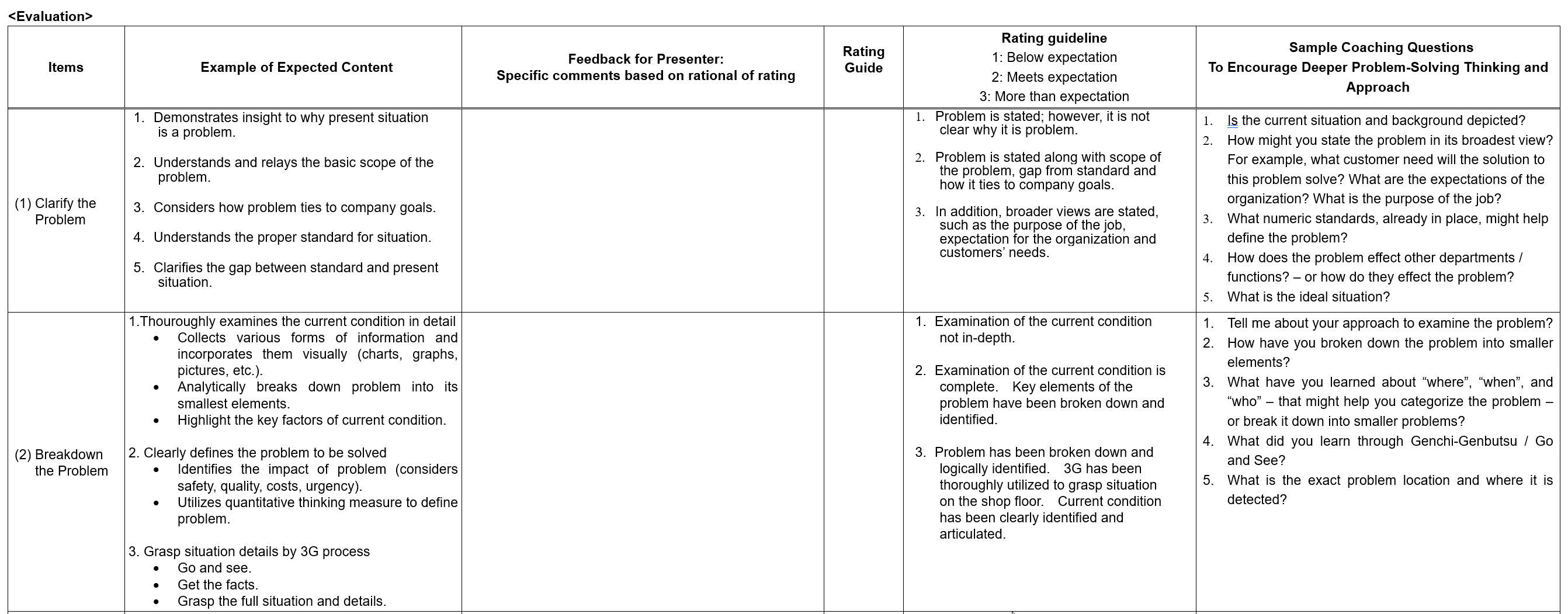
Each step has specific expected content, a three-point rating scale (below expectation, meets expectation, more than expectation), a column for written feedback, and five or more targeted coaching questions. Just these two steps alone contain more specific coaching guidance than the entire Toyota Kata framework. And there are six more steps beyond this, each with their own criteria and questions. Toyota does use coaching questions — for TBP, kaizen, and FMDS — but they are far more numerous, targeted, and specific than five generic questions on a laminated card.
Scientific Thinking
The book claims its foundation is “scientific thinking.” But there is no scientific method present — no structured data collection, no testable hypothesis, no controlled experiment. What the book describes is basic learn-implement-reflect, which is fine — Toyota does this through PDCA and 8-Step Problem Solving. But calling it “scientific thinking” overstates what is actually happening.
Toyota does practice rigorous scientific problem solving — but it looks nothing like what Toyota Kata describes. Kakuro Amasaka, who conducted training inside Toyota for many years in design, development, and quality functions, documents the actual progression in his book Science SQC:
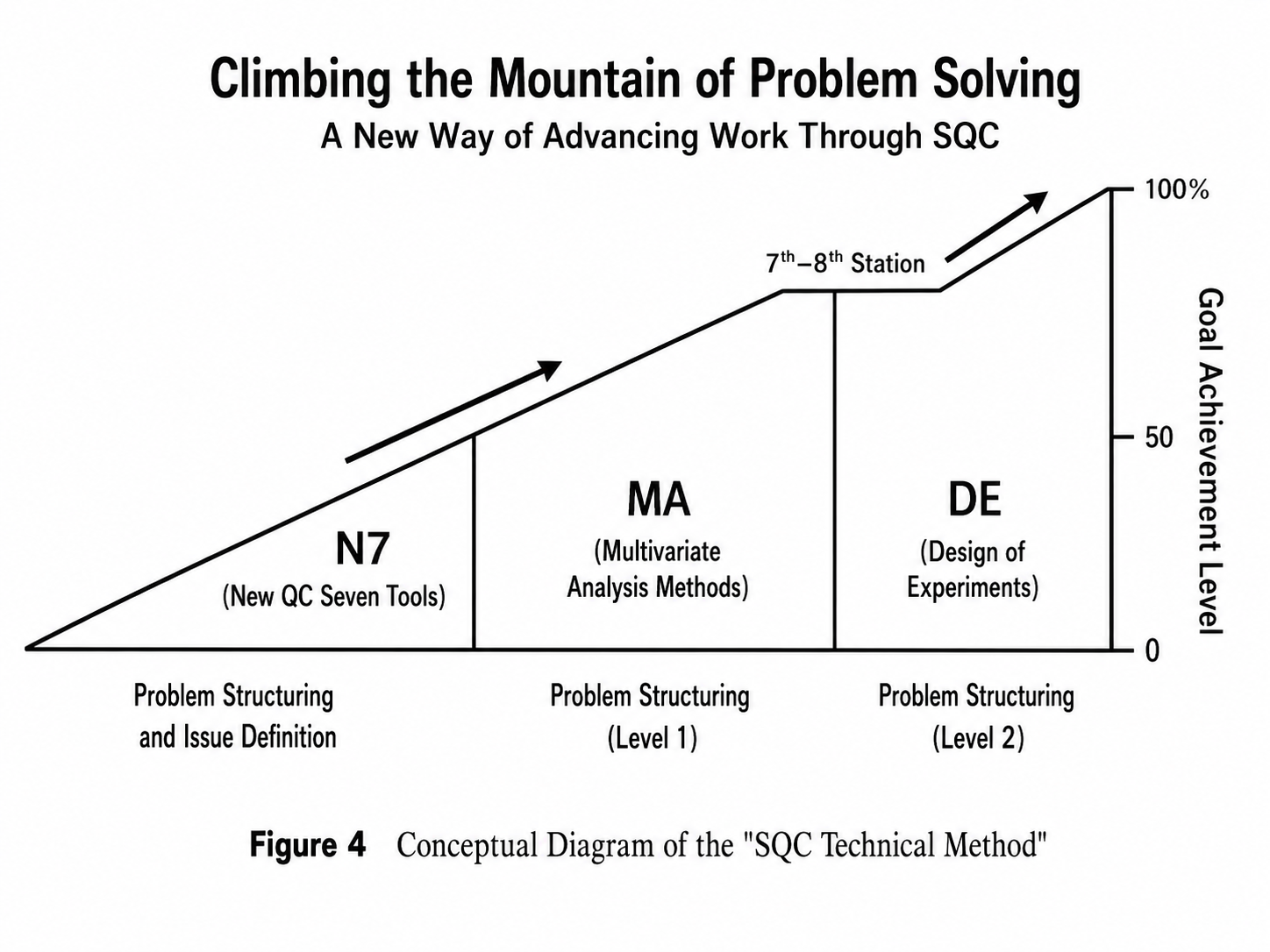
The progression moves from problem structuring and issue definition (N7), through quantitative multivariate analysis (MA), to actual design of experiments with testable hypotheses (DE). This is what scientific problem solving looks like inside Toyota for advanced practitioners — rigorous, quantitative, and methodical. It is not a generic coaching conversation.
Beyond these comparisons, the term itself has drifted. At lean conferences I have heard Toyota Kata described as learning, science, coaching, improving, a meta-wrapper for PDCA, and other terms — often by the same presenter. What is confusing to Japanese-speaking personnel in Toyota — and other Japanese-speaking professionals I speak with — is that “Toyota Kata” seems to mean whatever the speaker wants it to mean. It is unmoored from any meaning in actual Japanese because the term has been adopted without reference to its original language, context, or practice. When the VP of the Toyota Supplier Support Center was asked about “Toyota Kata” at a recent conference, he replied: “We don’t use that term, and I am frankly confused by what it means.”
Summary
Toyota has a multitude of methods for teaching, coaching, and improvement — but they are segmented by the type of work and the skill level of the individual. Beginners, intermediate practitioners, and advanced problem solvers are handled differently. Implying that one set of routines can address the diversity of actual cases in a complex organization is an oversimplification. At best, the book captures a subset of coaching interactions that occur at Toyota with more experienced people. At worst, it encourages expertise-free coaching — a model where the instructor does not need domain knowledge, only a set of questions. That may be convenient for scaling a consulting practice, but it contradicts many developmental methods Toyota uses, where the coach is an experienced person with deep knowledge of the work. It is a great model for the instructor but not necessarily for the learner. That said, if you are at an early stage of learning structured improvement, the questions and routines described in Toyota Kata can have real benefit.
If you want to learn more about actual Toyota improvement and coaching routines, I would suggest these articles and the books they came from:
- Toyota Leadership Training Methods — how Toyota develops supervisors and team leaders
- Floor Management Development System (FMDS) — how Toyota manages daily work at the team level
- 3 Pillar Activity — Toyota’s framework for daily maintenance, improvement, and people development