TWI at Toyota
What happened when Training Within Industry reached the company building the Toyota Production System.
This section tells the story of what happened when Training Within Industry reached Toyota. It is the part of the TWI history that matters most to a lean audience, because it is where TWI met the production system Taiichi Ohno was building — and where the company kept what worked, set aside what did not, and eventually grew its own courses out of the experience.
By the end of this section, you should understand:
- when and why Toyota adopted TWI, and in what order the three J programs arrived,
- how Taiichi Ohno regarded the material, and which program he valued most,
- how each of the three programs evolved inside Toyota over the following decades,
- the single idea that ties supervisor development to the production system: making things is making people.
A note before we begin: the facts in this section come from a primary source — Art Smalley's decades-long relationship with Isao "Ike" Kato. The two have known and worked with one another for some thirty years, going back to Art's own years at Toyota. Kato spent 35 years at Toyota, developed much of the company's training material under Taiichi Ohno and other executives, and is known internally as the "father of standardized work and kaizen courses"; he is also a master instructor of TWI. The direct quotations in this section are drawn from a 2006 conversation devoted specifically to TWI's influence on TPS, but the account behind them reflects many years of working discussion between the two.
1How TWI came to Toyota
TWI reached Japan after the Second World War, around 1947–48, and was first implemented at other companies before Toyota took it up. Toyota's adoption came out of a specific moment of crisis.
In 1950, during Toyota's near-bankruptcy period, management and the union reached a series of agreements. One of those agreements called for management to create some form of supervisor development and training. Toyota's HR department went looking for existing programs, was introduced to TWI, and — because it was already established and was receiving favorable reviews — evaluated it and adopted it.
That origin is worth holding onto. Toyota did not seek out TWI as a theory of production. It adopted TWI to answer a concrete, negotiated commitment to develop its first-line supervisors. What TWI was designed to do, and what Toyota needed it to do, were the same thing.
"In 1950, during the near bankruptcy period, management and the union made a series of agreements. One agreement was for Toyota's management to respond to the union's request to create some form of supervisor development and training." — Isao Kato
2The order of arrival
The three J programs came to Toyota in close succession in the early 1950s:
- Job Instruction (JI) — December 1951
- Job Methods (JM) — June 1952
- Job Relations (JR) — March 1953
In each case, about 300 people were trained in the method at the outset, with more trained every year after that.
Even at this early stage the three programs did not fare equally. JR was well received and would remain largely intact as a training course for a long time, with only the case-study examples later altered. JM was less of a success and was abandoned after several years. JI was the big success and had by far the most impact of the three. Those three different fates are the story of the rest of this section.
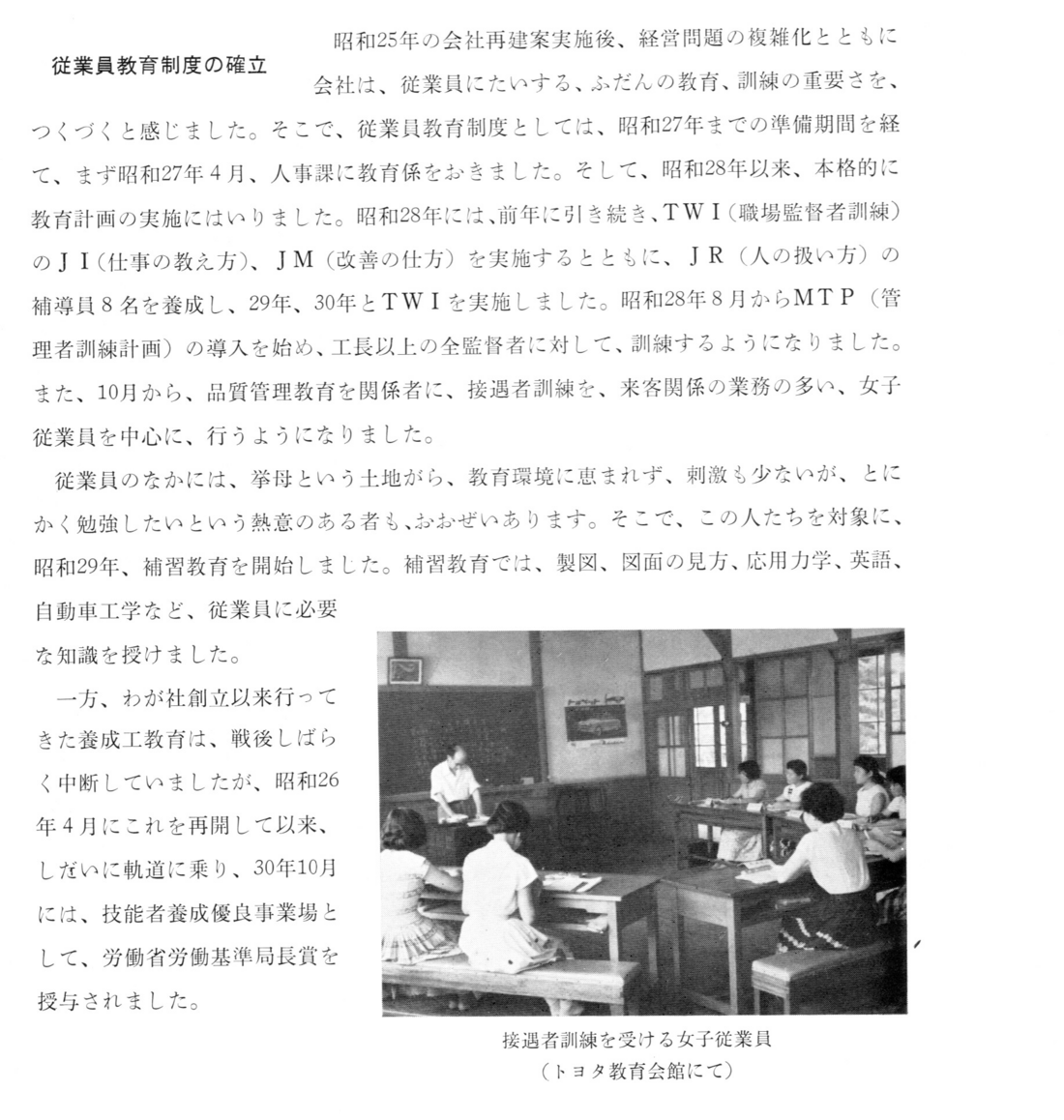
A page from Toyota Motor Corporation's official company history, Establishing the Employee Education System. Its text records that Toyota carried out TWI — Job Instruction (how to teach work), Job Methods (how to improve), and Job Relations (how to handle people) — from 1952 through 1955, and that the Management Training Program (MTP) was introduced from August 1953 for supervisors at foreman level and above. The photograph itself shows reception training for female employees at the Toyota Education Hall — not a TWI class; it is the surrounding text that documents the programs.
What to notice: this is Toyota's own account, in its official history — independent confirmation of when and how TWI and MTP were adopted. The same page notes that quality-control education began separately in October 1953 — a distinct stream from TWI.
3Ohno and the TWI material
Taiichi Ohno was not a distant observer of TWI. He was very aware of the programs and, by available accounts, attended and audited the courses himself. Ohno left no personal record of TWI, so his exact role in the training is not documented — but that he engaged closely with the material is clear from how he used it.
His regard for the three programs varied. He especially valued Job Instruction. He was frustrated with Job Methods, which did not fit well with his own developing notion of improvement. And he was, by Mr. Kato's account, somewhat ambivalent toward Job Relations.
To understand those reactions, it helps to remember where Ohno already was by the early 1950s. As far back as 1945 he had been managing a machine and assembly shop at Toyota and running experiments to improve flow — work that became known as the "Ohno line." By the early 1950s his thinking on just-in-time, kaizen, flow, multi-process handling, visual control, and standardizing work was already well established in the shops under his control and was being coached to his disciples. TWI arrived into a mind that had already formed strong, specific ideas about production. It was measured against those ideas — and that is why one program thrived, one was set aside, and one was kept but held at arm's length.
4Job Instruction: the lasting one
Of the three programs, Job Instruction had by far the biggest and most durable impact. Mr. Kato is direct about why: JI brought a great method for three things — breaking down the job, creating a four-step method for training others, and developing a multi-functional skills planning matrix.
That combination landed at exactly the right moment. Ohno was already experimenting with multi-process handling, which requires standards for the job, a notion of takt time, and a way to teach others as takt time changes. JI gave supervisors precisely that capability: a way to break down their jobs, write a job breakdown sheet, and train others. Ohno embraced it. He would scold people who had not broken the job down properly and written it on paper — whether for the sake of JI or for standardized work.
This is the heart of how JI fits the production system. JI is the practical layer beneath Standardized Work. Once a job is broken down and people can be reliably trained to it, it is a much smaller step to add the three elements of standardized work — takt time, work sequence, and standard work-in-process — and to balance the line and analyze it for improvement. And when takt time changes and work is rearranged, JI is the vehicle that retrains people to the new method so the gains hold.
Asked directly whether JI or Standardized Work is more important, Mr. Kato reframed the question:
"It is not really a question of importance; it is a question of sequence. I don't think you can do a good job of implementing standardized work or several other elements of TPS without the JI skill set in place… I can't see how standardized work can function without JI in place underneath to support it in the long run." — Isao Kato
That observation — sequence, not importance — explains a pattern Mr. Kato had seen elsewhere: companies that implement standardized work and kaizen but watch the short-term gains fall away over time, often because no proper plan was ever put in place to train people to the new method. JI is the skill set that prevents that.
Over the decades, JI survived inside Toyota in a virtually unchanged form. It was eventually replaced by an internal course, TJI (Toyota Job Instruction) — a superior course built around hands-on skills Dojos for practicing and certifying the breakdown-and-train cycle. The replacement is not a repudiation of JI; it is JI matured into Toyota's own house version.
5Job Methods: set aside, then absorbed
Job Methods did not last. Ohno was initially a proponent of it, even while thinking it narrow. JM's main contribution to improvement is the 5W1H method of inquiry, paired with the principle of ECRS — Eliminate, Combine, Rearrange, Simplify. Ohno regarded the 5W1H approach as all right at first, but eventually decided it was too superficial.
His objection was specific, not vague. JM looked mainly at assembly jobs, machines, and material handling, but it did not drive deep enough into the elimination of waste to suit him — and, critically, it had no connection to takt time, flow, or pull-style production. Ohno was by then driving a much broader way of thinking about the forms of waste and the need to attack their root causes. Eventually he decided JM was not delivering results and instructed the training department to stop the JM component of the program.
What replaced it tells you what Ohno thought was missing. In place of JM, Professor Shigeo Shingo was invited to Toyota to teach his views on industrial engineering and productivity. His lectures were summarized by Mr. Kato and a few others in the training department into what was called the "P-course" (P for production, or productivity), which became the main training vehicle for supervisors and engineers on methods-based improvement for the next several years.
JM's better elements were not thrown away — they were folded into something larger. Toyota eventually created its own Kaizen training course (built up through the 1970s) based on four ingredients: Ohno's thinking on improvement and standardized work, Shingo's P-course industrial engineering, the analysis elements of JM that survived intact (such as 5W1H), and the training department's own contributions. The full TPS content — the seven wastes, standardized work, just-in-time, and jidoka — lives in that course, not in JM. JM, in other words, was a starting point that Toyota outgrew and then partly reclaimed inside a far broader course of its own making.
6Job Relations: kept, then broadened
Job Relations sits between the other two. It was well received, was taught for decades, and remained largely intact as a course — though at lower frequency and impact than JI, and Ohno himself was ambivalent toward it. Over time Toyota altered the case-study examples, but the program endured.
JR deserves real credit on its own terms. Its core concern — the people and communication side of leading a team — fit Toyota and Japanese workplace culture well. The idea that a supervisor's job includes handling problems with people, and treating people as individuals, was a comfortable and natural fit.
JR was eventually replaced by an internal course, TCS (Toyota Communication Skills), aimed at supervisors and leaders. TCS is broader than JR, and the difference is instructive. JR is largely reactive: it gives a supervisor a method for working through a people problem once one has arisen. TCS is proactive: it teaches how to communicate, motivate, encourage, and lead before problems appear. That shift — from handling trouble to actively building relationships and leadership — corrects a genuine limitation of JR. As with JI and JM, the replacement grew out of the original rather than rejecting it: Toyota kept JR's sound human concept and widened it.
Adopted December 1951.
Matured into Toyota's own course, taught through hands-on skills Dojos.
Adopted June 1952; set aside as too superficial.
Industrial engineering and productivity.
5W1H absorbed; Ohno's improvement thinking, IE, and full TPS content.
Adopted March 1953; kept largely intact for decades.
Broadened from reactive problem-handling to proactive leadership.
Each of the three J programs followed a different path inside Toyota. Job Instruction (Dec 1951) was kept and eventually matured into Toyota Job Instruction, taught through hands-on skills Dojos. Job Methods (Jun 1952) was set aside, replaced first by Shingo's P-course, and its surviving analysis elements (5W1H) were later absorbed into Toyota's own 1970s Kaizen course. Job Relations (Mar 1953) was kept for decades, then broadened into Toyota Communication Skills.
What to notice: All three threads start in TWI and end in a Toyota-made course (TJI / the Kaizen course / TCS). The pattern is not adoption-and-discard; it is adoption, evaluation against a maturing production system, and then replacement by a superior internal course. JI's thread is the straightest and longest. JM's is the most transformed. JR's is the most preserved.
7The connective idea
Asked at the end of the interview why TWI is critical, Mr. Kato did not point to a tool. He pointed to capability at the supervisor level. TPS will not flourish, he argued, if only the staff and engineers are driving it from the side; the first line of supervision is what makes the small daily improvements, leads the work teams, and makes the whole system stick together.
He summed it up with a saying Toyota used:
"In Toyota we had a saying, mono zukuri wa hito zukuri, which means making things is about making people. If people want to succeed with lean or TPS they have to emphasize people development and making leaders capable of delivering improvements. TWI is a great starting point even today and a hidden strength of Toyota's production system." — Isao Kato
That phrase — making things is making people — is the thread running through this whole section. Each of the three programs was, at bottom, a way to build capability into a person. That is what Toyota kept investing in, even as it replaced the original courses with its own.
Section summary
Toyota adopted TWI after the 1950 near-bankruptcy, when a management–union agreement called for supervisor development. The three J programs arrived in close order — JI in December 1951, JM in June 1952, JR in March 1953 — with about 300 people trained in each at the outset. Taiichi Ohno knew the material well and attended and audited the courses himself; he especially valued JI.
From there the three programs took different paths. JI had the biggest and most lasting impact and is the practical layer beneath Standardized Work — sequence, not importance; it later matured into Toyota Job Instruction taught through skills Dojos. JM was set aside as too superficial and disconnected from takt, flow, and pull, replaced by Shingo's P-course and ultimately absorbed into Toyota's own 1970s Kaizen course. JR was kept for decades — its people-and-communication concept fit Toyota's culture well — and was later broadened into the proactive Toyota Communication Skills. Tying it all together is the conviction that making things is making people.
What this section has shown is genuine and underappreciated: TWI did real, lasting work in developing Toyota's first-line supervisors, and JI in particular sits underneath Standardized Work. It has also set up a harder question. If JI, JM, and JR were starting points that Toyota evaluated, kept selectively, and grew past with superior courses of its own, then what exactly did TWI seed — and what did it not? The final section takes up the "roots of lean" question directly and gives the honest verdict.