Toyota Leader Development
Toyota does not promote people into leadership and then train them. Development starts before the role — and only those who demonstrate aptitude advance.
1What Toyota Leadership Training Methods Says
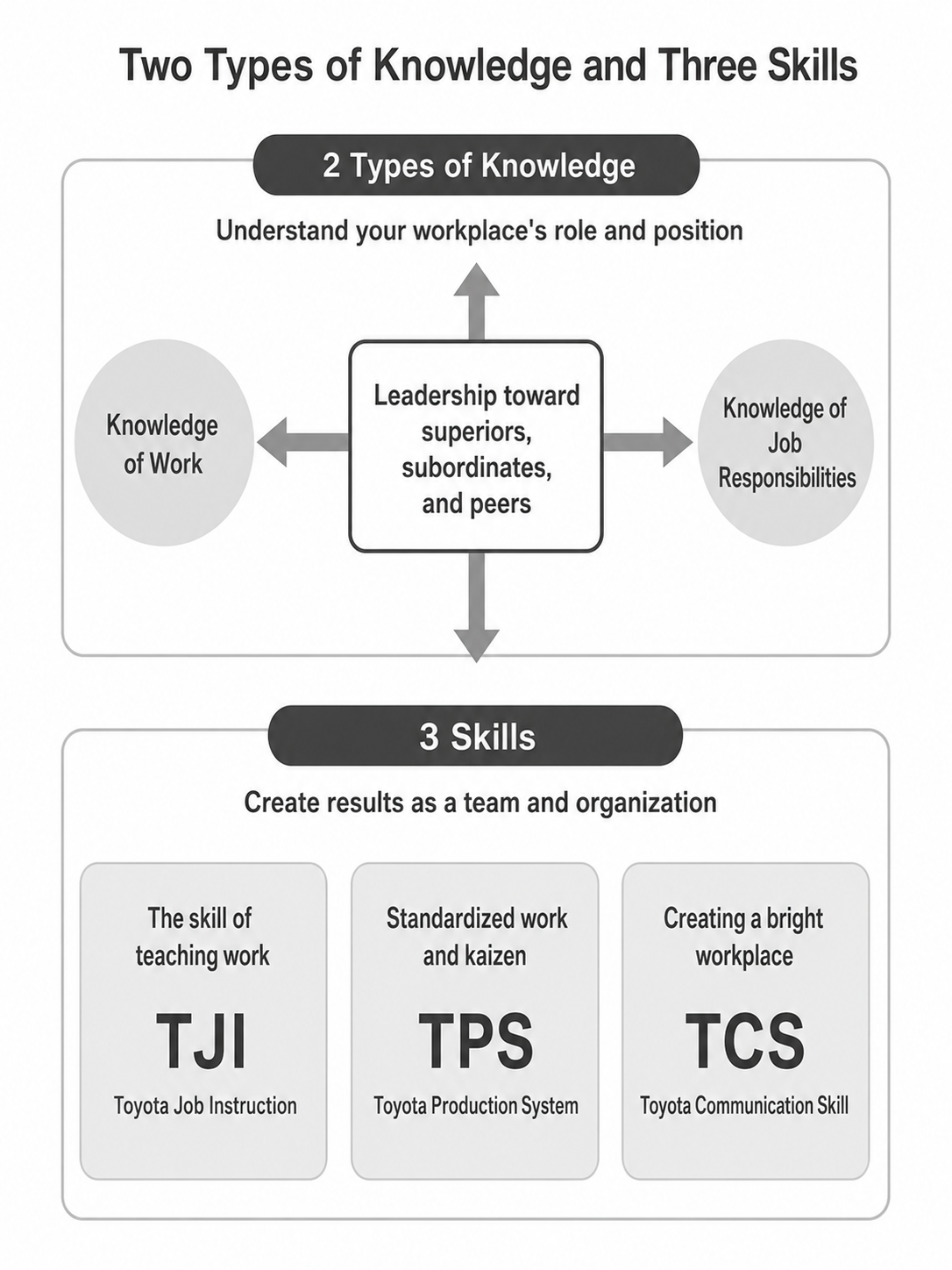
Chapter 2 explains Toyota's leader development system and introduces the "two types of knowledge and three skills" framework that structures the rest of the book.
Lecture 5: Development Starts Before Becoming a Leader
Toyota's leader development combines OJT (daily management board, workplace senior system, informal activities) with off-JT (level-by-level training). The distinctive feature is timing: candidates enter "special training" — a year-long program mixing classroom and practice — before promotion is decided. Only those who demonstrate both skill and aptitude advance. This contrasts with the common pattern of promoting top performers and hoping they figure out leadership afterward.
The book names several OJT mechanisms that prepare future leaders: the daily management board (which makes management visible to everyone), informal activities (horizontal networking across departments), and the workplace senior system (first leadership practice).
Lecture 6: TJI — The Skill of Teaching Work
The first of the three required skills. TJI (Toyota Job Instruction) is the method for reliably transferring work knowledge to others. The book positions it as foundational: if work cannot be taught correctly, standard work cannot be maintained, and quality suffers.
Lecture 7: TPS — Standardized Work and Kaizen
The second skill. The book frames TPS not merely as efficiency but as rooted in Sakichi Toyoda's desire to "make someone's work easier." Standard work is defined as "the best way of doing work at the present point in time" — and kaizen is the activity of making it better. The book emphasizes that leaders must not forget the human motivation behind TPS: making each member's work easier.
Lecture 8: TCS — Creating a Bright Workplace
The third skill, and the one that receives the most pages in the book. TCS (Toyota Communication Skill) creates the environment and atmosphere in which TJI and TPS can function. Without trust and open communication, members cannot learn standard work effectively, cannot raise problems, and cannot contribute to kaizen. TCS is positioned as the foundation that enables the other two skills.
The "Two Types of Knowledge" Framework
Alongside the three skills, leaders need two types of knowledge: knowledge of the work (rules, procedures, technical content) and knowledge of job responsibilities (understanding one's role in the overall process, what upstream and downstream expect, and how one's department contributes to the whole).
2Historical Context
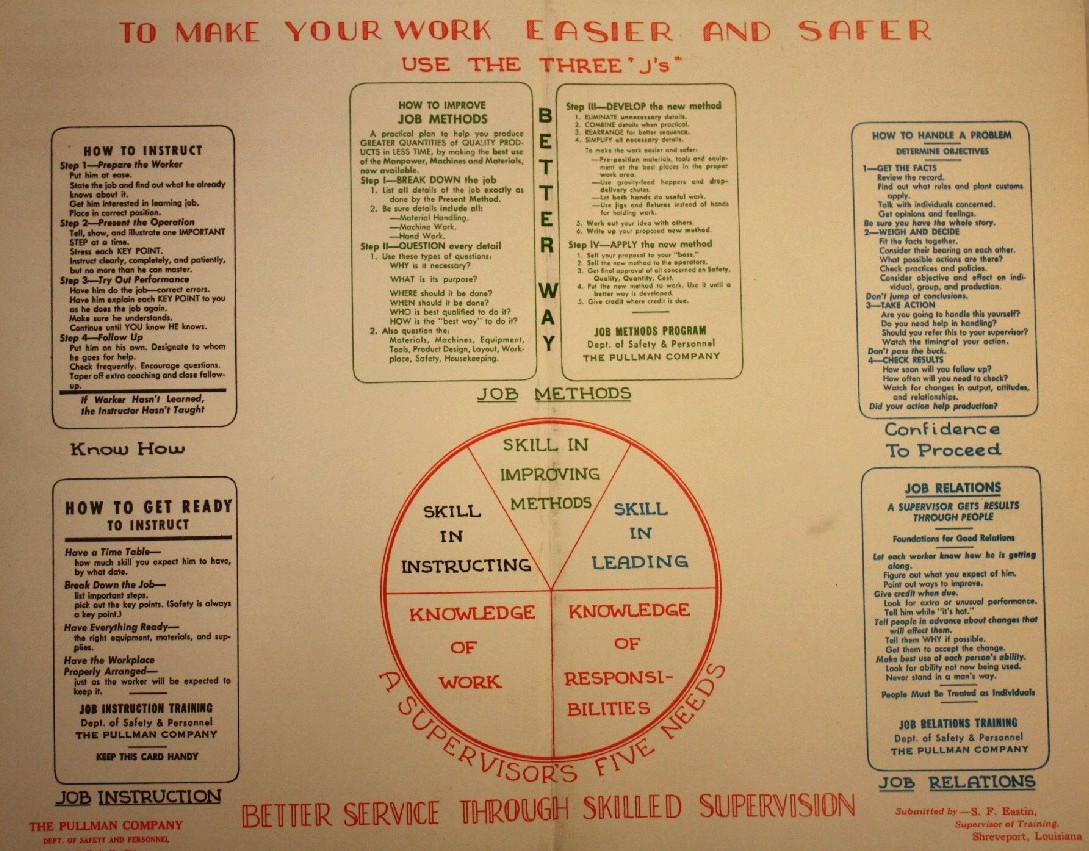
The "two types of knowledge and three skills" framework will look familiar to anyone who knows Training Within Industry. TWI's "Five Needs of a Supervisor," developed during World War II, uses the same structure: two knowledge areas (Knowledge of the Work, Knowledge of Responsibilities) and three skills (Skill in Instructing, Skill in Improving Methods, Skill in Leading). Toyota's version renames the skills to TJI, TPS, and TCS, but the architecture is the same. The diagram in the book maps almost exactly to TWI's original Five Needs model. Compare them yourself:
For more on this connection, see the Training Within Industry section of this site.
It is common to forget your roots. Toyota internalized TWI so deeply over decades that the lineage disappeared from institutional memory. But it is worth noting that even TWI had roots it did not always acknowledge. TWI's own founders said it plainly: "There is nothing new about TWI programs — they are built on accepted principles. The only new thing is that something was done about getting them used." The four-step teaching method in JI traces back to Charles Allen's WWI shipyard training (1919), which itself drew on Johann Friedrich Herbart's 19th-century pedagogy. Job Methods drew on the Gilbreths' motion study work. Job Relations drew on the workplace psychology of its era. Every generation builds on what came before, and every generation eventually forgets where the foundation came from.
This is not a criticism of the authors or of Toyota. It is simply what happens when methods are practiced long enough to become invisible — they stop being "a program we adopted" and become "the way we do things." The reader should recognize the similarities and understand that these ideas have a longer history than any single company.
3Commentary
These are timeless fundamental building blocks in production. There may be other ways of accomplishing the same things, but these methods have stood the test of time for over a hundred years across a wide variety of industries, cultures, and situations. They are as relevant today in an information-age society with AI as they ever were on a 1940s factory floor — and as they are in Toyota today in 2026.
The issue is not whether they work. They do. The issue is whether organizations adopt them and make them part of the company's leadership culture — not as a training event, not as a slide deck, but as the lived practice of how leaders are developed and how they behave every day. Most companies never get past the training-event stage. Toyota did, and that is the difference this chapter is really describing.
4Common Mistakes
- Neglecting fundamentals. Companies dismiss methods like these as too basic or too old to matter. They chase advanced topics while their supervisors cannot teach a job correctly or hold a productive conversation with a team member.
- Delegating to other departments. Leadership development gets handed to HR or a corporate training group. The skill set no longer resides in production, where the work actually happens. The people who own the results lose ownership of how leaders are built.
- Treating trainers as facilitators. Companies staff training roles with people from a training department who do not know the work. TWI puts methods in the hands of the people who know the work — the supervisor, the group leader, the line leader. A facilitator who has never run a process cannot teach someone how to run one.
- Abandoning the tools after a year or two. A company launches a leadership development initiative, runs it for twelve to eighteen months, then moves on to the next program or management fad. The methods never have time to become culture. They remain a project with an end date.
- Confusing documents with training. "We will make documents or videos and put them on SharePoint." That is not training. Training is a person teaching another person, face to face, with follow-up. Posting materials somewhere and assuming people will learn from them is the opposite of everything in this chapter.
5Key Takeaways
After a week of basic training and orientation, I went into production the next month. Butch Magori taught me using that era's version of Toyota Job Instruction, Toyota Communication, and Toyota Production System methods. Forty years later I still remember the feeling and the culture. That is what these methods produce when they are practiced — not compliance, but lasting impact.
- Toyota's "two types of knowledge and three skills" framework maps directly to TWI's Five Needs of a Supervisor — and both have roots stretching back over a century.
- The methods work. The question is whether your organization will adopt them as culture or treat them as a training event with an expiration date.
- Leadership development belongs in production, taught by people who know the work — not outsourced to a training department.
- Documents on SharePoint are not training. A person teaching another person, face to face, with follow-up — that is training.
- Toyota develops leaders before promoting them. Most companies do it the other way around and hope for the best.