Standardized Work and Job Instruction: The Document Does Not Teach the Job
A Standardized Work Chart can summarize the current method, but Job Instruction and practice are what teach the job.
This is article 8 of 10 in a series on Toyota Standardized Work.
A posted Standardized Work Chart does not mean a person has been trained.
This sounds obvious when stated plainly. Yet many companies behave as if the document and the training are the same thing. The standard is posted. The steps are listed. The timing is shown. Safety and quality points may be marked. The supervisor says, “The work is standardized.”
Then a new person struggles.
The response is often predictable. The operator did not follow the standard. The team leader did not audit the work. The supervisor did not enforce the chart. The document needs more detail. The training record needs a signature.
Sometimes those things matter. But the deeper problem is often simpler.
The document did not teach the job.
Toyota understood this distinction. Standardized Work and Job Instruction were related, but they were not the same thing. Standardized Work helped define the current best method for repetitive production work. Job Instruction helped a skilled person teach another person how to do the job safely, correctly, and conscientiously.
Those are different functions.
Toyota Did Not Start with Forms Alone
Toyota began using Training Within Industry Job Instruction after World War II. The old Toyota training material places TWI courses starting in 1951, which is a very important timing point.
Toyota had just gone through the 1950 crisis and major layoffs. Ohno was beginning his machine-shop experiments. Toyota had to improve productivity, quality, and stability with limited resources. It needed better methods, better supervision, and better ways to develop people.
In that context, Job Instruction was not a side topic.
Ohno and others recognized that the method of training in JI was valuable. It gave supervisors and team leaders a practical way to teach jobs. The Job Breakdown Sheet was a tool, but the more important contribution was the method: how to prepare, present, try out, and follow up.
None of that is contained in a Standardized Work Chart.
The chart may show the work sequence. It may show takt time, standard work-in-process, walking, safety, and quality points. But it does not by itself prepare the learner. It does not present the job step by step. It does not check understanding. It does not correct practice. It does not follow up until the person can perform reliably.
That is training work.
The Job Breakdown Sheet Is Not the Same as the Chart
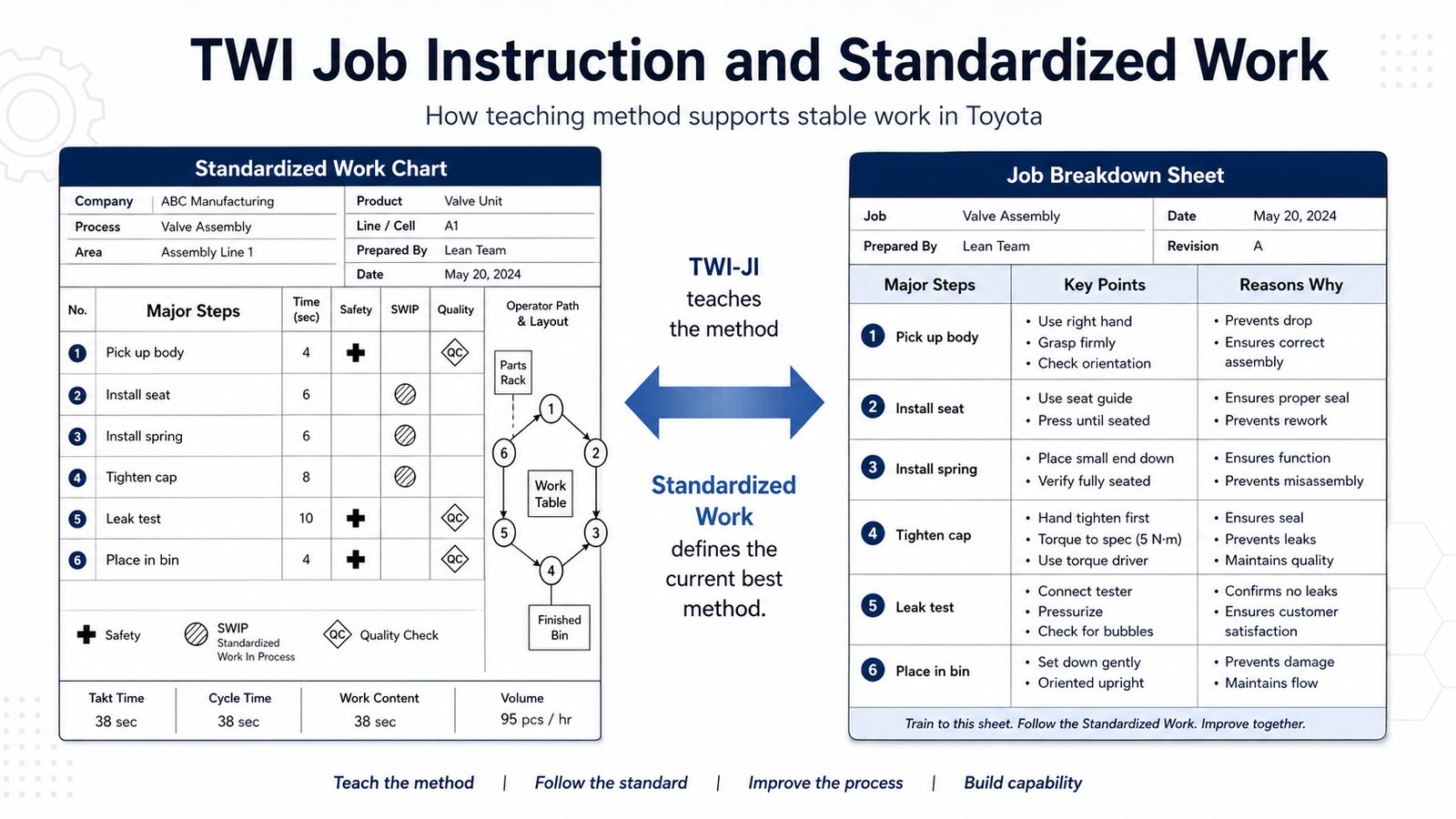
The Job Breakdown Sheet is often confused with Standardized Work because both deal with the job. But they are different documents with different purposes.
A Job Breakdown Sheet breaks the job into:
- major steps,
- key points,
- reasons why.
The major steps describe the important parts of the job that advance the work. The key points identify what is critical for safety, quality, ease, timing, or special technique. The reasons why explain why those key points matter.
That last part is often missing in weak training.
A person can be told, “Hold the part this way.” But if they do not understand why, they may change the grip when it feels awkward. They can be told, “Check this surface.” But if they do not understand the defect being prevented, they may glance without seeing. They can be told, “Stand here.” But if they do not understand the safety, ergonomic, or timing reason, they may drift into a different position.
The Job Breakdown Sheet forces the trainer to think about what must be taught.
The Standardized Work Chart summarizes the current workplace method.
The Job Breakdown Sheet supports the act of teaching that method.
Here is where the real world gets a little messy. Because of TWI/JI influence, you will sometimes see Work Standards, and even some Standardized Work Charts, with “key points” or “reasons why” depicted on them. That language is pure JI influence. Toyota people did not always keep the documents as separate in appearance as a classroom taxonomy might suggest. In some assembly-line environments, Toyota even combined JI and Standardized Work thinking into a Standardized Work Training Document.
That does not erase the distinction. It proves the influence.
The important point is not whether a key point appears on one form or another. The important point is whether the organization has a real method for teaching the job. If the key point is printed on a chart but nobody knows how to prepare the learner, present the work, try out performance, and follow up, then the JI words have been borrowed without the JI method.
A veteran employee may glance at a Standardized Work Chart and remember what to do. That does not mean a beginner can learn from the chart. To the experienced person, the chart is a reminder. To the beginner, it is often too compressed.
The job must be broken down.
JI Is a Method, Not Just a Sheet
This is the point many companies miss.
The Job Breakdown Sheet is useful, but Job Instruction is not just a form. It is a method for training.
The classic JI pattern is simple but demanding:
- Prepare the worker.
- Present the operation.
- Try out performance.
- Follow up.
Each step matters.
Prepare the worker means more than saying, “Watch me.” The trainer must put the person at ease, state the job, find out what the person already knows, create interest, and place the person in the correct position to learn.
Present the operation means showing and explaining the job carefully. The trainer presents the major steps, key points, and reasons why in a structured manner. The learner is not flooded with everything at once. The instructor teaches in a way the person can absorb.
Try out performance means the learner performs the job while explaining back the steps, key points, and reasons. The trainer corrects errors early. The learner practices until the method begins to settle.
Follow up means the trainer does not disappear after one demonstration. The trainer checks frequently, tapers help gradually, encourages questions, and ensures the person can perform the job safely and correctly under real conditions.
That pattern develops capability.
Posting a chart does not.
If the Employee Has Not Learned
One old JI statement is blunt: if the employee has not learned, then the instructor has not taught.
That sentence can sound harsh to supervisors, but it contains an important Toyota lesson. Training is not the same as telling. Training is not the same as showing once. Training is not the same as handing someone a document. Training is not the same as recording that the employee attended class.
Training means the person can actually perform the work.
That requires a skilled trainer.
Toyota’s use of Job Instruction helped convert experienced workers, team leaders, and supervisors into better teachers. A person skilled in the job still needed methodological skill in how to train. Being good at the job does not automatically mean being good at teaching the job.
This is a major gap in many companies.
They select the best operator and ask that person to train the new employee. The expert demonstrates too quickly, explains too much, skips the reasons why, assumes the learner sees what the expert sees, and then walks away. The new person copies the visible motion but misses the key point. Later, a defect occurs or the person struggles with timing, and the organization says the operator failed to follow the standard.
Maybe the operator was never properly taught.
Standardized Work Is Too Compressed for Beginners
A Standardized Work Chart is a highly summarized form of the job.
That is not a criticism. It is one reason the chart is useful. It puts the current standard condition at the workplace in a compact form. It shows sequence, layout, takt, cycle time, standard work-in-process, and key points in a way that supports observation.
But compression has a cost.
The chart cannot hold all the detail a beginner needs.
It cannot fully explain the knack of inserting a part without nicking a surface. It cannot show the hand pressure needed to seat a component. It cannot teach the sound of a good clamp. It cannot explain the feel of a tool beginning to wear. It cannot show the difference between looking at a quality point and actually seeing the defect condition. It cannot teach body position, rhythm, caution, judgment, or the reason behind every key point.
Those things must be taught.
Some can be written on a Job Breakdown Sheet. Some must be demonstrated. Some must be practiced. Some require correction by an experienced trainer standing beside the learner.
This is why Standardized Work and Job Instruction fit together. The chart defines and displays the current method. JI develops the person’s ability to perform it.
The Supervisor’s Skill Matters
Job Instruction also changes the role of the supervisor or team leader.
In weak systems, the supervisor is often a compliance checker. Did the person follow the standard? Did the form get signed? Did the audit pass?
In stronger systems, the supervisor is also a teacher and capability builder. Can the person do the job? Were the key points taught? Does the person understand the reasons why? Did we confirm learning? Are we following up? Is the method teachable? Is the standard itself realistic?
This is one reason Toyota’s frontline roles were so important. Standardized Work without capable supervision becomes paperwork. Job Instruction without a real standard becomes generic training. The two need each other.
A team leader who understands both can see more clearly.
If the worker deviates from the sequence, is it a training problem, a method problem, a process problem, a workload problem, or an abnormal condition?
If the worker misses a quality point, was the reason why taught properly?
If the worker cannot maintain takt, is the issue skill, work design, part presentation, machine condition, or sequence?
If the worker finds a better way, is it unsafe improvisation, a legitimate kaizen idea, or evidence that the old method was weak?
These are not audit questions. They are teaching and problem-solving questions.
Practice Is Part of the Standard
John Shook has emphasized practice in his writing on Standardized Work, and he is right. A person does not master a job because the document exists. Mastery requires repeated performance, correction, support, and experience.
Toyota jobs often look simple from the outside because the work is broken down and repeated. But simple-looking work can contain many key points. Safety, quality, timing, ergonomics, material handling, and knack are often embedded in small details.
A new person needs practice to make those details reliable.
A veteran can sometimes look at a chart and reconstruct the job because the chart connects to prior experience. A new person does not have that background. The chart may tell them the sequence, but it cannot create the skill.
This is why training must be embodied on the shop floor.
I experienced this directly on a Toyota engine assembly line. A team leader named Butch Magori trained me using JI-style methods. It was not a matter of pointing to a posted chart and saying, “There is the standard.” He taught the job in pieces, emphasized the key points, checked what I could do, corrected what I missed, and followed up. That is the part people often fail to see when they tour a plant and notice the documents.
The real test of JI is not whether the Job Breakdown Sheet exists. The test is whether a supervisor or team leader can use it to teach a person the job in real conditions.
Toyota Has Also Evolved
There is another complication. Pure old-style TWI/JI does not really exist inside Toyota today in the same way it did decades ago. Toyota absorbed the essence and evolved the practice.
Today you are more likely to see dedicated skill-development areas, often called skills dojos, where Toyota Job Instruction or T-JI is taught in a more developed form. It does not look exactly like old TWI/JI. Toyota has made significant advances with text, images, training equipment, practice stations, tests, and proficiency checks.
In many cases, new employees must master area-specific skills and display proficiency in core tasks before they ever see the assembly line. That is a very different idea from dropping a person onto the line with a posted chart and calling it training.
Toyota understood the essence of what to keep: break down the work, identify what matters, teach methodically, verify learning, practice under realistic conditions, and develop skill before expecting stable performance. The outer form of the training system changed. The underlying logic remained.
Other companies often fall victim to the seductive notion that if the standard is posted, the training has occurred. Toyota moved in the opposite direction. It kept developing better ways to build the human capability behind the standard.
The Document Supports Teaching; It Does Not Replace It
This is the practical distinction.
The Standardized Work Chart helps show the current standard condition.
The Job Breakdown Sheet helps structure what must be taught.
The JI method helps the trainer teach it.
The learner’s practice turns instruction into ability.
The team leader’s follow-up confirms the ability holds under real conditions.
When companies collapse all of that into “we posted the standard,” they miss the human development side of Toyota’s system.
They also create unfair expectations. A person is expected to perform a job they were never properly taught. A supervisor is expected to enforce a standard without being developed as a trainer. A chart is expected to carry knowledge it was never designed to carry.
That is not Toyota Standardized Work. That is document management.
The Practical Lesson
Standardized Work and Job Instruction are partners, not substitutes.
Toyota needed both. It needed a way to define the current best method for repetitive work. It also needed a way to teach that method reliably to human beings. TWI Job Instruction gave Toyota a disciplined pattern for preparing, presenting, trying out, and following up. The Job Breakdown Sheet helped identify major steps, key points, and reasons why. Supervisors and team leaders learned not only the job, but how to teach the job.
That capability mattered in 1951, when Toyota was under pressure and Ohno was experimenting in the machine shops. It still matters now.
A Standardized Work Chart can remind, display, and support observation.
It cannot teach by itself.
If the employee has not learned, the answer is not simply to point harder at the chart. The answer is to examine the training method, the Job Breakdown Sheet, the supervisor’s teaching skill, the opportunity for practice, and the actual conditions of the work.
The document does not teach the job.
People teach the job — if they have a method.
Series navigation: Previous: Work Standards Come Before Standardized Work | Next: Standardized Work and Kaizen: No Improvement Without a Baseline