The Machine-Shop Problem That Gave Birth to Standardized Work
The roots of Toyota Standardized Work are in machine-shop problems: human waiting, machine cycles, multi-process handling, takt, and overproduction.
This is article 2 of 10 in a series on Toyota Standardized Work.
In the first article in this series, I argued that Toyota Standardized Work is not just an SOP. It is not merely a work instruction with a Toyota label on it. It is a way of making work visible, measurable, teachable, repeatable, improvable, and connected to demand.
But that raises a natural question: where did this way of thinking come from?
The answer does not begin with a clean form. It does not begin with a consultant’s template. It does not begin with a laminated chart posted at a workstation.
It begins in Toyota’s machine shops.
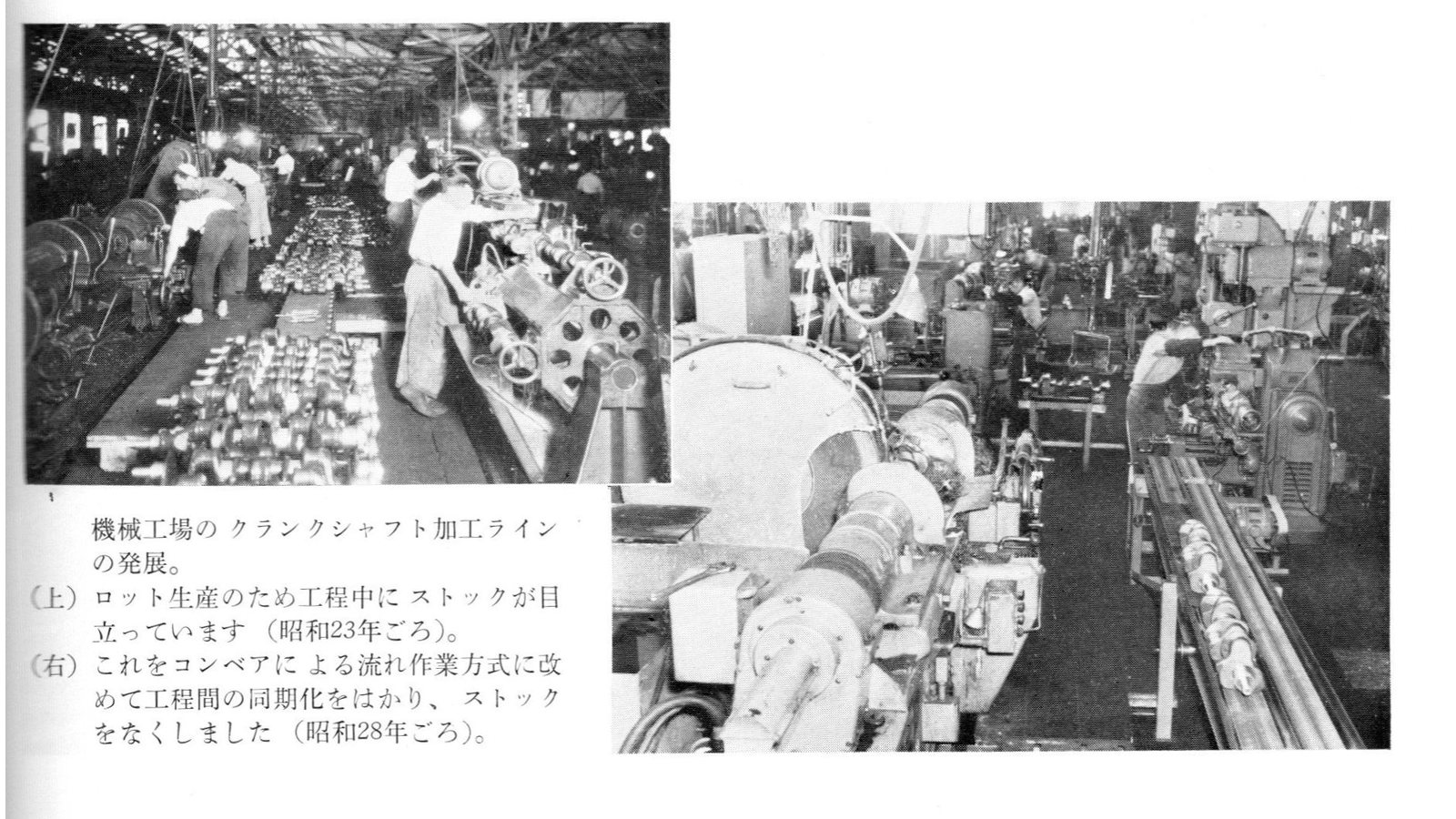
More specifically, it begins with the production problems Taiichi Ohno faced in engine machining in the years after World War II. Ohno was not sitting in a conference room designing a general management theory. In the early 1950’s he was responsible for engine production in Toyota’s machine shops, managing a large production area of more than 500 people. His problems were concrete: machine tools, cutting cycles, operators waiting, equipment reliability, low labor productivity, missing parts, process flow, and the danger of making more than the next process needed.
That is the background most explanations of Standardized Work miss.
Toyota’s Pressure in the Early 1950s
Toyota in the early 1950s was not the Toyota people imagine today. It was not yet the global company associated with world-class quality, productivity, and production control. It was a struggling company under severe pressure.
Toyota went through a major restructuring in 1950. Toyota’s own 75-year history states that, based on a corporate revival plan, the Kamata and Shibaura plants were closed on June 10, 1950, and a total of 2,146 employees were laid off, including 378 from the two plants. Internally, Toyota’s labor efficiency was estimated to be only a fraction of high-volume producers such as Ford — often described as roughly one-ninth. Whether the exact comparison is perfect or not, the message was clear enough. Toyota could not compete by simply accepting the old way of working.
But Toyota also could not copy Ford directly.
Ford had scale, volume, capital, and demand conditions Toyota did not have. Toyota’s market was smaller. Product variety was higher relative to its volume. Demand was limited and uneven. Simply producing more parts because a machine could produce them would only create inventory and cash problems.
So Ohno’s problem had two sides that pulled against each other.
Toyota had to improve labor productivity dramatically.
Toyota also had to avoid overproduction.
That combination is crucial. If the only goal had been to raise machine output, the answer would have been different. Run the machines. Build inventory. Keep everyone busy. Improve local utilization numbers.
But that was exactly the trap Ohno was trying to avoid.
The One-Person, One-Machine Assumption
In many machine shops of that era, one person tended one machine. That was the normal mental model.
A machine was cutting, drilling, grinding, turning, or milling. The operator stood nearby. He loaded the part, started the cycle, watched the machine, unloaded the part, checked something, and repeated the pattern. Even when a machine had automatic feed or automatic cutting, it was common for the operator to remain near the machine and monitor it.
This seemed reasonable. Machines were not always reliable. Tools broke. Chips clogged. Quality could drift. If something went wrong and nobody was watching, the consequences could be serious.
But from Ohno’s point of view, this arrangement contained enormous hidden waste.
If the machine was cutting automatically, what was the person doing during that time? Waiting? Watching? Being available in case something happened? Was that necessary every cycle? Was it necessary for the entire cycle? Could the machine be made to stop safely? Could abnormality detection be improved? Could the operator load another machine while the first machine was cutting?
Those questions sound simple now. They were not simple at the time.
They required breaking a deeply held assumption: that a person and a machine belonged together as a pair.
Standardized Work eventually became one way to make that relationship visible. But the first challenge was more basic. Toyota had to learn to see human work and machine work as different things.
Shingo’s Observation of Toyota
Shigeo Shingo decades later wrote about what he observed at Toyota upon his early visits to the company. It is important to frame this correctly. Shingo was observing, teaching industrial engineering concepts, and later writing about practices he saw and learned from Toyota. His recollections are useful precisely because they show how unusual Toyota’s machine-shop experiments looked to an outside IE instructor at the time.
The Shingo material in this article is drawn mainly from Chapter 1, pages 1–24, of his Japanese book 工場改善の体系的思考 —改善のためのSTメカニズム— (Systematic Thinking for Factory Improvement: The ST Mechanism for Improvement), published by Nikkan Kogyo Shimbunsha in 1980. To my knowledge, this book was not translated into English.
In that account, Shingo described conducting a P-Course at Toyota Motor in 1955. What surprised him most was that one person was tending many machines. In the five years since he became production manager, Ohno had already made substantial inroads.
Shingo provides some striking numbers. In the machine shop, he says there were about 3,500 machines and 700 workers — an average of five machines per worker. He also records that in some maximum cases a person in Toyota’s machine shop tended as many as 26 machines.
Even if we treat the numbers as Shingo’s recollection rather than a formal Toyota production record, the implication is powerful. Toyota was already moving far beyond the simple one-person, one-machine model. It was experimenting aggressively with multi-machine handling.
For a person coming from the more common machine-shop assumption of the era, this was startling.
The question was not, “Can we write a better procedure?”
The question was, “Can we redesign the relationship between people, machines, time, motion, and demand?”
Separation of Man from Machine
This is where the phrases “jidoka” and “separation of man from machine” become important.
In English, people sometimes hear those phrases and make them sound abstract. In the Toyota machine-shop context, they were very practical and had dual meanings: build in quality at the process and enable separation of man from machine.
If the machine is doing automatic work, the human being should not be chained to the machine merely to watch it. If the machine requires constant watching because it is unreliable, then the correct question is not how to make the operator better at watching. The correct question is how to improve the machine, the tooling, the detection method, or the stopping mechanism so the person can be freed to do value-adding work elsewhere.
This is one of the meanings of jidoka, or autonomation — automation with a human element. It is not just “automation.” It is not merely buying a machine that runs by itself. It is designing the machine and process so that abnormality is detected, the machine can stop appropriately, and the person does not have to babysit the equipment.
Shingo’s account describes this mental shift clearly. The old view was: automation is unreliable, so a person must stand by and monitor it. The Toyota view became: if reliability is low, improve the reliability and abnormality detection; do not permanently assign a person to stand there and watch.
That difference is enormous.
It changes the purpose of the operator. It changes the purpose of the machine. It changes the layout. It changes the timing. It changes the standard.
And eventually, it changes the documents needed to describe the work.
Ohno’s Experimenting Mindset
Shingo also describes Toyota’s early experimentation with two-machine handling as it was described to him. In his recollection, a question was raised: if an automatic machine is cutting, why can’t one person tend two machines?
The reply was the typical concern: bits may break, chips may clog, and someone has to monitor the machine.
According to Shingo’s account, Ohno tested the assumption by standing by the machine for an entire week, from morning to evening, watching whether trouble actually occurred. The result was that no trouble occurred during the trial, and two-machine handling was allowed to proceed.
Again, we should be careful about treating every detail as if it came from a formal Toyota archive. There is no doubt some element of exaggeration involved. But as a description of Ohno’s overall approach during that period, it rings true.
Do not debate forever from assumptions.
Go and see.
Observe the actual condition.
Test whether the opinions or concerns are accurate.
If the problem is real, solve it. If it is not real, change the method.
That pattern is central to Toyota’s later problem-solving and kaizen practice. It also sits underneath Standardized Work. The standard is not supposed to be a frozen opinion. It is supposed to be based on observation of actual work under actual conditions.
The Real Economic Logic
Many people misunderstand multi-machine handling as a simple labor-reduction trick. That is too crude.
Of course labor productivity mattered. Toyota had to close a massive productivity gap. Ohno was under pressure to improve labor efficiency in machining operations. But the reasoning was not simply “make people work harder.”
The better distinction is between human waiting, machine waiting, overproduction, and cost.
A machine may have low utilization in a local sense if an operator is tending multiple machines. Many factories hate that. They look at the machine and say, “The utilization is low. This is bad.”
Ohno’s logic was different. A machine is a purchased asset. Once depreciated, its cost behaves differently from a person’s labor time. A person’s waiting repeats every day, every hour, every cycle. If the operator waits while the machine cuts, that waiting is built into the production system. It became one of his famous “7 forms of waste”.
This does not mean Toyota ignored machine utilization. Expensive equipment, bottleneck processes, and capacity constraints always matter. But the point is that local machine utilization was not allowed to dominate the entire system. Toyota was looking for the best total relationship among people, machines, flow, cost, and demand.
Shingo makes this point in several examples. People seeing many-machine handling for the first time often objected that machine utilization would fall. He argued that this objection often saw only the surface-level utilization number and missed the deeper cost-reduction question that Ohno was pursuing.
That is an important lesson for Standardized Work.
The goal was not to keep every person busy in a superficial sense.
The goal was not to keep every machine running regardless of need.
The goal was to create the best current method for producing what was needed, when it was needed, with the least waste.
Layout Had to Change
Once one person tends multiple machines, the layout becomes a problem.
The old layout may have made sense when one person stood in front of one machine. It may not make sense when one person must load one machine, walk to another, unload a part, check quality, start another cycle, and return at the right time.
Now walking matters. Waiting matters. Machine cycle time matters. Manual time matters. Direction matters. Distance matters. The order of work may not be the same as the process order.
This is one of the most important points in Shingo’s description of Toyota in the latter 1950’s. In multi-machine handling, the operator’s action sequence does not necessarily follow the process sequence. The sequence should be set according to the relationship between machine completion timing, human motion, and the work that must be done.
That idea points directly toward to what later becomes known as the later Standardized Work Combination Table.
If a machine finishes cutting in 30 seconds, and another machine finishes in 45 seconds, and the operator needs 8 seconds to unload and reload one, 10 seconds to check another, and 6 seconds to walk between them, then the actual question is not “What is the SOP?”
The question is: what combination of human work, machine work, walking, waiting, and sequence can meet the required timing without overproduction and without waste?
That is a very different level of analysis.
Shingo also notes that Toyota experimented with layouts to minimize human movement — U-shaped, L-shaped, comb-shaped, and other arrangements over time. The point was not that walking was automatically good. Walking is usually something to reduce. But walking to operate several machines may be better than standing still and waiting beside one machine.
Again, the issue was the total system.
JIT Was in the Background
There is another point that must not be missed. Multi-machine handling by itself could still lead to overproduction if not connected to demand.
If one person can run five machines, or ten machines, or more, the temptation is to keep all of them producing. But Toyota’s problem was not simply to produce as many pieces as possible. Toyota had to produce according to need.
This is where takt time and Just-in-Time enter the story.
The operator-machine combination had to be tied to the required production rate. Otherwise the improvement in labor efficiency could simply become faster overproduction. That is why Standardized Work later included takt time as one of its three basic elements.
Takt was not a decoration. It was the demand constraint.
The work sequence was not merely the “best way” in the abstract. It was the best current sequence under a given takt.
Standard work-in-process was not just inventory lying around the job. It was the minimum necessary material condition to allow the sequence to function.
These ideas were not separate from Ohno’s machine-shop experiments. They were part of the same struggle: improve productivity, expose waste, and avoid making what was not needed.
The Birthplace of Kaizen Thinking
This machine-shop context also helps explain Toyota kaizen.
Kaizen is often explained as “continuous improvement.” That is true but too vague. In Toyota’s machine shops, kaizen was not a slogan. It was the practical need to keep studying the work because the current method was never good enough.
Can one person tend two machines?
Can the machine stop itself at the end of the cut?
Can the tool be changed faster?
Can the operator’s walking be reduced?
Can the layout be changed?
Can the machine cycle be shortened?
Can the work be connected to takt without producing extra inventory?
Can the waiting be removed without creating defects or breakdowns?
These are kaizen questions. They are also standardized work questions.
The two grew together. This point is important. It was not a neat sequence where Toyota first created finished Standardized Work forms and then later applied kaizen on top of them. Nor was it pure kaizen with no documentation. Toyota was improving the work and developing ways to analyze, record, teach, and stabilize the improved method at the same time.
Early forms and documents served both purposes. They helped people analyze the current condition, and they helped capture the next condition after improvement. Kaizen changed the method. The new method needed to be made visible, taught, followed, and improved again.
This is why it is a mistake to treat Standardized Work as a compliance document. In this origin story, the standard was not the end of thinking. It was part of the thinking pattern used to generate an improvement result.
Why This Led Toward the Three Forms
At this point, we can see why a simple work instruction was not enough.
If the problem is one person doing one task at one bench, a basic instruction sheet may be sufficient. But if the problem is one person handling several machines in relation to takt time, machine cycles, walking, waiting, quality checks, tool changes, and standard work-in-process, then a more powerful way of seeing is needed.
You need to know what the process can actually do.
You need to know the capacity of each machine or process.
You need to know the manual time and automatic machine time.
You need to know the walking time.
You need to know when the operator waits and when the machine waits.
You need to know the required production rate.
You need to know the minimum standard work-in-process.
You need to know the work sequence that makes the whole thing possible.
That is the problem field from which Toyota Standardized Work emerged.
Over time, Toyota’s learning was captured in the three basic forms most associated with Standardized Work: the Process Capacity Sheet, the Standardized Work Combination Table, and the Standardized Work Chart.
But we should be careful here. Those final forms did not appear fully developed at the beginning of the 1950s. Toyota was experimenting, improving, documenting, revising, and teaching as the work evolved. The complete form of Toyota Standardized Work, as most people recognize it today, emerged later — with the mid-1960s being a better reference point for the more mature form, and further refinement continuing after that.
Those forms did not appear because Toyota wanted better paperwork. They appeared because the problem was too complex to manage by opinion, memory, or generic instruction.
The forms made the relationship visible.
Not a Documentation Story
This is the main point of Article 2.
Standardized Work was born from Toyota’s production struggle in the machine shops. It came from the need to improve labor productivity without creating overproduction. It came from breaking the assumption that one person should stand beside one machine. It came from separating human work from machine work. It came from improving equipment so people did not have to babysit it. It came from changing layouts, studying motion, timing cycles, reducing waiting, and connecting the work to demand.
Shingo’s recollections on this topic are useful because they show how unusual this looked. One person tending many machines was not normal practice. Toyota’s average of several machines per worker, and maximum examples far beyond that, were signs of a different production logic emerging.
But the important figure is not the number of machines. The important point is the thinking.
Toyota was learning how to see work as a relationship among people, machines, time, motion, material, and demand.
Standardized Work became one of the ways to express that relationship.
That is why the next article will turn to the three forms. Once you understand the machine-shop problem, the forms make much more sense. The Process Capacity Sheet, the Standardized Work Combination Table, and the Standardized Work Chart were not bureaucratic attachments to lean. They were Toyota’s way of making a difficult production relationship visible enough to manage, teach, and improve.
Series navigation: Previous: Why Standardized Work Is Not Just an SOP | Next: The Three Forms Behind Real Toyota Standardized Work