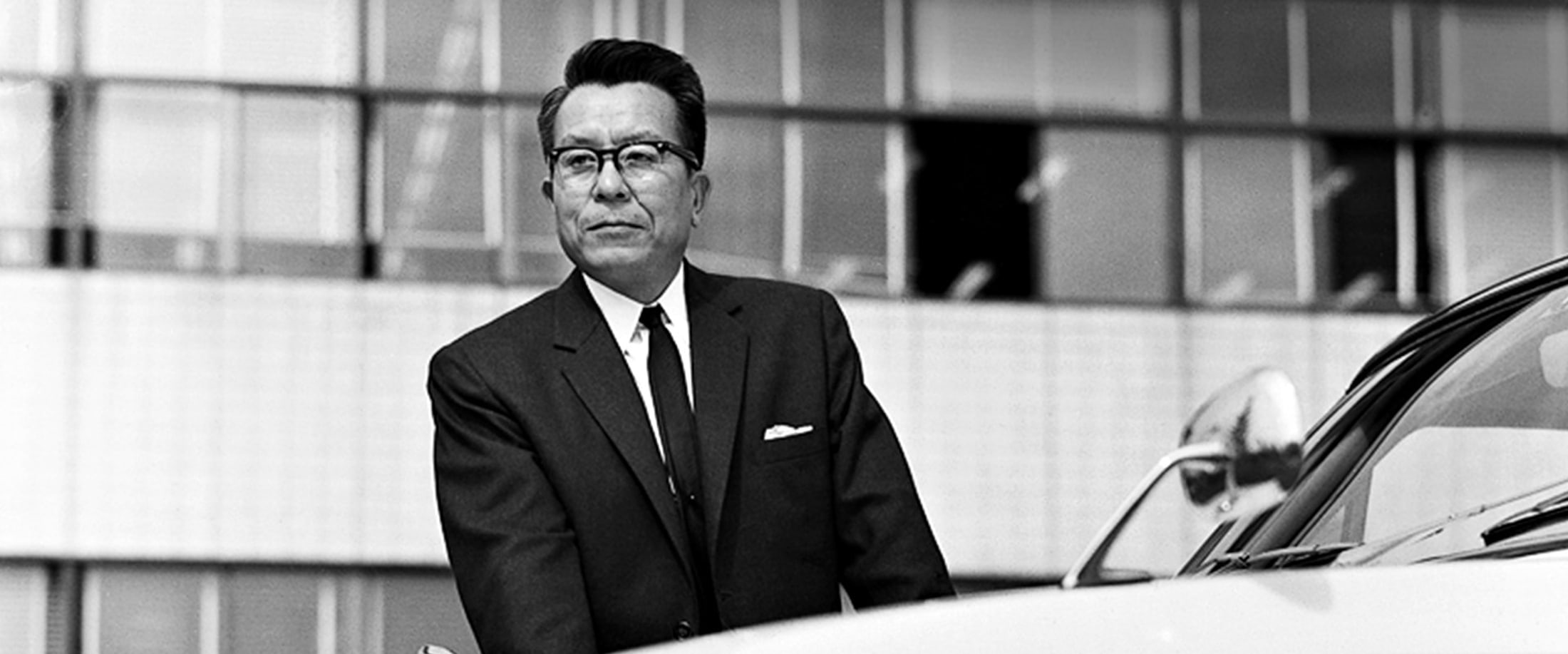
Who Was Tatsuo Hasegawa?
Kenya Nakamura proved that a single, willful leader could integrate an entire car. Tatsuo Hasegawa (長谷川龍雄, 1916–2008) proved something harder and more lasting: that the feat did not have to depend on a once-in-a-generation personality. He took Nakamura's improvised method and turned it into a system — with explicit planning disciplines, a cost methodology imported from aircraft design, an organizational home that outlived its founders, and a written code for what a chief engineer must be.
If Nakamura was the soul of the shusa system, Hasegawa was its architect. And the reason he could see the system where others saw only Nakamura's force of personality is that he came to cars from a completely different world.
How Did an Aircraft Engineer End Up at Toyota?
Hasegawa was not an automotive man by training. He graduated from the Department of Aeronautics at Tokyo Imperial University in 1939 and joined Tachikawa Aircraft, where he worked at the leading edge of Japanese aviation. He developed a laminar-flow wing section known as the "TH wing" — TH for his own initials — and during the war served as chief designer of the Tachikawa Ki-94, a high-altitude interceptor meant to reach the B-29 bombers that flew above the range of most Japanese fighters. Intercepting a B-29 demanded a pressurized cockpit and turbo-supercharging to hold power in thin air. One Ki-94 was completed as the war ended; it never flew in combat.
Aircraft design taught Hasegawa a way of thinking that would define his automotive career. In an airplane nothing is independent: change the wing and you move the center of gravity, which changes the tail, which changes drag, which changes fuel load, which changes range. The machine is a tightly coupled whole, and the chief designer's job is to manage the trade-offs across all of it at once. This systems instinct — and, crucially, the weight-budget discipline that goes with it — was Hasegawa's native language before he ever saw an assembly line.
When Japan's aviation industry was dismantled after the surrender, thousands of elite aeronautical engineers lost their field. In 1946 Hasegawa joined Toyota. The contrast staggered him. The gap between the aircraft industry he had left and the carmaker he had joined, he recalled years later in an NHK documentary, was something like ten to one in both technical level and the size of the works — "honestly, I thought my life was over." He stayed, and turned that systems training on the problem of building cars.
What Did Hasegawa Learn Under Nakamura?
Hasegawa's first major assignment was as assistant (副主査, fuku-shusa) to Kenya Nakamura on the first Crown. This apprenticeship is the hinge of the whole story, because it is where the method was transferred.
The organizational idea was not foreign to him. The shusa system is widely said to have drawn on the chief-designer (主務) system used in fighter development, which Hasegawa knew firsthand — though it was Nakamura who first held the role and gave it life. Working at Nakamura's side, Hasegawa saw close up what a single accountable leader could accomplish — the walking, the arguing, the sign-off on every drawing, the integration of a whole vehicle by persuasion rather than rank. He also, with an analyst's eye, saw the cost of it. Nakamura fought the same battles over and over by main strength. There was no standard way of setting targets, no method that someone less formidable could pick up and run. Nakamura's intuition was extraordinary, but you could not clone it ten times to staff ten programs. If Toyota was going to become a mass manufacturer with many cars in development at once, the role of the shusa would have to be made teachable. It needed a method. Hasegawa set out to build one.
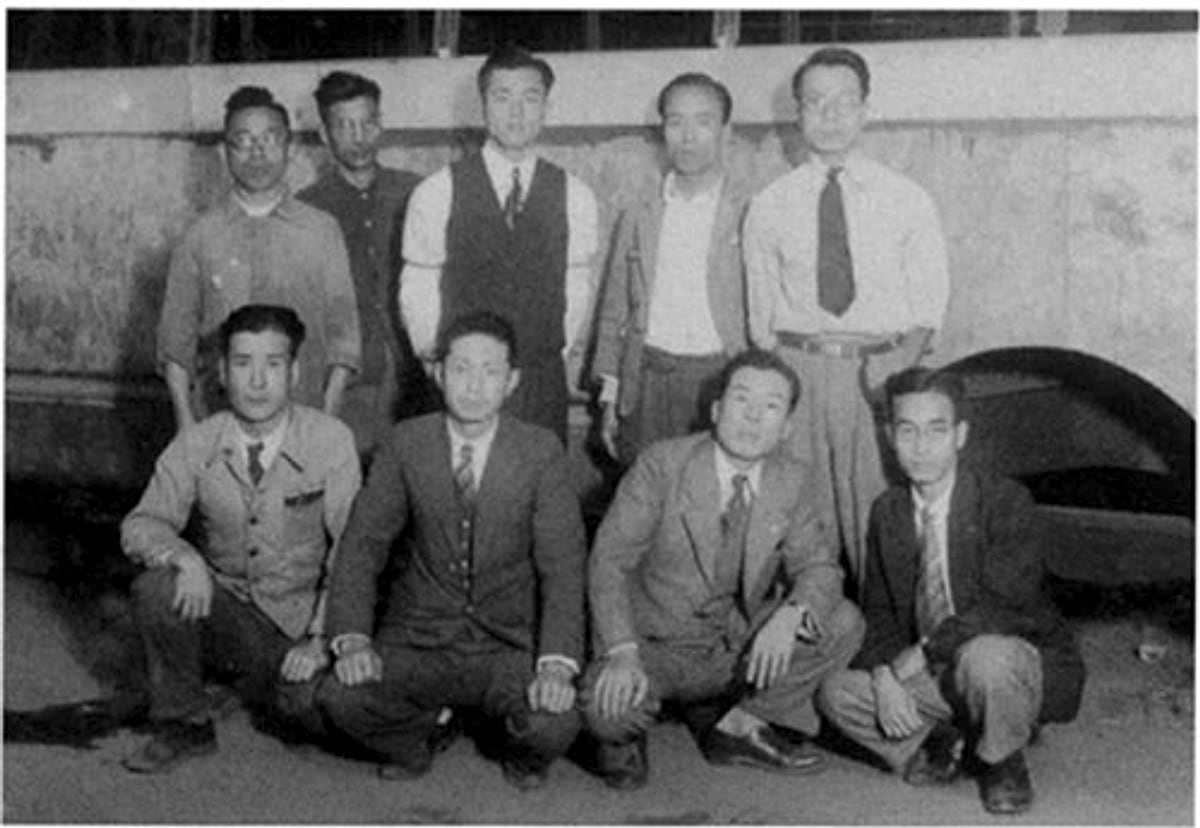 A Toyota vehicle development team of the 1950s, photographed with a prototype.
What Did the Publica Teach Hasegawa?
Hasegawa's first major passenger-car program as a chief engineer was the Publica, a small, inexpensive "people's car" responding to the government's national-car concept, developed in the late 1950s. He approached it as an aircraft engineer would: a transportation module, stripped of waste, lightweight, air-cooled to delete the radiator and water pump and their failure points. As a piece of engineering it was disciplined and clever.
As a product it disappointed. The Japanese buyer of the early 1960s did not want austerity. Car ownership was aspirational; the spartan, frill-free Publica read as cheap, a reminder of the poverty people were trying to leave behind rather than the future they wanted. Toyota ended up adding more comfortable, better-equipped versions to lift it.
For Hasegawa the lesson was formative and a little painful: customer value is not the same as engineering efficiency. In aviation, performance is objective — climb rate, top speed. In a consumer car, "performance" includes comfort, status, and feel, which are subjective and decisive. A chief engineer, he concluded, has to be more than the best engineer in the room. He has to understand what the market actually wants before the design is fixed. He carried that lesson straight into the car that made his name.
What Was Hasegawa's "80 Points Plus Alpha"?
The first-generation Corolla, launched in 1966, became one of the best-selling automobiles in history and the template against which the shusa system was measured. Hasegawa set its founding philosophy, captured in a phrase that is still quoted inside Toyota: 80 points, plus alpha (80点主義+α).
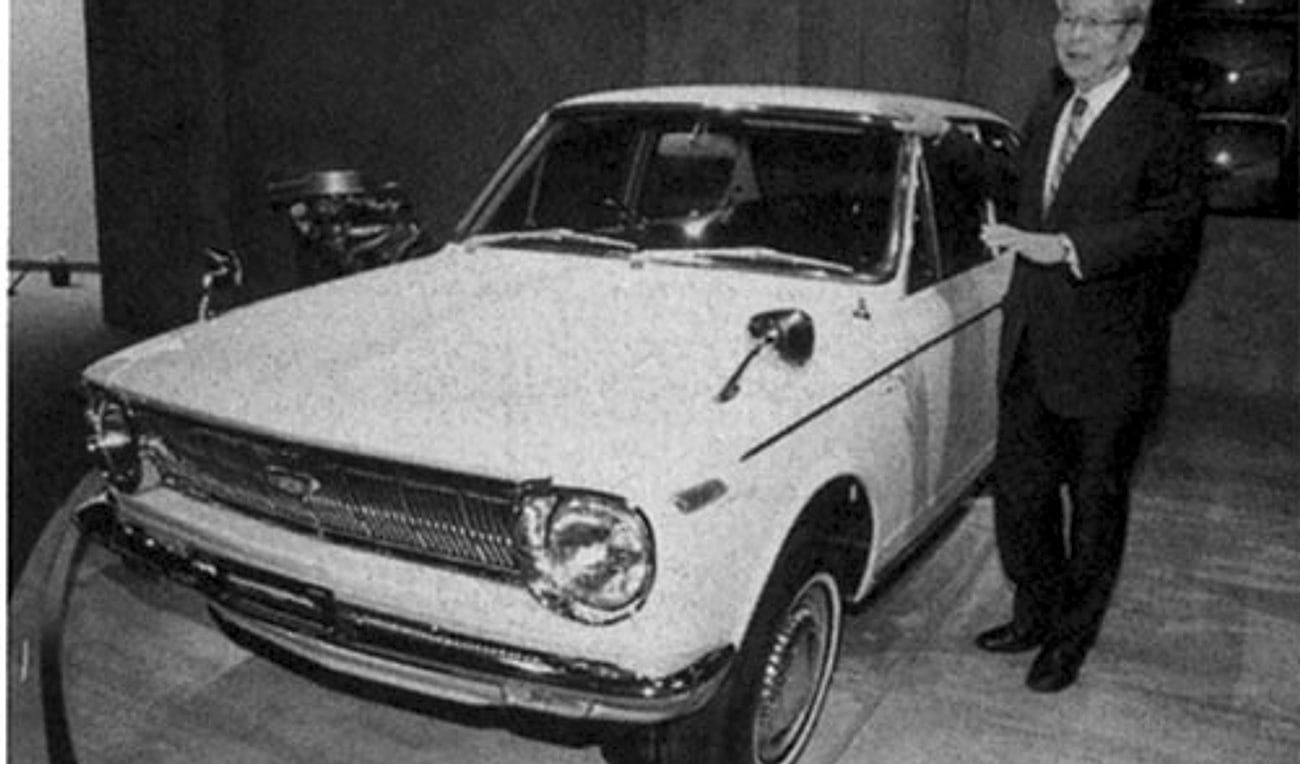 Hasegawa with an early Toyota passenger car.
The idea is precise. The car must score at least 80 out of 100 on every dimension that matters to a customer — ride, handling, quietness, space, reliability, cost. It is not allowed to be brilliant in one area and poor in another; a car that is superb on power but weak on brakes fails the test. That floor guarantees a product with no fatal flaws, acceptable to a broad market. But a car that is merely competent everywhere is forgettable, so on top of the 80-point floor the chief engineer must add an alpha — a specific, deliberate excellence that creates desire. For the Corolla, Hasegawa chose a feeling of sportiness, and to deliver it he insisted on features then considered too expensive for an economy car: a MacPherson-strut front suspension and a four-speed floor shift where rivals used leaf springs and a three-speed column shifter. The cost controllers objected. Paying for the alpha without breaking the car's price is exactly the problem his next invention was built to solve.
How Did Hasegawa Invent Target Costing?
The discipline Hasegawa is most associated with is genka kikaku (原価企画), target costing — and its origin is precisely where his two careers meet.
In aircraft design, weight planning (重量企画) is the supreme law. The aircraft has a maximum takeoff weight, and the chief designer allocates a weight budget to every subsystem. If the landing gear comes in fifty kilograms heavy, that weight has to be found somewhere else; the total may never be exceeded. Hasegawa transposed this logic directly onto cost. As the Waseda case study on Toyota target costing documents, the first time this approach was actually run inside a development project was on the third prototype of the first Publica, in 1959, when Hasegawa — newly a shusa — applied the weight-planning method he had practiced at Tachikawa Aircraft to cost, and named the result genka kikaku. (Toyota internally traces the deeper root of the idea even further back, to a memo by founder Kiichiro Toyoda on cost calculation; Hasegawa is the one who turned the instinct into an operating method.)
The mechanics invert Western "cost-plus" pricing. Instead of cost plus profit equals price, Hasegawa worked from market price minus required profit equals allowable cost. That allowable cost was then broken down and allocated across every subsystem — engine, transmission, body, interior. Critically, he did not allocate the whole of it. The chief engineer kept a reserve — a "pocket money" buffer — held back against the unexpected and, in practice, used to pay for the alpha. When the cost engineers protested that the Corolla's MacPherson struts were over budget, the shusa could deploy the reserve to cover the gap, while enforcing ruthless discipline on the invisible parts — brackets, harnesses, fasteners — where customers would never notice the savings.
This turned the shusa from an advocate into something closer to a general manager with profit-and-loss responsibility, and it gave him the hard financial data to win arguments against the functional departments rather than merely out-shout them. The method, devised for the Publica and proven on the Corolla, is still in use at Toyota some sixty years later, and target costing went on to be studied and adopted across Japanese manufacturing and well beyond it.
How Did Hasegawa Institutionalize the Chief Engineer Role?
A method is not yet an institution. In the early years a shusa was still, organizationally, a senior engineer on loan from a department — which left him exposed to the political weight of the functional managers who actually controlled the engineers and the budgets.
Around 1965 Toyota established the Product Planning Office (製品企画室) — Nakamura's own record shows him appointed to it that February. This was the structural move that let the system outlive its founders. The chief engineers were given a permanent organizational home of their own, with dedicated staff (主査付, shusa-tsuki), reporting toward top management rather than sitting beneath the engineering functions. The matrix that defines Toyota product development to this day was now built into the org chart: the functional divisions held the engineers, the deep technical capability, and the standards; the Product Planning Office held the vehicle concept, the cost target, and the customer's voice. The productive tension between "best technology" and "best vehicle" — the tension Nakamura had generated through sheer presence — was now a permanent feature of the structure rather than a property of one man. Hasegawa rose within it to deputy head in 1967 and head in 1972, becoming in effect the dean of a school for chief engineers.
What Are Hasegawa's Ten Principles?
Hasegawa also wrote the role down. His "Ten Principles concerning the Chief Engineer (主査)" — preserved in the Akihiro Wada Oral History — read less like a job description than a code of conduct, an attempt to transmit the tacit mindset of the shusa to the engineers who would follow him. A few, in his own words:
I. 主査は自分自身の方策を持つべし — "The chief engineer must have his own plan. Handing over a blank sheet with no idea of your own and saying 'please take care of it' will not make people follow you. But putting too much out at the start — leaving the other person no room or pleasure to think, 'do it exactly as I say' — is also wrong. Reveal it little by little, giving both trust and direction."
II. 主査は常に広い智識・視野を学べ — "The chief engineer must always cultivate broad knowledge and perspective. At times, knowledge from outside one's specialty is decisive. A specialty, after all, is only the bottom of a well. To have one specialty beyond your specialty is a great asset — it lets you fix a problem from another point of view."
IV. 主査は常に全智全能を傾注せよ — "The chief engineer must pour in all his wisdom and ability. When seriousness begins to exude from you naturally, people will follow regardless of the absolute level of your ability. Put your body on the line. Never let people sense that you are looking for an escape route from the start."
VI. 主査は物事の責任を他人のせいにしてはならぬ — "The chief engineer must never put the blame on others. He bears the responsibility to get a good result — even if it means changing the very structure to do it. Yet he has never had authority. All he has is the power to persuade."
That last principle is the paradox of the role stated as plainly as it has ever been stated: full responsibility, no authority, and persuasion as the only instrument. It is a direct codification of what Nakamura had done by instinct — proof of exactly the translation from soul to system that Hasegawa accomplished. (The principles were revered enough that later chief engineers wrote their own responses to them; Wada, finding Hasegawa's version "too lofty, too splendid," composed a deliberately down-to-earth ten of his own.)
What Was Hasegawa's Later Career and Legacy?
Hasegawa led the Sports 800, the Celica, and the Carina in addition to the Publica and Corolla, then rose through Toyota management, retiring as a senior managing director in 1982. He spent the following years consulting and, in retirement, cultivating roses and orchids. He was inducted into the Japan Automotive Hall of Fame in 2004, recognized both for applying aerodynamic theory to car design and for establishing mainstream product planning in the corporate setting. He died in 2008.
His legacy is the system itself. Nakamura proved the concept could work; Hasegawa proved it could work with different people, on different cars, at growing scale — which is what made it an institution rather than a legend. The pieces he added are still load-bearing: target costing, now standard across the industry; the "80 points plus alpha" discipline; and the Product Planning Office that gave the chief engineer a permanent home. The two founders together resolved the central problem of developing a complex product — how to keep the depth of specialized engineering while still producing a coherent, customer-focused whole — and the answer they built is, in its essentials, how Toyota still develops cars.
Methods & Materials
This article draws primarily on Japanese-language sources: the Akihiro Wada Oral History, which preserves Hasegawa's Ten Principles in his own words; Toyota's corporate histories and official Corolla materials; the Japan Automotive Hall of Fame; and a Waseda Commercial Review study of Toyota target costing — supplemented by the author's research database of Toyota materials. Where popular accounts conflict with primary records, the primary record was followed: Hasegawa designed the Ki-94 at Tachikawa Aircraft, not Nakajima as some retellings state. The dates given for the Product Planning Office reflect that the office existed by 1965 (when Nakamura was appointed to it) while Hasegawa rose to deputy head in 1967 and head in 1972. Quotations translated from the Japanese are the author's renderings; the wartime recollection quoted here survives through a later NHK documentary and is presented as such. Interpretations and any remaining errors are the author's responsibility.
Companion piece: Kenya Nakamura — the first chief engineer, who put the soul into the system. For the role itself, see the encyclopedia entry on the Chief Engineer (shusa).