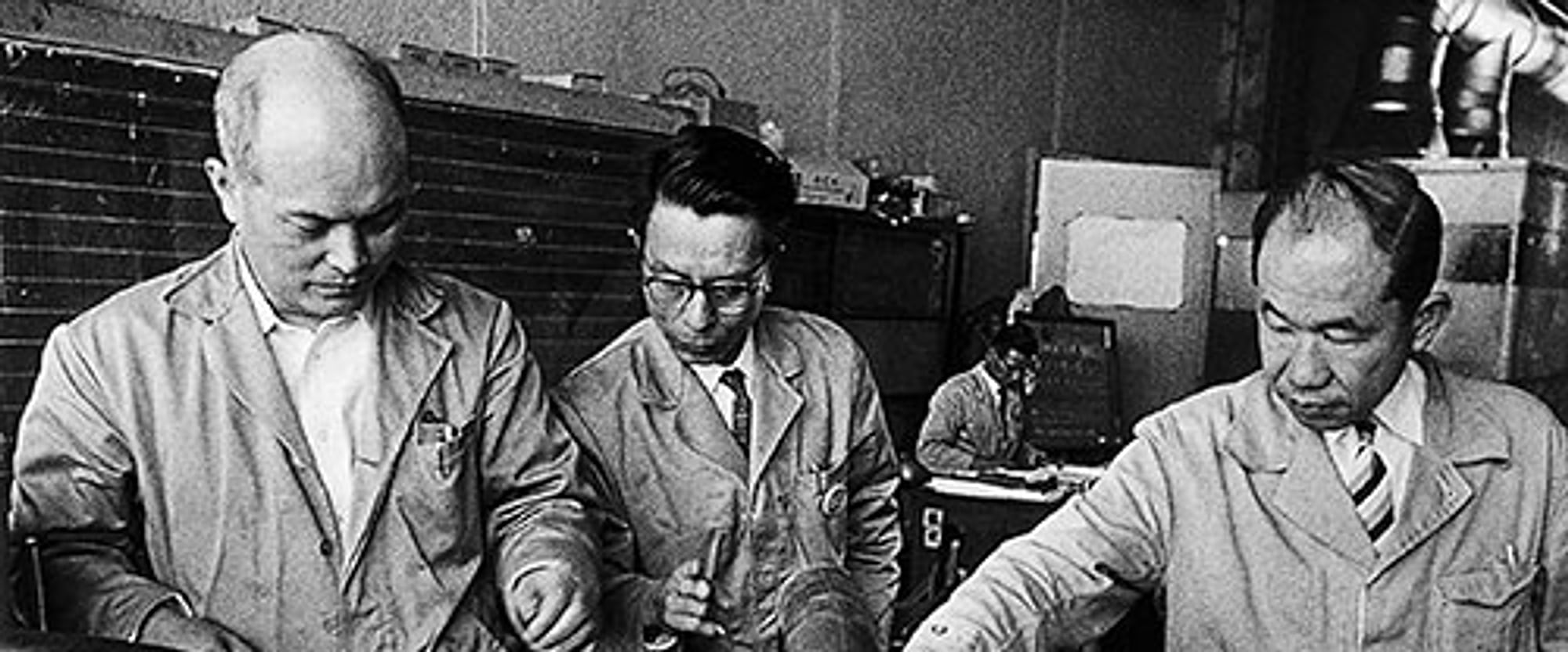
Who Was Kenya Nakamura?
Kenya Nakamura (中村健也, 1913–1998) was Toyota's first chief engineer — the first shusa — and the person who proved that a single leader, holding total responsibility for a vehicle but almost no formal authority over the people building it, could pull an entire car together. He did it on the original Toyopet Crown, Japan's first genuinely domestic passenger car, and the working method he improvised there became Toyota's signature approach to product development.
Decades later, Shoichiro Toyoda described Nakamura's contribution plainly: it was Nakamura who put the soul into the chief engineer system. The way he worked "became the skeleton," Toyoda said, and "successive chief engineers inherited it; what Nakamura did became the framework, and that became Toyota's distinguishing characteristic and its asset." The system that later researchers would study and rename — "heavyweight product manager," "the CEO of the car" — started as one stubborn engineer refusing to let a car be designed by committee.
What is striking about Nakamura is that he did not reach product development by the obvious route. A trained engineer, he had wanted to work on vehicle design — but Toyota, short of engineers in production, assigned him instead to production engineering: bodies, presses, and tooling. He proved himself there so decisively that he earned his way across into vehicle development. His authority was won in steel before it was ever granted on paper.
How Did Nakamura Build Toyota's 2,000-Ton Press?
Nakamura joined Toyota in 1939 and was assigned to body production and tooling at the Koromo plant. His defining early assignment came in 1941: design and build, in-house, a 2,000-ton stamping press.
This was not a routine engineering task in 1940s Japan. Large body panels — roofs, hoods, fenders — require enormous force to form from a single sheet of steel. Without a large press, panels had to be stamped in pieces and welded (heavy, prone to rust, crude) or beaten out by hand (slow and inconsistent). A press of this scale was the kind of equipment a country imported, if it could get one at all. Toyota could not.
Working with Sumitomo Machinery on the drive mechanism and basing the design on a press owned by another firm, Nakamura led the effort through the war and the chaotic years after it. Preliminary drawings were finished in 1944; the work was interrupted, resumed in 1946, and the completed press — a 2,000-ton machine weighing 216 tons in all — finally went into operation in 1951, a full decade of effort. It ran for more than seventy years.
The press mattered for what came next in a specific way. In a manufacturing culture, the engineer who builds the tools commands the respect of the people who use them. When Nakamura later argued with body, chassis, and engine specialists about what a car should be, he was not speaking as a stylist with opinions. He was speaking as the man who understood, in his hands, what the steel and the machines could actually do. That "product and process together" instinct — design judged against what can really be made — was the seed of how he ran a vehicle program.
How Did Nakamura Come to Lead the First Crown?
In January 1952, with Toyota committing to build a true passenger car on its own rather than licensing a foreign design, Eiji Toyoda put Nakamura in charge of the development that became the Crown. The logic was direct: a man who could build a 2,000-ton press from nothing could lead a car program.
Nakamura's approach was unusual for Toyota at the time. He began not with drawings but with the market — surveying taxi operators and dealers to fix clear objectives: a car roomy inside a compact footprint, economical enough for taxi duty, durable on Japan's rough roads, and comfortable. His targets were concrete (roughly 1,200 kg, a 1,500 cc class engine, 100 km/h), and his concept was characteristically vivid: a bride in full bridal dress, he insisted, should be able to get in and out comfortably.
The first Crown launched in January 1955 as the Toyopet Crown RS, with distinctive center-opening doors (観音開き, kannon-biraki) — conventional front doors paired with rear-hinged rear "suicide" doors that made it easy to get in and out — and an independent front suspension that was bold for the road conditions of the day. The doors were a signature of this first generation alone; the car became known as the "kannon-biraki Crown," and the easy entry made it a favorite with taxi operators. It was Japan's first passenger car designed and built domestically from the ground up, and it established Toyota as a credible maker of passenger vehicles. A national pride attached to it: newspapers ran long-distance endurance reports, the car was entered in overseas rallies, and the Crown came to be seen as a small symbol of a country slowly becoming prosperous again.
How Did Nakamura Lead With No Authority?
When Nakamura took the Crown, the role of shusa did not yet exist as a defined position; it was an assignment. The institution then formed around what he did. On May 1, 1953, Toyota reorganized its engineering department and established a chief engineer's office (主査室), with Nakamura as its first shusa, charged with driving a program comprehensively — in the company's own words, "from engine and vehicle design through to production preparation." What he made of that mandate became the model.
The defining feature — present from the very first day — was a deliberate imbalance. The chief engineer carried total accountability for the vehicle concept, its performance, and its commercial success, but he had no line authority over the engineers doing the work. They reported to their functional bosses in the body, engine, and chassis departments. Nakamura could not order a suspension redesigned; he could only get it redesigned.
He did it two ways. The first was the drawing. As Akihiro Wada — himself later a chief engineer and executive vice president — explained, to make anything you need a drawing, and the last person to sign every drawing was the shusa. On paper the shusa was staff; in practice, if the shusa would not sign, the drawing did not live. Nakamura himself drew a sharp distinction here, telling colleagues there was a difference between "a signature that approves" and "a signature that says I have seen it."
The second way was relentless personal engagement. Nakamura went to people. He walked between the design rooms and the prototype shops, sought out the young engineers in particular, laid out what he wanted, pressed, argued, and refused to settle conflicts by averaging opinions. One Japanese account of the Crown development calls what he did "the organization of intellectual combat" (知的コンバットの組織化): not an organization that moves people by title, function, or power, but one that goes to the other person, takes a genuine interest in what they care about, and through thorough dialogue gets them to apply their own ability of their own will. The same account records Nakamura's own rule of thumb: a shusa has no direct subordinates but an assistant, so he must be persuasive enough that the people around him think, for that person, I will do whatever it takes — and if you can produce that feeling, you have already succeeded as a shusa about ninety percent.
This is the paradox that every later description of the Toyota chief engineer circles around, and Nakamura lived it first: responsibility without authority, leadership by credibility and persuasion rather than command.
Why Did the First Crown Fail in America?
Nakamura's tenure also contained an instructive defeat. In 1957 Toyota tried to export the Crown to the United States. It went badly. The car had been engineered for the low speeds and rough roads of 1950s Japan; subjected to sustained American highway speeds, it overheated and vibrated, and Toyota withdrew it.
The failure is worth dwelling on because of what it revealed. Force of will and production mastery were enough to build a car that worked superbly in the conditions Nakamura knew. They were not enough to anticipate the demands of an unfamiliar market before the first line was drawn. Building the right car for an unknown world required something Nakamura's intuitive, combative style did not by itself supply: systematic forward planning — translating market conditions into engineering targets in advance, and budgeting cost and weight with discipline. That capability would be the contribution of the man who had served as Nakamura's assistant on the Crown, Tatsuo Hasegawa. The two of them, together, are the reason the shusa system became both powerful and repeatable.
What Did Nakamura Build After the Crown?
Nakamura did not stop at one car. After the first Crown he led, in succession, the second-generation Corona, the second-generation Crown, the Crown Eight, and the first-generation Century — guiding Toyota's expansion across the passenger-car range.
The choices show a consistent mind. Stung by the US export experience, he aimed the second Crown at "a car that works in the world," targeting sustained high-speed cruising and quietness. For the first Century — Toyota's flagship — he deliberately rejected fashion, designing it to need no model change for at least ten years; it stayed in production, essentially timeless, for thirty. Along the way he pushed advanced hardware: an aluminum V8, a three-speed automatic, and Japan's first air-suspension independent setup on a domestic passenger car. (He also installed a radio as standard on the Crown for the first time — and, characteristically, designed the speakers himself.)
How Did Nakamura Anticipate the Hybrid?
In 1968, after a career of leading conventional vehicles, Nakamura turned to gas-turbine research — though he framed it, tellingly, not as "gas turbines" but as "the new-engine and energy problem," thinking about solar, hydrogen, and alternative energy media decades before the industry did. The work evolved into a single-shaft gas-turbine-and-battery hybrid, tested in a Sports 800 and shown as a Century gas-turbine hybrid at the 1975 Tokyo Motor Show.
Toyota's own 75-year history places this work in the lineage that eventually led to the Prius. Nakamura retired in 1980 and kept at it privately — programming thermodynamic models on home computers into his eighties, maintaining a personal library of some ten thousand volumes. In October 1997 the first Prius went on sale; Nakamura, then eighty-four, lived to see the hybrid idea he had chased three decades earlier become a production reality. He died the following year.
What Kind of Engineer Was Nakamura?
Nakamura's philosophy was of a piece with how he worked. The Japan Automotive Hall of Fame's biography records sayings of his that capture it:
- "To sell something to people with conviction means making something you yourself truly believe is good — something with the real customer's heart in it. Only when people drive a car you have put your own conviction into will they say, 'This is interesting. I want to drive it.' Putting a car like that before the world is the role of the shusa."
- "There is no development that is one hundred percent certain. If the probability is fifty percent you must not abandon it. Even at thirty percent, if there is a possibility, you should take it on."
- And his standing rule for himself: do what you believe is right, even against the opposition of everyone around you.
He was, by the accounts of those who worked with him, demanding and often abrasive — Toyota's product-development counterpart to Taiichi Ohno on the manufacturing side. He once accused a board member of "having no dreams" for the company and was briefly demoted for it. He said openly that he could never have succeeded without Eiji Toyoda's full backing. The combination — conviction, abrasiveness, total ownership, and a leader above him willing to protect him — is exactly what the role required and what no org chart could specify.
What Is Nakamura's Legacy?
Nakamura's most durable creation is not any single car, remarkable as the Crown and Century were. It is the chief engineer system itself — a single concept-holder responsible for the whole vehicle, coordinating roughly ten functional departments without authority over any of them, winning by credibility and persuasion. He proved it could be done. His successor Hasegawa would prove it could be made repeatable and handed down.
That division of labor between the two founders is the real story of how Toyota's product development came to work, and it is why Nakamura is remembered the way Shoichiro Toyoda remembered him: as the man who put the soul into the system. The framework he improvised on the Crown is still, in its essentials, how Toyota builds cars — and, by way of the researchers who studied it, part of how the wider world came to think about leading the development of a complex product.
Methods & Materials
This article draws primarily on Japanese-language sources: the Japan Automotive Hall of Fame biography of Kenya Nakamura, Toyota's own 75-year corporate history, the Akihiro Wada Oral History, and contemporary accounts of the first Crown's development, supplemented by the author's research database of Toyota materials. Where sources differ on dates — for example, the precise sequence by which Nakamura became Toyota's first chief engineer — the most authoritative Toyota or Hall of Fame record was followed, and timelines were cross-checked for consistency. Quotations translated from the Japanese are the author's renderings; a few widely repeated sayings attributed to Nakamura survive mainly through his Hall of Fame biography and similar secondary accounts, and are presented as such. Interpretations and any remaining errors are the author's responsibility.
Companion piece: Tatsuo Hasegawa — the architect who turned Nakamura's method into a system. For the role itself, see the encyclopedia entry on the Chief Engineer (shusa).