The A3 Book That Was Too Small for an A3
A short reflection on the publishing compromise behind Understanding A3 Thinking, restoring a full-size A3 example online, and why AI-assisted problem solving may help make A3 logic more visible.
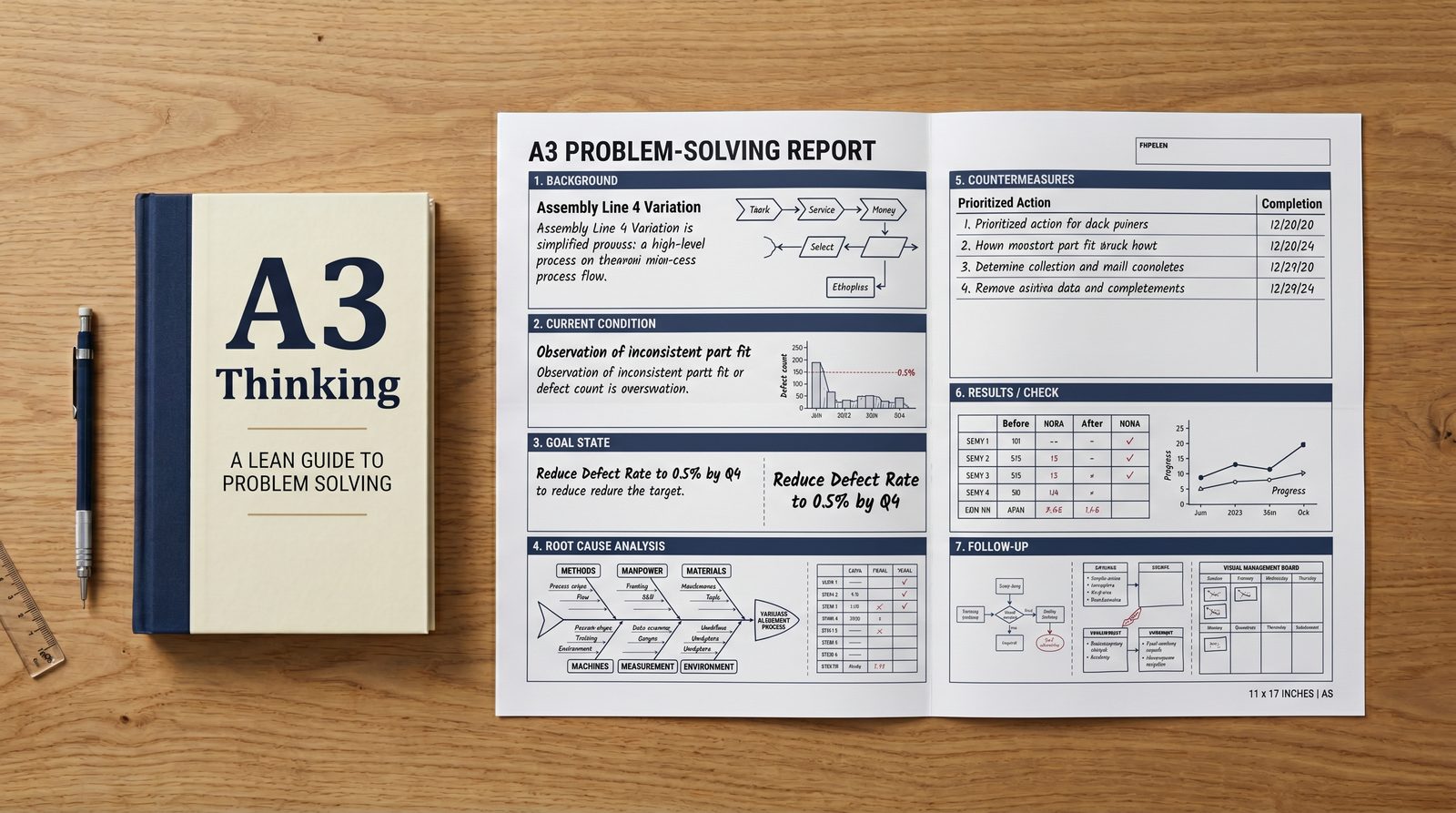
When Professor Durward Sobek and I wrote Understanding A3 Thinking nearly twenty years ago, Productivity Press had a practical publishing idea: make it a small, portable book. Something easy to hold, easy to carry, and easy to read on the go.
The idea was reasonable.
There was only one small problem.
It was a book about A3 thinking.
An A3, of course, is not six inches by nine inches. It is roughly 11 by 17 inches. The physical size matters because the format invites a certain kind of thinking: concise, visual, structured, and connected. The story, analysis, countermeasures, and follow-up all need to fit together on one page in a way that helps the reader see the logic.
As we got closer to finalizing the book, the consequences of the smaller format became clear. The words had to become smaller and denser. The example A3s had to be reduced. Graphics had to be compressed. In one section, I had to sacrifice a fuller multi-level fishbone cause-and-effect diagram for the machine shop scrap problem. The simplified graphic still got the basic point across, but I always regretted that compromise.
The irony was not lost on me. We had written a book about A3 thinking that could not easily show an A3 at A3 size.
The thinking itself, however, has held up. The core pattern has not changed: clarify the problem, grasp the current situation, set a goal, analyze causes, develop countermeasures, check results, standardize, and reflect. Good A3 thinking is still disciplined thinking. It is still about learning, alignment, and better problem solving — not merely filling out a form.
What has changed is the technology around it.
Today, with online publishing, larger screens, searchable repositories, and AI-assisted tools, we can represent A3 thinking in ways that were difficult twenty years ago. We can post full-size examples online. We can store and retrieve problem-solving cases. We can compare patterns across many A3s. We can coach people through the thinking process with better prompts, examples, and feedback.
To ease my old regret, I recently created an AI-assisted version of the machine shop scrap A3 problem and posted it online: Reducing Scrap in the Machine Shop — A3 Practical Problem Solving Report. The goal was not to change the thinking. The goal was to show the thinking more clearly than the book format allowed at the time.
I have also been working with several AI-assisted problem-solving applications over the past year. Honestly, I have been surprised by the quality of feedback these tools can provide when they are grounded in sound problem-solving logic and good examples. They are not a replacement for human judgment, coaching, or going to see the actual situation. But they can help people ask better questions, see gaps in their logic, and improve the structure of their thinking.
That trend will continue.
A3 size is not cosmetic. The larger format helps the reader see the logic whole. Background, current condition, goal, cause analysis, countermeasures, results, and follow-up are not separate essays. They are connected parts of one thinking process.
A good A3 example also needs room for evidence, causality, and countermeasure logic. If the page becomes too compressed, the thinking can look simpler than it really is. That was my regret with the original machine shop scrap example. The reduced fishbone showed the general idea, but it did not show enough of the layered cause-and-effect reasoning behind the conclusion.
AI assistance can help here, but only if used in the right way. It should not write around weak thinking or decorate a poor analysis. Its better use is to help expose gaps, organize information, retrieve examples, and make the logic more visible for review and coaching.
So if there is ever a second edition of Understanding A3 Thinking, I will insist on one non-negotiable design requirement:
It must open up to 11 by 17 inches.
Some books need room to breathe. A book about A3 thinking certainly does.
A3 thinking was never about paper size alone. The paper size helped create discipline. It forced clarity. It made the logic visible. But the deeper point was always the thinking pattern.
If AI can help more people practice that thinking pattern with better examples, better retrieval, and better coaching, then I see that as a positive development.
Maybe the formula for the future is simple:
AI + humans > problems.
And perhaps, after all these years, the machine shop scrap A3 finally has room to breathe.