The Algorithm: Elon Musk and Lean Thinking
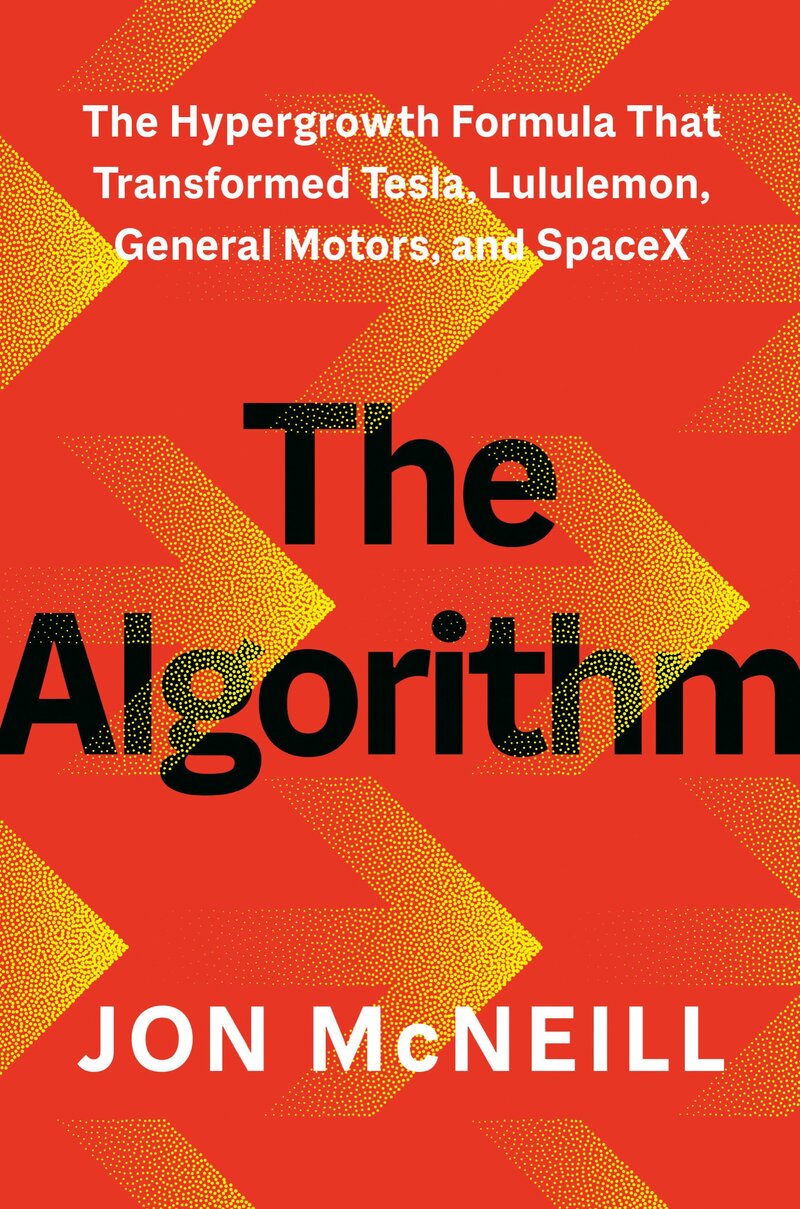
Jon McNeill served as Tesla’s president of global sales and service from 2015 to 2018, through the launch of the Model X and Model 3 and the negotiation of Gigafactory Shanghai. His book The Algorithm was published in 2025. It describes the five-step improvement method he observed Elon Musk apply inside Tesla and SpaceX. Walter Isaacson summarized the same method in his Musk biography, and by McNeill’s account it was Isaacson who suggested the method deserved a book of its own.
The book is an engaging read. It provides a look into parts of the Elon Musk thought process and his first principles approach to problems. At approximately 130 pages of actual content, I thought the book did a nice job of distilling basic elements of Musk’s thinking into a simple pattern that others can appreciate. I found that the book unfortunately did not have as much to say about how Musk appears to think when confronted with harder engineering problems. It also did not delve into the roots of where some of this thinking came from. Much of the Algorithm predates Elon Musk and stems from Industrial Engineering and other disciplines. In this article I will explain what I appreciated in the book and where I wish it had shed more light.
First of all for curious readers, here is “The Algorithm,” which the book explains in five steps, each with its own section and examples. Much of it will seem familiar to those with backgrounds in Lean Thinking or Toyota’s continuous improvement practices.
- Question every requirement. Organizations accumulate rules until nobody remembers which ones are real. Many turn out on inspection to be conventions, supplier preferences, or someone’s old judgment call. Only the laws of physics are treated as fixed.
- Delete every possible step in a process. Cut aggressively, on purpose slightly too far. If roughly a tenth of the deleted steps do not have to be reinstated, the cutting did not reach the true limit.
- Simplify and optimize. Applied to whatever survives the first two steps, and only then.
- Accelerate cycle time. Speed is treated as the payoff of the first three steps and as a diagnostic. Running a process faster exposes quality and process problems that a slow pace conceals.
- Automate last. Mechanize a process only after it has been questioned, pruned, simplified, and accelerated. Tesla learned this one publicly and expensively when the heavily automated Model 3 line failed and production was recovered by pulling work back to people.
I think the book is an interesting look at a challenging period for a manufacturing company. First, it is a rare inside codification of how a hyper-growth company actually thought about improvement. It was written by an operator who applied the method, not a journalist who observed it. Second, the account is honest in nature. The failures are told as failures, including the automation collapse that nearly sank the company. McNeill himself applied the steps mainly to commercial processes such as online sales, delivery operations, service, and training. Those chapters carry the specific numbers and the texture of someone who did the work.
The vantage point McNeill had stems from his days of running the commercial side of Tesla. However he did not run product development or engineering in the organization. Those functions reported directly to Elon Musk at Tesla. The book consequently supplies a view of the Algorithm mainly from the sales and distribution point of view.
The author’s actual title at Tesla deserves precision, because the book does not supply it. McNeill describes himself as president of Tesla, and the book’s promotion does the same. The actual title, per Tesla’s own announcement in November 2015, was president of global sales and service. To the best of my knowledge Tesla in that period had no chief operating officer and no company-wide president. Product development, engineering, and manufacturing reported directly to Musk. When McNeill departed in early 2018, Musk absorbed his responsibilities personally. So the presidency was real, but it was a presidency of the commercial half of the company. The book strikes me as the view of the Algorithm mainly drawn from that half.
The Technical Elements
The first place I thought the book could be stronger concerns Musk himself, or rather the technical half of him. The Musk of this book questions rules, sets extreme targets, and pushes speed. And I have no doubt that is all a highly correct account. However the Musk who reasons from physics on more technical matters, such as the Raptor rocket engine, barely appears.
By most serious accounts, including Isaacson’s, first-principles thinking is the core of how Musk works. Reason down to the physical facts of a problem: the material properties, the energy required, the cost of the actual raw inputs. Then rebuild the solution up from there rather than from how the industry has always done it. Questioning a requirement, in that mode, is not merely a management posture. It is an engineering calculation. If a part costs far more than the metal in it, the price is often convention rather than actual physics. The requirement can be attacked. Musk’s influence on Tesla product designs, full self-driving experiments, or the redesign of rockets at SpaceX and their engines for re-usability would have provided far more interesting examples from a technical point of view. At the least they would have given a more balanced perspective on the improvement mindset of Musk. I suspect the author in his position did not have as much exposure to this side of the business.
Musk explained that reasoning himself in September 2012, thirteen years before the book appeared, in an interview with Kevin Rose. The relevant two-minute excerpt is short enough to watch in full for those interested. Asked for an example of his first principles thought process, he takes battery packs. The industry position at the time was that packs cost about six hundred dollars per kilowatt-hour, that they always had, and that they were not going to get much better. Musk does not argue with the position. He instead decomposes the battery pack into its primary elements. Cobalt, nickel, aluminum, carbon, polymers for the separator, a steel can. He then prices those constituents at spot value on the London Metal Exchange. The answer comes to roughly eighty dollars per kilowatt-hour. Material is not what makes a battery expensive. The remaining cost sits in how the materials are combined, processed, and managed, which makes it more of an organizational problem than a physical limit.
That distinction is the whole of it. Separate the material cost from the conversion cost, and the conversion cost becomes the target. Value analysis has worked this way since Lawrence Miles developed it at General Electric in the late 1940s. Cost the function and the material, not the quoted price of the part. Toyota’s cost planning practice rests on the same separation. A price that cannot be explained by its physical content is a price built out of process, convention, and accumulated overhead, and all three of those can be attacked. Musk arrives at the identical conclusion apparently from physics rather than from the improvement literature.
That technical reasoning, however, is what gives step one of “The Algorithm” its teeth. Without it, “question every requirement” is merely an attitude. With it, the questioner knows which requirements are physics and which are habit. The questioner can hold that line when an engineer insists something cannot be done. The book shows exactly one glimpse of this Musk, pressing a lead engineer on the loads in a seat cross-member. Then it moves on in a paragraph. First principles reasoning in the physics sense never fully appears as a method. I think it warranted a fuller treatment.
My interpretation is that the omission is structural rather than intentional. The engineering application of the Algorithm happened in design reviews and production engineering rooms that a president of sales and service had no reason to sit in. McNeill documents the half of the method he lived. But the result understates what made the method work. The five steps operated inside a company whose chief executive could argue design constraints and material costs with the responsible engineer. A checklist extracted from that environment and handed to a leadership team without the technical depth behind it is a different and much weaker thing.
The Missing Frameworks
The second striking omission in the book is more historical in nature. The thinking patterns in the five steps have been in the improvement literature for decades, and the book gives no sign of knowing it.
The core sequence is old. Question the work, eliminate what is unnecessary, combine elements, rearrange work, simplify what remains. It appears throughout the methods engineering and work simplification textbooks of the early and mid twentieth century, compressed into the shorthand ECRS, for eliminate, combine, rearrange, and simplify. In the 1940s the Training Within Industry program packaged the same pattern for wartime supervisors as its Job Methods course. The card tells the supervisor to break down the job, question every detail, and improve it by those four moves. Generations of engineers learned all of this before anyone at Tesla was born.
The later steps have equally long roots in Toyota Motor Corporation’s improvement practices known as kaizen, which build further upon these methods. Compressing lead-time and surfacing hidden problems (waste) is the flow logic of the Toyota Production System. The book itself notes, accurately, that Toyota could turn raw material into a finished car in about five days while Tesla took nearly three times as long. And automating last is not really a Musk discovery. Toyota spent decades building automation on top of stabilized, simplified manual work, and treated premature mechanization as a way to cast waste in steel. The Model 3 early automation failure in the book reads to a Lean Thinking audience as an expensive confirmation of long settled doctrine.
The book misses these connections because the author’s improvement education, as he explains it, ran through a single channel. McNeill describes his formative improvement experience as reading Eliyahu Goldratt’s fictional novel The Goal. The author encountered the book during a meatpacking consulting engagement early in his career with Bain & Company. Bottleneck hunting is the one lens the book applies everywhere, including to episodes that have nothing to do with constraints. Kaizen in contrast receives a single sentence. It characterizes kaizen as working on principles similar to Goldratt’s, a description no one familiar with both would write. This is not unusual. It is close to the normal case for how improvement knowledge reaches senior executives: one popular book, absorbed early, standing in for the entire literature.
The missing parallels do not diminish the Algorithm. The pattern is more common than one might think. A first-principles engineer, distrustful of inherited practice, interrogated production work from scratch. Eighty years after the textbooks, he arrived at roughly the same sequence they taught. That is evidence the old sequence was right. Similar organizations under similar pressures converge on similar thought patterns. The history of production methods is full of such convergence. The book documents an instance of it without realizing that is what it is doing and what it is omitting.
An Honest Omission
To be perfectly clear, none of this appears to be intentional neglect or omission by the author. Most likely the author did not know it, and nothing in the book suggests he thought to put the question to Musk himself. Where the five steps came from is simply never asked. Musk may have reinvented the pattern from physics. He may have absorbed pieces of it from an industry saturated with Toyota-derived vocabulary. It may be some mixture of the two. It is worth remembering that Tesla built cars in the former NUMMI plant in Fremont, the GM-Toyota joint venture factory that Tesla purchased from Toyota in 2010. The proximity was real even if the transmission is unproven.
Musk himself may be no better informed on this point than his former sales and service president. A person can rediscover an old solution in full sincerity, and the rediscovery is no less real for having predecessors. I think the book would have been stronger if it had included more technical dimensions and probed more deeply into the roots of the thinking on several matters. As it stands, the book still provides excellent insight into the thought process of Elon Musk in general and how certain events played out in the development of Tesla.