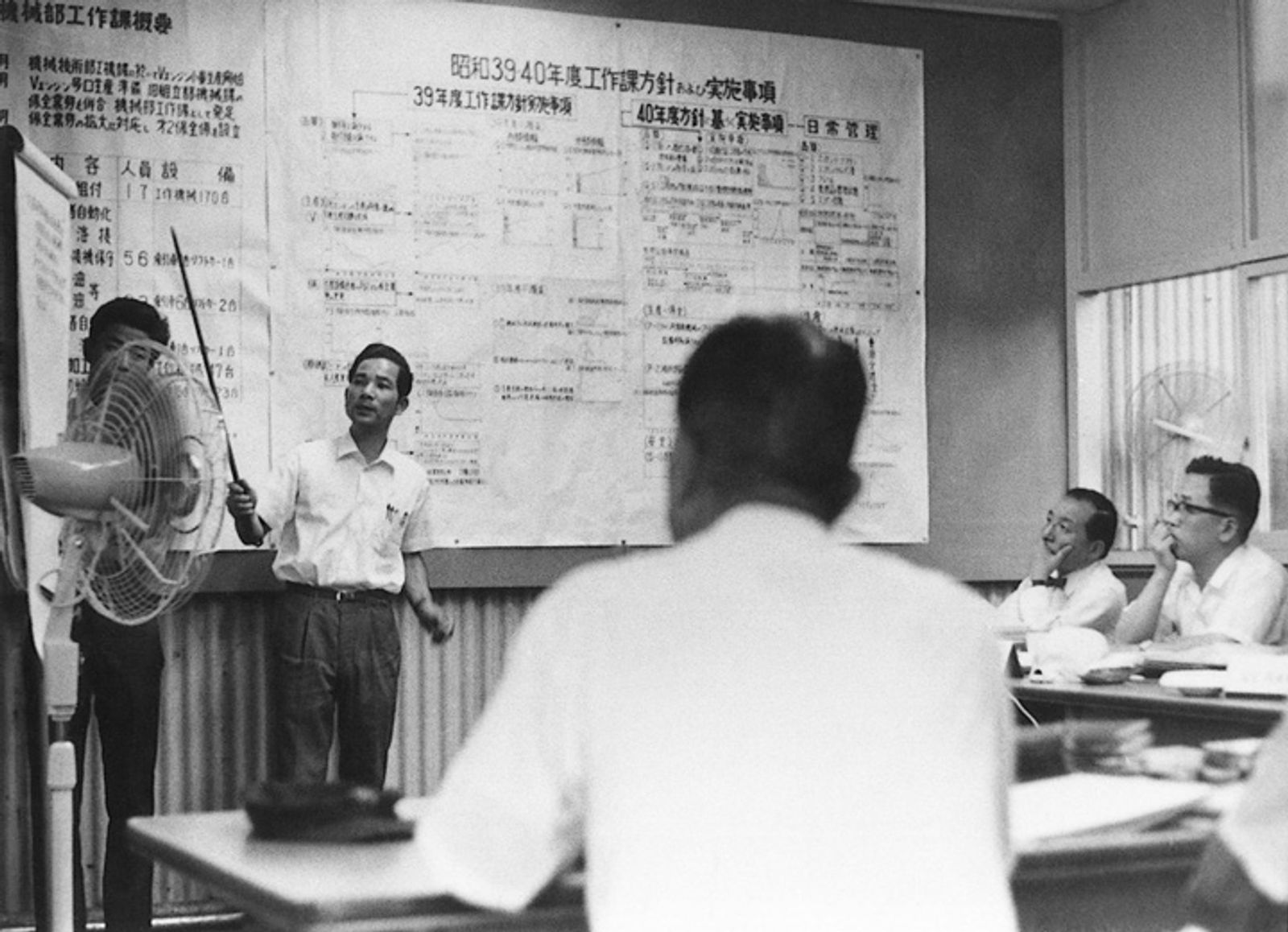
More Than One Origin Story
The Plan-Do-Check-Act cycle (PDCA) is one of the most widely used terms in lean thinking and quality management. Almost everyone can recite the four steps. And most people will tell you that W. Edwards Deming taught PDCA to the Japanese after World War II.
Except he didn't. Not exactly. Instead, Deming taught the Shewhart Cycle, a four-stage wheel focused on product quality: design, make, sell, research. The term "PDCA" as we know it was developed inside Japan over the following two decades by Japanese engineers and management thinkers, most notably Shigeru Mizuno and Kaoru Ishikawa, who reconstructed Deming's ideas alongside other influences into something broader and more practical. When Deming encountered the result in the 1980s, he did not recognize it as his own work. According to quality historian Ron Moen, Deming initially reacted harshly, calling PDCA a corruption of the original concept. Once he realized how deeply it had spread through Japanese industry, he grudgingly accepted the situation but insisted on a revision: Plan-Do-Study-Act. Most of the world kept using PDCA anyway.
That gap, between what Deming taught and what Japan built, is just the tip of the story most English-speaking practitioners have not heard. I recently came across a 2016 article in Japanese by Junya Onishi and Wataru Fukumoto of Japan's Policy Research Institute that organized this history more clearly than anything I had seen previously published. That paper is aimed at a policy audience, but the chronology resonated with what I had encountered during my years working in Japan and personal study. The first half of the document traced the roots of the PDCA improvement concept from the Japanese practitioner perspective. The second half delved into financial scorecards. What follows is my attempt to make the initial half of the 30-page document accessible to an English-speaking audience.
Of course, as many people have noted in the past, we can take the PDCA concept all the way back to the beginnings of the scientific method. For practical management purposes in industry, however, I am only going to focus on the last century. Even focusing on this more limited period, the full development of the PDCA concept has more contributors than most people realize. The first half of the story takes place in the United States, a series of ideas about scientific management, cyclical thinking, and statistical quality that developed over fifty years. The second half takes place in Japan, largely out of sight to the English-speaking world, where those American inputs were reconstructed into the framework we all use today. I think it is important to understand the Japanese point of view on this topic they helped make familiar worldwide.
Frederick Taylor and the Separation of Planning from Doing
The research paper's account of PDCA's origins starts with Frederick Winslow Taylor, which immediately creates a positioning problem for some people. Taylor was of course trying to bring scientific thinking into management in the United States. Taylor is often known for his controversial separation of planning from execution. This separation drew criticism both in his own time and remains controversial to this day. Regardless of that reality his concepts were influential and matter to this day. Japanese management scholars and engineers post WWII studying Taylor's work called it the basis for Plan-Do-See style of management.
Before Taylor was a management theorist, he was an empirical scientist. He spent years conducting rigorous experiments on metal cutting, feeds, speeds, tool angles, materials, and heat treatment. His work on high-speed steel cutting tools alone was a genuine breakthrough, replacing craft-based rules of thumb with systematically verified knowledge. This was scientific management in the most literal sense. It launched the discipline of tooling engineering, which continues to this day. When Taylor applied the scientific method to materials and machines, the results were lasting and largely uncontroversial.
The criticisms later came when he applied the same mechanistic logic to people. His time studies, task prescriptions, and rigid separation of thinking from doing treated human labor with the same engineering mindset he brought to cutting tools. People are not machines, and the resistance and criticism that followed were legitimate. This is the form of Taylorism that most people know, and it reflects the complicated part of his legacy.
But for the PDCA lineage, his contribution is specific and separate from that controversy. In his 1903 Shop Management, he established that planning was a distinct function separable from execution, and that results should be inspected against standards.
Ironically, the very thing he is most criticized for, separating planning from doing, is exactly what set the stage for what came later. His framework involved three distinct activities: planning the work, executing the task, and inspecting the result. Before Taylor and other industrial engineers, thinking and doing were fused in the craftsman's judgment. After Taylor, the concepts would be separated and eventually be arranged into a repeating sequence.
To be clear, Taylor did not describe his work as a cycle, nor did he use the language of continuous improvement. No one in the West gave his three-part logic a compact label. But Japanese management thinkers after World War II did, they called it Plan-Do-See. That term was never used by Taylor and almost never appears in Western management literature except when referencing Japanese material. How and when it entered Japanese usage is a question we will return to. For now, the important point is that Taylor provided the raw ingredients. Others would arrange them more effectively.
The Circular Turn: From Taylor's Line to the Management Cycle
Taylor separated planning from doing, but his framework was still linear. Management plans the work, workers execute the task and then inspect the result. Another critical step came from American management thinkers who recognized that these functions should not end but repeat.
Alvin Brown, in his 1947 Organization of Industry, argued that management activities should be understood as a circular rotation rather than a straight line. He linked planning, execution, and checking in a continuous loop. Two years later, R. T. Livingston described what he called the "Cycle of Enterprise" in The Engineering of Organization and Management (1949), a five-stage loop of deciding, planning, preparing, operating, and reviewing. The essential insight was the same in both cases: management is not a sequence you complete one time. It is an ongoing set of functions you keep performing.
Brown and Livingston were not working in isolation. They belonged to what became known as the management process school, an intellectual tradition tracing back to Henri Fayol, the French industrialist who in 1916 identified the core functions of management as planning, organizing, commanding, coordinating, and controlling. By the 1950s, this school was flourishing. William Newman's 1951 Administrative Action included a circular diagram of management functions, planning, organizing, assembling resources, supervision, and controlling, arranged as a continuous cycle. Newman's textbook was later translated into Japanese, and American management thinking also reached post-war Japan through training programs such as the Civil Communications Section (CCS) management courses run during the occupation of Japan from 1945 to 1952.
 Newman's circular diagram of management functions from Administrative Action (1951)
None of these management thinkers connected their work to quality control or statistical methods. Their contribution was about how organizations govern themselves, the cycle of planning, acting, and reviewing as an ongoing discipline. But their ideas entered the same Japanese intellectual environment before and after World War II that was simultaneously receiving the related but different contributions of Walter Shewhart and W. Edwards Deming. That convergence would matter enormously.
Shewhart and the Scientific Method Applied to Quality
While Brown and Livingston were making management cycles explicit, an entirely separate and earlier line of work decades before was already underway in statistical quality control. It would contribute something the management thinkers never provided, a scientific basis for determining whether a process was working or not. It involved the concept of statistical control.
Walter Shewhart was a physicist, not a management theorist. He came to quality from the world of data, measurement, and statistical reasoning. Working at Western Electric's Hawthorne Works, he faced a practical problem: how to improve the reliability of telephone equipment without simply inspecting every finished piece and discarding the bad ones.
In 1924, Shewhart created the control chart. This was another decisive move away from the rule of thumb, different from Taylor's but equally consequential. Where Taylor replaced craft judgment with systematic planning, Shewhart replaced subjective quality inspection with statistical measurement. The control chart allowed one to monitor a process while it was running, distinguish between normal variation and signals of real trouble, and act before defects accumulated. Quality was no longer a sorting exercise performed after the fact. It became an ongoing discipline built into the process itself, grounded in data rather than opinion.
This feat alone would earn Shewhart a place in the story. But his 1939 book, Statistical Method from the Viewpoint of Quality Control, added something more. In it, he described a three-stage model for manufacturing: specification, production, and inspection. Shewhart made the explicit point that viewing these as a linear sequence was the old way of thinking. His insight was that the three stages mapped directly onto the scientific method, specification was hypothesis, production was experiment, and inspection was the testing of the hypothesis. Arranged as a circle rather than a line, the sequence became a learning loop. Each pass generated knowledge that improved the next cycle.
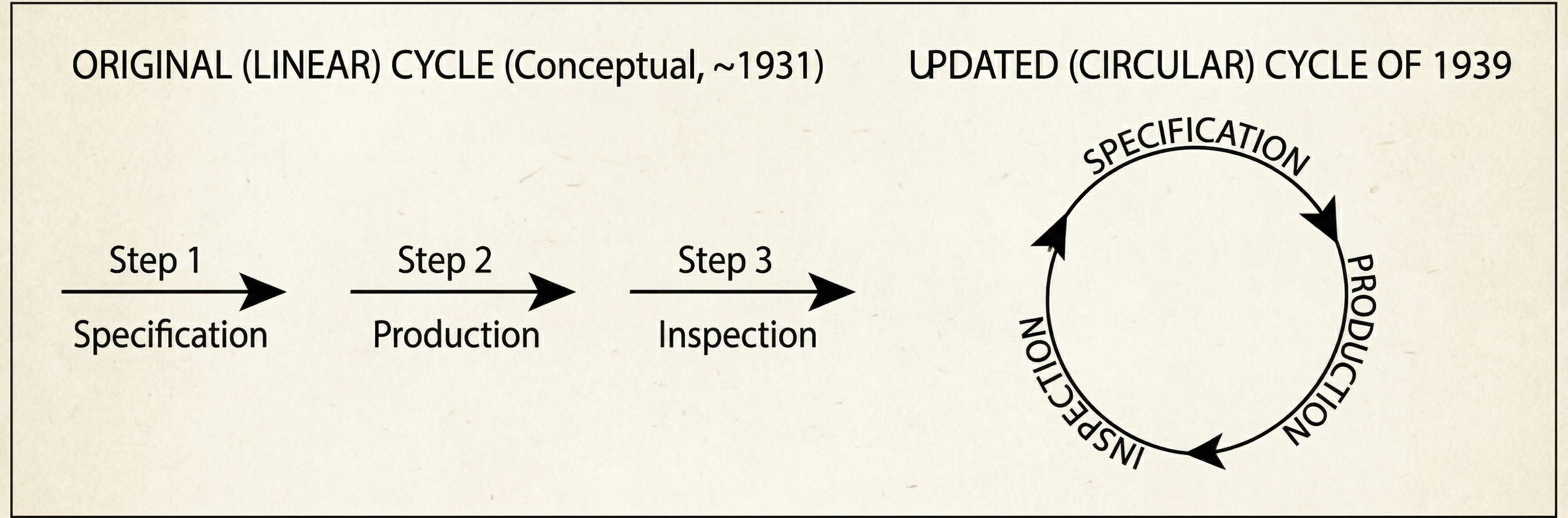 Shewhart's three-stage cycle: specification, production, and inspection arranged as a scientific learning loop
This was a fundamentally different contribution from anything on the management side. Brown and Livingston made organizational management functions circular. Shewhart further made the cycle scientific, grounded in statistical evidence and the logic of hypothesis and verification. While management thinkers gave rise to the early roots of what later became PDCA in the form of its repeating shape Shewhart gave it its intellectual and statistical engine.
Shewhart's ideas regarding quality improvement were rigorous but also difficult. His writing was dense and his statistical methods demanding, they did not spread easily. Even within his own organization control charts were not widely adopted and met resistance. But he had a close collaborator in W. Edwards Deming, nine years his junior, who had first encountered Shewhart's work in 1927 and would maintain the relationship for four decades. Deming edited Shewhart's 1939 book and by most accounts could explain Shewhart's ideas more clearly than Shewhart himself. When Deming traveled to Japan in 1950 at the invitation of the Union of Japanese Scientists and Engineers (JUSE), he carried Shewhart's thinking with him and always insisted the cycle he taught be called the Shewhart Cycle. The Japanese to his chagrin called it the Deming Wheel or Deming Cycle.
The Shewhart Cycle and Deming Wheel in Japan
Before Deming ever lectured on quality in Japan, the groundwork was already being laid by other key contributors. Homer Sarasohn and Charles Protzman, working under the Civil Communications Section of the American occupation, had been running management seminars for Japanese executives since 1949. Their courses covered industrial management fundamentals, systems thinking, quality as a management responsibility, and the integration of customer satisfaction into product development. Early graduates included the founders of Sony and what later became Toshiba Corporation. When Sarasohn and Protzman prepared to leave Japan in 1950, they wanted someone to continue the quality campaign. Their first choice was Shewhart himself, but he was in poor health. Sarasohn recommended Deming instead.
Deming was not a stranger to Japan. He had earlier visited in 1946 and 1947 to assist with census work under General MacArthur's occupation government, work that had nothing to do with quality. But through those visits he had built relationships, and when the Union of Japanese Scientists and Engineers invited him to lecture in 1950, he came prepared to teach what he knew best: Shewhart's ideas about statistical quality control.
What Deming presented in those 1950 lectures was not the term PDCA. It was what he called the Shewhart Cycle, a four-stage wheel for product quality: design, manufacture, sell, and research. He emphasized that these stages should rotate continuously, with market research feeding back into the next round of design. He drew it as a circle to make the point that quality improvement has no beginning and no end. For a Japan rebuilding its industrial base from devastation, this was powerful and timely. The Japanese ever respectful of his teachings honored him by calling it the "Deming Wheel."
 The Deming Wheel as taught in Japan: design, manufacture, sell, research — a product-focused quality cycle
The Deming Wheel was a product-focused cycle, design, manufacture, and sell a better product, study how customers use it, and then redesign. The content mostly focused on statistical quality control. The model was not yet a general framework for managing an organization or solving specific problems. That transformation would happen over the next decade, driven by Japanese thinkers who took what Deming brought and reconstructed it into something more flexible. Deming also introduced JUSE's managing director, Kenichi Koyanagi, to Joseph Juran at an American quality conference. Juran would later arrive in Japan in 1954 with a different emphasis, management's responsibility for quality, and his influence would prove equally consequential for what PDCA eventually became.
The Japanese Reconstruction: Shigeru Mizuno's Role
If this article has a hidden protagonist, it is Shigeru Mizuno. In the West, the PDCA story typically jumps from Deming's 1950 lectures straight to the finished acronym, as if the Japanese simply received an American idea and applied it. What instead happened was a decade-long reconstruction, and Shigeru Mizuno was at the center of it.
Mizuno was a Japanese quality and management scholar who recognized something that neither the American management thinkers nor the American quality experts at the time had fully seen. He realized that Deming's product-focused wheel and the broader management cycle of thinking were related but distinct, and that both could be expressed in a common framework.
As early as 1952, Mizuno was writing about the Deming Cycle in the Japanese journal Quality Control, interpreting its stages for a domestic audience. By 1954, he had begun translating the quality cycle into the language of general management using four Japanese terms:
- 企画 (kikaku) — planning
- 作業 (sagyō) — work
- チェック (chekku) — checking
- 処置 (shochi) — corrective measures, action
This was a subtle but critical move. Deming's wheel was about designing, making, selling, and researching a product. Mizuno was recasting those same cyclical principles as something any manager in any function could use to run any process, not just product development. And the terminology he used was already strikingly close to the final PDCA form, a full decade before Ishikawa officially named it.
What made Mizuno's contribution so important was his position between two worlds. On one side was the quality tradition he had absorbed from Deming and Shewhart, focused on statistical control and product improvement. On the other side was the management process tradition, the Fayol-to-Newman lineage of planning, organizing, and controlling that had entered Japan through translated textbooks and occupation-era training programs. Mizuno saw that these two streams shared a common logic, cyclical, feedback-driven, and improvement-oriented, and he began the work of merging them.
He did not complete that merger alone however or all at once. Joseph Juran's arrival to Japan in 1954 would provide a crucial push, and it would take until the end of the decade before the management circle was formally distinguished from the quality circle. But Mizuno set the direction. He was five years senior to Kaoru Ishikawa, and both had been colleagues since JUSE's original Quality Control Research Group was formed in 1948. Mizuno got the concept most of the way there. Ishikawa would give it its final form and the name that stuck.
Joseph Juran and the Management Turn
If Deming gave Japan the statistical tools for quality, Juran gave them the management framework for using those tools. His 1954 lectures in Japan, delivered at JUSE's invitation, shifted the conversation in a direction that would prove decisive for PDCA's development.
To be fair, Deming's 1950 contribution was not entirely statistical. The Shewhart Cycle he drew on the board, design, make, sell, research, was itself a management concept about product development. But the bulk of his actual eight-day course was heavily technical: statistical process control, sampling methods, control charts, and variation analysis. Peter Kolesar of Columbia University, who analyzed the original lecture transcripts, concluded that Deming spent most of the eight-day series on statistical process control, with management philosophy appearing mainly in his opening remarks. JUSE's own description of the course confirms this emphasis, calling it an "Eight-Day Course on Quality Control" in which Deming "taught the basics of statistical quality control." The wheel was a relatively small part of a course aimed primarily at engineers and statisticians.
By the early 1950s, Japanese practitioners were recognizing this as a management gap. Statistical methods could identify problems, but they did not fully answer the question of how management should organize itself to act on what the data revealed.
Joseph Juran defined quality control as a management function, not merely a statistical one. In his framework, management's job was to set standards, plan how to meet them, measure performance, and take corrective action on the difference. He emphasized that quality was a leadership responsibility that belonged to senior and middle managers, not just to engineers and shop floor inspectors. Whereas Shewhart and Deming had given Japan a better way to check quality, Juran gave them a better way to plan, organize, and act.
Many Japanese quality leaders came to regard Juran's emphasis on management responsibility as the more transformative insight. Ishikawa himself acknowledged Juran's contribution, and the 2016 Onishi and Fukumoto paper identifies Juran's 1954 visit as a catalyst for the shift from quality-specific style to management-general style of PDCA. The two Americans contributed different and complementary content. The Shewhart and Deming side brought statistical rigor. Juran further added managerial logic. Japan's industrial leaders realized correctly that the country needed both.
For the PDCA story specifically, Juran's influence mattered because it strengthened the management interpretation of the cycle. After Juran, it became natural to think of Plan not just as designing a product but as setting organizational goals, and to think of Check not just as inspecting output but as reviewing whether management's plan was working. This was the convergence that Mizuno had been working toward, and Juran's encouragement and authority gave it momentum.
Mizuno and Tomizawa: The Management Circle Becomes Explicit
A very pivotal moment came in 1959. Shigeru Mizuno and Hiroshi Tomizawa published a paper in the Japanese journal Quality Control titled "管理図講座 第1講:管理の考え方" (Lecture on Control Charts No. 1: The Concept of Management). Despite the modest title, this paper drew a line that had never been drawn so clearly before.
Mizuno and Tomizawa argued that there were two distinct cycles operating under the same overall logic. One was the Deming Wheel, focused on product quality: design, manufacture, inspection and sales, and research. This was the quality cycle that had entered Japan through Deming's 1950 lectures and had become familiar to engineers and statisticians across Japanese industry.
The other was what they called the Management Circle, applicable to all forms of organizational activity, not just product development. Their definition merged both into four stages using Japanese terminology:
- 計画 (keikaku) — planning
- 実行 (jikkō) — execution
- 反省 (hansei) — reflection, review
- 処置 (shochi) — corrective measures, action
Modern readers will immediately recognize the structure. This modification is PDCA in all but name. The four-part logic, the cyclical sequence, the distinction between reviewing results and taking corrective action, are all present. However, what was not yet present was the actual English-language label. Mizuno and Tomizawa's work stayed hidden in Japanese. That final step would come five years later from Kaoru Ishikawa.
For post WWII Japan this was the moment when the two streams that had been developing separately, the quality tradition from Shewhart and Deming and the management tradition from Fayol, Newman, and Juran, were formally distinguished and placed side by side. In their 1959 paper Mizuno and Tomizawa did not claim one was superior to the other. They showed that both existed, that both were cyclical, and that the management circle was broader in scope than the quality circle style. Their terms were more abstract and intended to encompass both sides of the equation.
The significance of this paper is easy to understate because the structure looks so familiar to modern eyes. But in 1959, no one had yet separated these two interpretations into print and unified them under one umbrella concept. The Deming Wheel was still being used loosely across Japanese industry, sometimes as a product development tool, sometimes as a general management framework, without anyone explicitly acknowledging that these were different applications of the same underlying logic. In their published articles in Japan Mizuno and Tomizawa made the distinction visible.
By 1959, the functional components of what we now call PDCA were fully established in Japanese literature. The structure was in place. It only needed a name.
Kaoru Ishikawa and the Naming of PDCA
In 1964, Kaoru Ishikawa published 新編 品質管理入門 (New Introduction to Quality Control) and gave the cycle the name the world would most widely adopt: Plan, Do, Check, Action — PDCA. Whereas Mizuno's work remained in Japanese Ishikawa's work was translated into English.
By this point in history, the reader can see that Ishikawa was not inventing something from scratch and never made that claim. The four-part structure had been in circulation in Japanese quality and management literature for a decade, developed primarily by his senior colleague Mizuno. What Ishikawa did was codify it, simplify it, and make it practical enough to spread. He also added examples and steps to further advance its acceptance. Other Japanese in turn had translated terms as far back as Frederick Taylor in a similar way with Plan Do See so it was a familiar choice of words as well.
Ishikawa explicitly positioned PDCA as a more actionable version of the older Plan-Do-See. His criticism of PDS was direct: the word "See" was simply too passive. In Japanese practice, he observed, people tended to look at results without doing anything about them. PDCA replaced the vague "See" with two distinct and more demanding steps: "Check," meaning a deliberate evaluation of results against the plan or standard, and "Action," meaning specific corrective measures or standardization of what worked. This was not cosmetic relabeling. It was a structural improvement that built accountability into the cycle.
 Ishikawa's PDCA cycle and six-step breakdown from New Introduction to Quality Control (1964)
In even more detail Ishikawa also broke the cycle down into six practical steps to make it usable for frontline workers who were increasingly participating in QC Circles:
- Determine goals and targets
- Determine methods for reaching those goals
- Engage in education and training
- Implement the work
- Check the effects of implementation
- Take corrective action
Just as Shewhart, Deming, Juran, and others emphasized he added that after step six, there should always be a re-check, a verification that the action taken solved the problem. This insistence on re-checking reflected a commitment to genuine learning rather than one-pass problem solving.
Ishikawa's genius was not conceptual originality but practical clarity. He took a decade of Japanese thinking, shaped by Shewhart, Deming, Mizuno, Juran, and the management process school, and compressed it into a four-letter acronym that anyone in an organization could remember, teach, and apply. The English letters made it portable across languages. Japanese management used the terms PDCA in English for simplicity instead of more complicated Japanese kanji or kana. The six-step breakdown further made it usable on the factory floor. And the explicit contrast with Plan-Do-See gave practitioners a reason to adopt the new version over the older version. In the decades that followed it won the battle of adoption across Japanese industry and became the most dominant form.
Why Ishikawa's version stuck where earlier formulations did not is worth a moment's reflection. Several factors contributed. The English-letter acronym PDCA was compact and memorable in a way that Japanese terminology was not, even within Japan. Ishikawa published it in a widely read textbook rather than a specialist journal article, giving it far broader reach than Mizuno's earlier papers. The timing also mattered: by 1964, QC Circles were starting to spread rapidly through Japanese industry, and frontline workers needed a simple framework they could apply without deep statistical training. PDCA met that need perfectly. And Ishikawa was both a gifted educator and communicator with a talent for making complex ideas accessible. The same remarkable gift that produced PDCA also produced the cause-and-effect diagram that also bears his name. Whatever the precise reasons, it was Ishikawa's formulation that entered the bloodstream of Japanese industry and eventually exported back to the outside world. The earlier versions by Mizuno and others did the conceptual work. Ishikawa made it stick.
By the late 1960s, PDCA had become a standard operating framework for Japanese industry. It was embedded in QC Circle activities, in company-wide quality control programs, and eventually in the Deming Prize criteria. Throughout Japan managers and executives considered the Deming Wheel to be synonymous with the PDCA. The term that Deming never taught had become inseparable from his name in Japan.
Deming's PDSA Objection
This tale has one last bizarre twist to the historical tale of PDCA. The story comes full circle in the 1980s, when Deming eventually encountered the thing that had been built partly from his own ideas and yet he did not recognize it.
Deming did not speak or read Japanese. Very few westerners did at the time and Japanese journals were simply not being translated into English. English papers were translated into Japanese, but the opposite rarely occurred even in the 1980's. This created a very one-way mirror which eventually caused Deming some consternation regarding the term PDCA.
The record of his reaction, assembled by Ron Moen who worked closely with Deming from 1981 to 1993, is clear. In a 1980 roundtable at the U.S. Government Accountability Office, Deming was asked how PDCA related to his Deming Circle. His response: "They bear no relation to each other." In a 1990 letter to Moen, he wrote: "Be sure to call it PDSA, not the corruption PDCA." And in 1991, responding to a chart labeled Plan/Do/Check/Act: "What you propose is not the Deming Cycle. I don't know the source of the cycle that you propose. How the PDCA ever came into existence I know not."
Deming's consternation was initially about the overall wording and then later his specific objection was to the word "Check." The abstract version of PDCA lost the specific terms he had used in teaching the Japanese. Despite remaining connected to the Deming Prize in Japan and annual visits to the awards ceremony etc. he was not tightly connected to ongoing education inside Japanese companies. That role was fulfilled by JUSE and other parties. When he learned that it had been used for over a decade, he begrudgingly accepted the fact but argued against the use of the word "Check" in PDCA. He argued it implied simple pass/fail inspection, whereas "Study" better reflected the scientific learning that Shewhart had originally intended.
Later in the United States he advocated for the use of the term Plan-Do-Study-Act for the rest of his career. Due to his insistence and later teachings in the United States PDSA found a following in healthcare and certain quality improvement communities, but PDCA had already become embedded in the Deming Prize criteria in Japan, in company training and standards, and in daily practice worldwide. Deming may not have created the exact term PDCA but he undeniably influenced it, and the cycle that bears his legacy in Japan is one he reluctantly embraced.
Summary: A Name from 1964, a History Much Older
PDCA in English was named by Kaoru Ishikawa in 1964. But the thinking behind it had been forming for many decades across multiple disciplines and two continents.
From the American side: Taylor separated planning from execution. Brown, Livingston, and Newman made management functions circular. Fayol gave the management process school its intellectual foundation. Shewhart applied the scientific method to quality and turned inspection into a learning loop. Deming carried Shewhart's ideas to Japan at a critical moment.
From the Japanese side: Sarasohn and Protzman laid the groundwork for Japanese management education. Mizuno bridged the quality tradition and the management tradition, getting the four-part structure into place a full decade before it had a name. Juran strengthened the management interpretation. Tomizawa helped make the two-track distinction explicit. And Ishikawa gave it a name simple enough to travel the world.
No single person invented what we now call PDCA. It was built by many hands across roughly a century of work. The fact that most people attribute it to one person, Deming, who neither created it nor fully endorsed it, is itself a measure of how poorly the full story has been told in the English-speaking world.
Understanding the dual origin of PDCA also sheds light on why the term can feel different depending on the context. PDCA carries two distinct historical meanings. The first is the quality improvement track, rooted in Shewhart's scientific method and Deming's product-focused wheel. The second is the management control track, rooted in Fayol, Newman, Juran, and Mizuno's broader vision. In this interpretation, Plan means setting organizational targets, Check means reviewing whether those targets were met, and Action means corrective measures to get back on course. It is top-down, goal-driven, and oriented toward accountability. Both are highly valuable.
Most practitioners today use PDCA without recognizing that they are drawing on one track or the other or sometimes using both at once. This is not necessarily a problem. The power of the acronym is partly that it works at both levels. But understanding the dual origin helps explain why PDCA sometimes feels like a scientific quality focused learning tool and other times like a management control system. It is both, because it was built from both.
This article is an attempt to tell that history more completely. There are details I have not been able to verify, gaps in the chronology that remain open, and other sources I am still searching for. The full tale unfortunately requires reading both Japanese and English language authors for grasping the problems in translation and inevitable communication errors.
As I stated in the introduction I personally think there are more people who deserve to be mentioned in a retrospective inquiry into the roots of PDCA. John Dewey and his contributions early in the 20th century are notably lacking. Wilbur McGill taught QC concepts in Japan earlier than Deming. Many other specialists in statistical fields could be added as well. However, when I started this article, I was primarily trying to convey the main contents of the Junya Onishi and Wataru Fukumoto article from the Japanese Finance Ministry's Policy Research Institute and not to create an encyclopedia of all the moving parts. That scope was beyond my intent. I think that the Onishi and Fukumoto article is an insightful summary regarding the history of the term PDCA and importantly it reflects the Japanese perspective on the topic. I hope that sharing it with additional sections from my own research adds value to the rich history of the concept and its formation.
End Notes
Japanese-Language Sources
- Onishi, Junya and Fukumoto, Wataru. "PDCAについての論点の整理" (A Summary of the Discussion Points Regarding PDCA). PRI Discussion Paper Series No. 16A-09. Policy Research Institute, Ministry of Finance, Japan. May 2016.
- Mizuno, Shigeru. Quality Control journal articles, 1952 and 1954. Published by the Union of Japanese Scientists and Engineers (JUSE).
- Mizuno, Shigeru and Tomizawa, Hiroshi. "管理図講座 第1講:管理の考え方" (Lecture on Control Charts No. 1: The Concept of Management). Quality Control, 10(1), 1959, pp. 52-64.
- Ishikawa, Kaoru. 新編 品質管理入門 (A編) (New Introduction to Quality Control, A volume). JUSE, 1964.
- Mizuno, Shigeru. 全社総合品質管理 (Company-Wide Total Quality Control). JUSE, 1984.
- Ishikawa, Kaoru. 品質管理入門 第3版 (Introduction to Quality Control, 3rd edition). JUSE, 1989.
- Kōno, Shigeharu. "マネジメント技法" (Management Techniques). In Yamashiro, ed., 経営教育ハンドブック (Management Education Handbook). Dōbunkan, 1990, pp. 55-62.
English-Language Sources
- Taylor, Frederick Winslow. Shop Management. Harper & Brothers, 1903.
- Shewhart, Walter A. Economic Control of Quality of Manufactured Product. Van Nostrand, 1931.
- Shewhart, Walter A. Statistical Method from the Viewpoint of Quality Control. Graduate School, Department of Agriculture, Washington, 1939. Edited by W. Edwards Deming.
- Brown, Alvin. Organization of Industry. Prentice-Hall, 1947.
- Livingston, R. T. The Engineering of Organization and Management. McGraw-Hill, 1949.
- Sarasohn, Homer and Protzman, Charles. Fundamentals of Industrial Management. Civil Communications Section, GHQ/SCAP, 1949.
- Deming, W. Edwards. Elementary Principles of the Statistical Control of Quality. JUSE, 1950.
- Newman, William H. Administrative Action: The Techniques of Organization and Management. Prentice-Hall, 1951.
- Juran, Joseph M. Juran博士 品質管理講義:品質管理成功法 (Quality Control Success Methods). JUSE, 1956.
- Kolesar, Peter J. "What Deming Told the Japanese in 1950." Quality Management Journal, Vol. 2, No. 1, 1994.
- Moen, Ronald. "Foundation and History of the PDSA Cycle." Proceedings of the Asian Network for Quality Congress, Tokyo, 2009.
- Fisher, Nicholas I. "Homer Sarasohn and American Involvement in the Evolution of Quality Management in Japan, 1945-1950." International Statistical Review, 2008.
- Ishikawa, Kaoru. What is Total Quality Control? The Japanese Way. Translated by David J. Lu. Prentice-Hall, 1985.