Definition
Toyota divides everything a worker does during the shift into two kinds. Motion (動き, ugoki) is any physical activity. Work (働き, hataraki) is the motion that advances the process and raises the value of the product. The rule is direct. Only when the process actually moves forward and the job gets completed, meaning value has been added, does Toyota say the person has worked. Activity that could be omitted with no effect on the outcome is not work. Such activity is only motion.
The distinction comes before the seven wastes in Toyota's own teaching. Toyota teaches the distinction under the heading 動くと働く (ugoku to hataraku, "moving and working") in its material on efficiency (能率, nōritsu), then defines waste as the motion that can be omitted. Motion must be turned into work, because however much a person moves, moving does not amount to having worked.
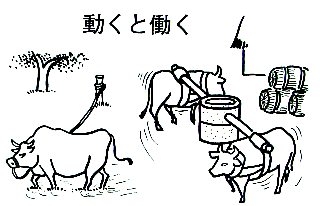
動くと働く (ugoku to hataraku, "moving and working"), from an early Toyota TPS training manual. The bull on the left walks in circles. The bull is moving but not working. The bull on the right turns a millstone and grinds grain. The same motion produces value. Toyota used this picture to teach the distinction between motion and work.
Japanese Origin
動き (ugoki) is the noun form of 動く (ugoku), to move. 働き (hataraki) is the noun form of 働く (hataraku), to work. The two characters differ by one element. The character for work, 働, is the character for move, 動, with the person radical (人偏, ninben) added on the left. The same character appears in Toyota's spelling of jidoka as 自働化 (jidōka, automation with a human element) rather than the ordinary 自動化 (jidōka, automation). Work, in Toyota's usage, is motion with human wisdom attached.
That reading is explicit in Toyota's teaching. Work is motion to which a person's wisdom has been added, and it can also be described as motion to which the supervisor's wisdom has been added on behalf of the subordinate. The responsibility for turning motion into work sits with supervisors and engineers, not with the operator.
Work, Motion, and Waste Within One Cycle
Within one cycle an operator may move continuously. The motion divides into two groups. The first group is motion that raises the value of the product, together with the motion that cannot be separated from that work under current conditions. The second group is everything else, and everything else is waste. A person's capacity is judged on the first group. Motion with waste still in it must not be mistaken for the person's capacity.
Toyota writes the relationship as 作業 = 働き + ムダ (sagyō = hataraki + muda), an operation equals work plus waste. Current capacity therefore contains both. Removing waste reveals capacity that was already there. The instruction that follows is to use that capacity to make the required quantity with fewer people, not to make more.
Examples of Motion That Is Not Work
The supervisor's question is whether a person is working or only moving. Watching a running machine is motion. Walking to fetch a part that should have been at hand is motion. Repacking goods, unwrapping packaging, and folding wrapping paper are Toyota's own examples of operations that are not inherently necessary.
Labor Density
Toyota defines labor density (労働密度, rōdō mitsudo) as the ratio of work to motion, written as 労働 (rōdō, labor using the work character) over 労動 (rōdō, labor using the move character). Raising labor density means directing more of the operator's energy to genuinely necessary work. Converting motion into work is the link between this distinction and man-hour reduction.
Relationship to the Three-Way Classification

Original, from an early Toyota TPS training manual

English rendering of the same diagram
Motion (動き, ugoki) is the center. Everything the operator does, the operation (作業, sagyō), is the ring. The ring divides into waste (ムダ, muda), work without added value (付加価値のない作業, fuka kachi no nai sagyō), and the small hatched wedge of value-adding work (正味作業, shōmi sagyō). The picture makes the point that value-adding work is a small share of what an operator does.
Toyota also draws the distinction as three categories rather than two.
- Waste (ムダ, muda). Motion that is not needed at all and can be removed at once. Waiting and meaningless transport, such as stacking and restacking parts or carrying them twice, are the standard examples.
- Work without added value (付加価値のない作業, fuka kachi no nai sagyō). Motion that adds no value but has to be done under the current conditions of the workplace. Walking to fetch parts, unwrapping supplier packaging, taking parts out of a large pallet a few at a time, and pressing the start button are the examples given. Toyota's guidance is to treat this category as waste too, since removing it requires changing the conditions of the workplace, not just the operator's motion. Later materials call this category incidental work (付随作業, fuzui sagyō).
- Value-adding work (正味作業, shōmi sagyō). Motion that raises the value of the product. The share of value-adding work in a cycle is smaller than most people expect.
Man-hour reduction means raising the share of value-adding work. Waste is removed first. Work without added value is removed as conditions allow. Value-adding work is kept, and is reduced only by means such as automation. The fuller treatment is in What Is the Relationship Between Work and Waste in the Toyota Production System?.
Common Misunderstandings
Reading effort as work. A worker who is visibly busy may be moving all day without advancing the process. The test is whether the process moved and value was added, not whether the person was occupied.
Starting from the seven wastes. Most lean training begins with the list of wastes. Toyota begins with the definition of work, then defines waste against the definition of work. Without the definition of work there is no standard against which to call something waste.
Placing the responsibility on the operator. Toyota places the responsibility on supervisors, whose wisdom is supposed to be built into the operator's motion through standardized work. An operator who is only moving is evidence of a work design problem.