Ask Art
"Does everyone in Toyota create A3 reports for problem solving?"
Does Everyone in Toyota Write A3 Reports for Problem Solving?
Short answer: Everyone in Toyota eventually learns how to write A3 reports — but A3 reports are not written for every problem. The vast majority of problems are solved verbally or with simpler, task-specific forms. A3 reports are triggered by harder problems, recurring problems, safety issues, and major breakdowns.
A3 Reports Are Real — and Common
A3 reports are common in Toyota and you will still find them today, in both Japanese and English. They grew out of the hoshin kanri, quality improvement, and PDCA movements of the early 1960s. Some managers — Taiichi Ohno is the famous example — notoriously hated paperwork and often refused to read reports more than a single page in length.
What emerged was a general communication tool called an A3, used for planning, proposing, report writing, and problem solving. Prof. Durward Sobek and I wrote about this in Understanding A3 Thinking: A Critical Component of Toyota’s PDCA Management System. John Shook does an excellent job of explaining how to write an A3 in his book Managing to Learn, published by LEI.
Unlike value stream maps, everyone in Toyota eventually learns how to author A3 reports and use them for a variety of purposes.
But Not Every Problem Gets an A3
The vast majority of problems in Toyota are handled verbally and with task-specific problem solving forms particular to each area. These are usually less complex problems that can be solved within minutes or hours by trained personnel skilled in troubleshooting.
A Toyota vehicle assembly factory has several thousand andon cord pulls per shift. There is no way to document every one of these, hold Six Sigma meetings, or chant “Kata” — as I like to point out in Four Types of Problems.
What Most Problem Solving Actually Looks Like
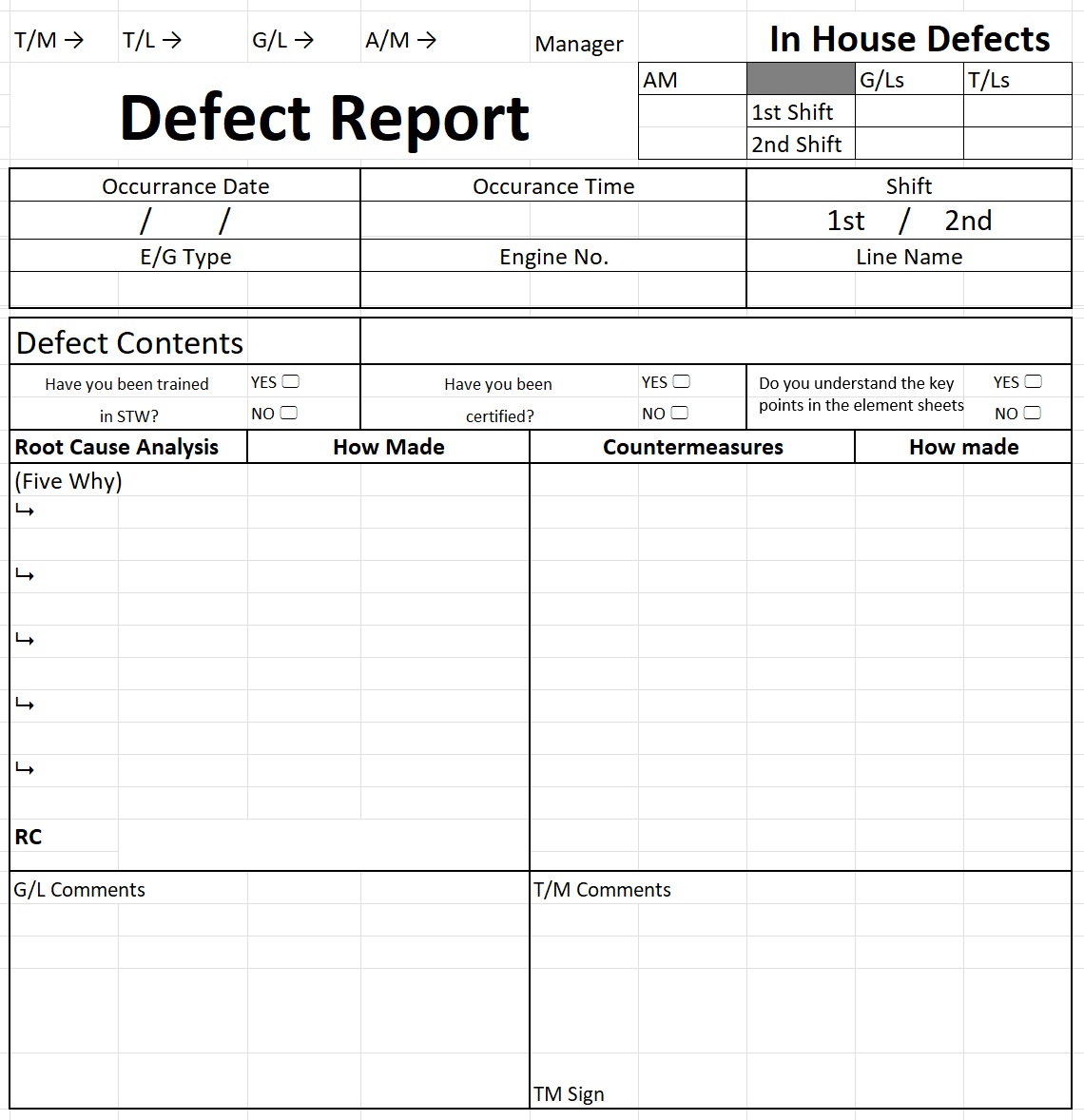
This is an actual Toyota defect content report that a team member and team leader would fill out for certain types of defects. I loosely use the term “4C” to describe these events: you fill out the concern (defect content), analyze the root cause(s), list specific countermeasures taken, and on the team daily management board you check and track results. It is a basic shop floor level PDCA cycle.
This form is from production, but similar forms exist in virtually every part of Toyota, specific to the area in question. Note the paper size is A4 — that is 8.5” x 11” in U.S. terms. I regret not talking more about these in my books on A3 thinking. These and similar forms are by far the most common forms filled out for problem solving in Toyota.
When A3 Reports Do Get Written
Specific types of problems trigger a multi-step A3 problem solving report: harder problems, recurring problems, safety issues, major quality incidents, or significant machine breakdowns. There are many shapes and sizes for these reports depending on the needs of the situation.
So does everyone in Toyota write A3 reports for every problem? No. Far more problems are rapidly solved verbally or by simpler reporting mechanisms. But specific types of problems get written up as A3 reports — even today in 2026.
The most common form of problem solving in Toyota for harder problems — in production and other departments — is called TBP, or Toyota Business Practice. It contains eight explicit steps for problem solving and is the current company standard. In Toyota today you will find single-page A3-style TBP reports and longer page-by-page versions in PowerPoint and PDF formats. It often depends on the audience and how the work is being presented — in person versus online, for example.
Most importantly, as we tried to convey in Understanding A3 Thinking, what matters is the inherent thinking patterns inside of Toyota and the nested PDCA loops for every phase of the problem solving journey.