Operational Audits: The Missing Feedback Loop in Hoshin Kanri
This article is based on a chapter from Global Ten, a Japanese book by Mikio Sugiura, one of the key figures in the early development of Toyota’s Hoshin Kanri system. It is due to be translated and published in English next year.Some of the English terms are approximate translations, but the management lesson is clear: Toyota did not arrive at effective Hoshin Kanri simply by writing better plans. It had to learn how to close the loop.
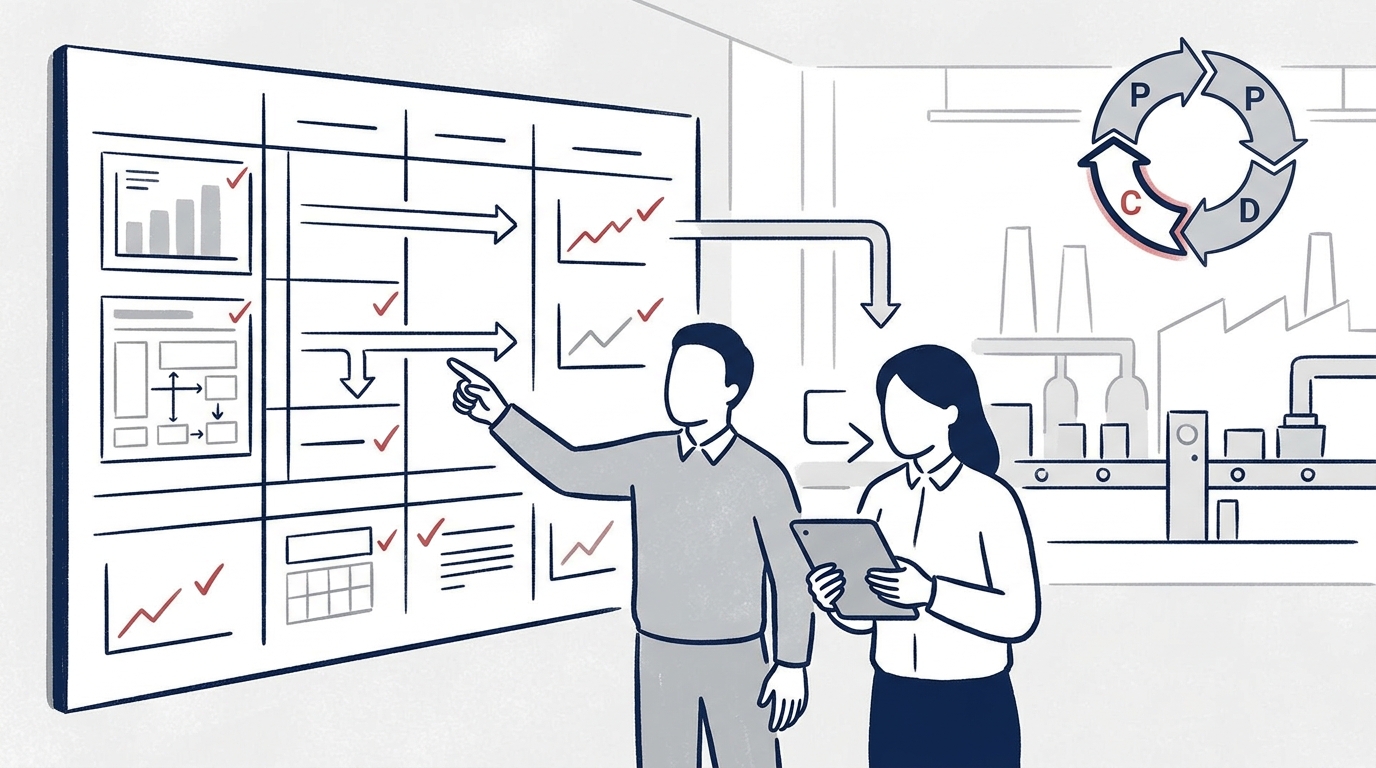
That point may surprise readers. Many companies today struggle with Hoshin because the planning side is elaborate — hoshin templates, cascade meetings, catchball discussions, and colorful Excel tracking sheets — while the review side is weak. Toyota faced a version of this same problem in the early phases of its own Hoshin development. The company learned that equal importance had to be placed on all parts of the PDCA cycle. Without a disciplined Check and Act process, Hoshin becomes an annual planning exercise with uneven implementation, minimal reflection, and limited adjustment.
Toyota’s answer was the operational audit — originally described by Sugiura as a company internal audit (shanai kansa) — an executive-led review of how Hoshin was actually being executed in the field.
The important point is the mechanism: what Toyota reviewed, who conducted the review, how gaps were surfaced, and how management attention was reset when Hoshin drifted away from actual conditions.
What an operational audit is — and is not
First, terminology. “Audit” in English carries baggage from finance and compliance, and that is not what is meant here. A Toyota operational audit (Kansa in Japanese) was not a controls check, not a maturity assessment, and not a scorecard exercise. It was a structured executive visit to a Hoshin theme, a plant, a function, or later an affiliate, in which senior leaders went to the place where the work was happening, examined what had actually been done against the Hoshin target, and used the gap to reset resources, priorities, and management attention for the next cycle.
The authority of the audit mattered. Sugiura is explicit that Company Hoshin were the President’s Hoshin, and therefore operational audits were, in effect, the President’s audits. Themes were proposed by Corporate Planning, but the President made the final decision. The auditors were senior executives and responsible executive managers, not neutral staff reviewers. That gave the process weight. When a weakness appeared, it was not treated as a local department problem alone; it also reflected on the executive managers directly under the President who owned the Hoshin execution system.
In PDCA terms, the operational audit is the Check that forces a real Act. Without it, Hoshin Kanri degenerates into annual goal-setting with monthly status reporting — which is precisely what most companies have.
The historical arc: from quality audit to operational audit
Toyota introduced Total Quality Control in June 1961, led by the Quality Assurance Department. The first company-wide quality audit followed in July 1962, and it surfaced four major management and quality problems that the new TQC framework alone was not going to fix. Out of that came a decision in January 1963 to commit the “Company Hoshin” to paper, structured as Basic, Long-term, and Annual Hoshin. The famous 25-year “Toyota-wide Quality Assurance” slogan dates from this era and gives a sense of the timescales the company was willing to plan against.
The audit mechanism evolved alongside the Hoshin structure. What started as a quality audit broadened, over the 1960s and 1970s, into a general operational audit covering any Hoshin theme the executive team wanted to verify in the field. Two examples are worth holding in mind.
The 1974 energy-saving operational audit. In the wake of the 1973 oil shock, Toyota launched a resource and energy-saving campaign as an explicit Hoshin theme. All forms of energy had to be conserved. The operational audit attached to it reportedly produced savings of roughly 480 million yen per month. The number matters less than the mechanism: a Hoshin theme triggered by an external crisis, executed through the line organization, and verified by an executive-led audit that closed the loop fast enough for the savings to compound through the year. These are Toyota’s own internal figures, so read them as company evidence of how the system was run, not as an independent measurement.
The Tahara Plant distribution kaizen. Tahara was Toyota’s first plant located more than an hour away from the main production complex. That distance strained the existing style of parts delivery. A local solution that worked around Toyota City did not automatically scale to a remote plant. The countermeasure was a mixed-conveyance milk-run system tied to heijunka. Eiji Toyoda’s takeaway, reportedly delivered after one of these audit visits, was that TPS depends heavily on efficient distribution — a conclusion he might not have realized from a status report alone.
The point in both cases is the same. The audit was not ceremonial. Executives went, looked, asked, identified problems, and changed the plans and resource allocations as a result.
The mechanics: A3, ten minutes, and the questions that mattered
By the 1980s, particularly during the post-merger integration between Toyota Motor Company (TMC) and Toyota Motor Sales (TMS) after 1982, the audit format had tightened into something a modern practitioner would recognize. Presentations to senior executives were expected on a single A3, delivered in roughly ten minutes, with the remaining time used for executive questioning and direction.
The format does work that PowerPoint cannot. A single A3 style report forces the presenter to show, in one visual field, the target, the actual, the gap, the cause analysis, and the countermeasures. A ten-minute limit forces the presenter to know the content rather than read it. The executive time freed up by both constraints is what makes a real Check possible — because what the audit is actually buying is the questioning, and the thinking, not merely the reporting.
The questions that mattered in these audits were not simply, “are you red or green?” They were closer to: What was your Hoshin target, and why that number? What did you actually achieve, and how do you know? Where is the gap coming from? How will you close the gap? What countermeasures are already underway? And, if the gap cannot be closed at your level alone, what decision, resource, or support do you need from us?
That last question is one of the things that distinguishes an operational audit from a status review. The audit exists to clarify both sides of responsibility: what the department manager must do next, and what the executives must decide, adjust, or remove so the Hoshin can actually be achieved. Sugiura notes that department managers were sometimes asked, “What would you do as President?” or “What would you do if you were the responsible executive?” The point was not rhetorical. Some countermeasures required changes to operating systems, working methods, or resource allocation that exceeded a department manager’s authority.
The audit allergy: bringing Hoshin review into resistant functions
The harder problem — and the one most modern lean leaders are actually facing — is not designing the audit. It is getting non-manufacturing parts of the organization to accept being reviewed in this disciplined way.
Toyota ran into this directly when TMC and TMS merged in 1982. TMC, the manufacturing side, had two decades of audit culture by then. TMS, the sales side, had what Toyota people described as an “audit allergy.” The word audit itself, to a sales organization, signaled inspection, blame, and headquarters interference.
Managing Director Masao Nemoto, who had taken on the Corporate Planning Department in late 1978 and brought with him the Kanri Noryoku Program (Kan-Pro), handled this by changing the framing rather than the substance. He did not call them operational audits at TMS. He called them exchanging business reports. The content was largely the same: a structured executive visit, an A3, a gap discussion, and a resource decision. The label removed the threat.
In 1981, ahead of the formal merger, Nemoto personally trained about 60 TMS area managers to introduce QC and Hoshin Kanri to roughly 400 dealers in the network. Shoichiro Toyoda separately pushed managers across the merged organization to use “readily understandable language” rather than the mutually unintelligible jargon that the manufacturing and sales sides had each developed. The cultural integration work was inseparable from the audit mechanism work.
The lesson for a modern practitioner is not that you should simply rename your audits. The lesson is that the audit mechanism is what matters and the label is negotiable. If “operational audit” makes your commercial, IT, or clinical leaders go rigid, call it something else and run the same disciplined review. What you must not do is concede on the mechanism itself — the executive presence, the A3 thinking patterns, the gap questions, the resource decisions.
Toyota later used lighter executive meeting formats with affiliates and distributors, but the same principle remained: senior leaders met directly with the responsible managers, reviewed real conditions, asked specific questions, and made decisions. The label and setting could change. The management function did not.
Practical implications for today
Sugiura does not present these as a modern implementation checklist. But for organizations trying to use Hoshin Kanri today, several practical implications follow from Toyota’s experience.
-
Build the audit discipline into the plan from the beginning. Do not bolt it on later or hope the normal monthly review process will somehow close the loop. If the audit plan is visible when Hoshin targets and countermeasures are set, people know from the start that execution, checking, and adjustment are part of the management system, not afterthoughts.
-
Force disciplined report-outs. The format does not have to be a Toyota-style A3 in every organization, but the discipline matters. Make people report on a defined topic in a short time — ten minutes is a useful benchmark — and protect time for questions, decisions, and follow-up. Do not let the review turn into a two- or three-hour discussion session with no clear purpose or action.
-
Make gap closure and needed support central to the discussion. The audit should not stop at explaining whether the target is on track. It should clarify the gap, the plan to close it, the countermeasures already underway, and what help is needed, if any. Sometimes the answer is “we own it.” Sometimes the answer is that a resource, priority, policy, or cross-functional obstacle has to be addressed by executives.
-
Make the language fit your environment. Do not use Japanese terms such as hansei or kansa for appearance. Use words that help people understand the purpose. If “audit” creates the wrong reaction, change the label. But do not water down the intended function: real reflection, fact-based review, gap closure, and management action.
-
Go to the actual worksite as part of the work. Do not skate on assumptions. The Tahara example matters because a plant more than an hour away exposed limits in Toyota’s existing parts delivery practice. The mixed-conveyance milk-run countermeasure was not just a logistics tweak; it taught senior executives that local solutions do not always scale automatically. That kind of learning is much harder to get from a conference room.
Hoshin Kanri without operational audits is a planning ritual. Hoshin Kanri with them is a steering system. The difference shows up not in the plan document but in what the organization does in month seven, when the world has moved and the original targets need to be defended, adjusted, or replaced. That is the moment the audit mechanism was built for, and it is the moment many implementations discover they have only a reporting routine, not a steering system.
Note: This article was produced with AI-assisted research, editing, and production for development purposes. Please verify details before citing or relying on specific facts.