Muda, Mura, and Muri: The Three Lenses for Finding Waste in the Toyota Production System
Muda, mura, and muri are three Japanese terms Toyota uses as complementary lenses for finding inefficiency in any process. Muda means waste — activity that adds cost without adding value. Mura means unevenness or variation in workload. Muri means overburden — loading people, equipment, or methods beyond their reasonable capacity. Together they are sometimes called the 3M or, within Toyota, 3ムダラリ (san-mudarari).
Western lean literature fixates on muda and its seven subcategories. Mura and muri are often treated as afterthoughts — mentioned for completeness, then ignored. Inside Toyota, all three are taught together as different angles for examining the same reality on the shop floor. Mura and muri are frequently more actionable than muda because they address root conditions rather than symptoms.
Where did muda, mura, and muri come from?
Toyota’s 1973 internal TPS training manual uses the full triad ムダ・ムラ・ムリ throughout. The chapter on safety (1-4) states directly that eliminating muda, mura, and muri is the first step to a safe workplace. The standardized work chapter (3-2) says work sequences must be free of all three. The kanban chapters use the collective term 3ムダラリ (san-mudarari) and state that muda, mura, and muri hide inside people, warehouses, materials, and equipment.
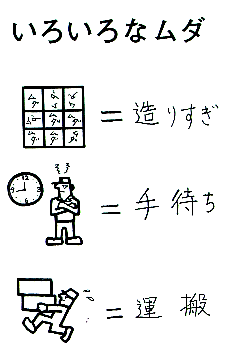 “いろいろなムダ” (Various types of waste) — from Toyota’s 1973 internal TPS training manual. The illustrations show overproduction (造りすぎ), waiting (手待ち), and transportation (運搬).
The waste-specific chapter (2-3) gave detailed treatment to muda’s subtypes but discussed only four of the eventual seven: overproduction, waiting, transportation, and processing. This is curious — all seven types existed in practice at Toyota by that time. The remaining three (inventory, motion, defects) were presumably understood but not elaborated in that particular chapter.
People who worked in TPS development during that period — including Isao Kato and Tom Harada — have confirmed that muda, mura, and muri were part of TPS teaching extending back into the 1960s, consistent with how thoroughly the 1973 manual uses all three terms.
Muda has the longest pedigree of the three. Its roots connect to TWI Job Methods (JM) training, which Toyota adopted in 1951. The JM framework teaches supervisors to improve work by examining every detail and applying four steps: Eliminate unnecessary details, Combine, Rearrange, and Simplify. The “eliminate unnecessary details” focus maps directly to muda elimination. Toyota’s early waste-reduction thinking grew from this TWI foundation.
The subdivision of muda into specific types came later, as TPS textbooks were written and revised. The eventual seven types of waste that exist in Toyota today — overproduction, waiting, transportation, processing, inventory, motion, and defects — represent a mature categorization that developed over time, not a list that was handed down complete from the beginning.
What is muda?
Muda is waste: any element in the production process that adds cost without adding value. Toyota’s TPS glossary defines it as “生産現場において、付加価値をうみださないで、原価だけを高める生産の諸要素” — elements of production that raise cost without producing added value.
The seven types of muda recognized in Toyota today are:
- Overproduction (造りすぎのムダ) — producing more than needed, or earlier than needed. Toyota considers this the worst waste because it generates secondary wastes: excess inventory, unnecessary transportation, and additional handling.
- Waiting (手待ちのムダ) — a worker unable to proceed to the next step in the work sequence, often because of insufficient workload or machine cycle constraints.
- Transportation (運搬のムダ) — unnecessary movement of materials beyond the minimum required for just-in-time production, including temporary staging, restacking, and transfer between containers.
- Processing (加工そのもののムダ) — unnecessary processing steps that do not advance the product or improve quality.
- Inventory (在庫のムダ) — raw material, work-in-process, or finished goods beyond what the production and conveyance system requires.
- Motion (動作のムダ) — human movement during production that does not add value to the product.
- Defects and rework (不良品・手直しのムダ) — producing items that must be scrapped or reworked. Toyota notes that when rework becomes a formal process step, people lose the sense that waste is occurring and improvement stops.
Most Western lean content stops here. Muda gets detailed treatment — entire books, courses, and consulting frameworks built around the seven wastes. This is not wrong, but it is incomplete.
What is mura?
Mura means unevenness. Toyota’s glossary defines it as variation in production plans and production volumes — quantities that are not constant and fluctuate up and down over time. For people, it means workload that varies against a baseline.
Japanese notation: ムラ (Mura) — Unevenness. 車両や部品の生産計画や生産量が一定でなく、一時的に増減変動することをいう。人の面では、ある基準に対し負荷のバラツキをいう。
A better English translation for mura in the Toyota context would be variation rather than “unevenness.” The word variation captures more of what Toyota actually means: not just that things are uneven, but that the fluctuation itself is a problem to be managed. When production volume swings from 80 units one day to 120 the next, that is mura. When one worker’s cycle is loaded to 95% and the adjacent worker’s cycle is loaded to 60%, that is mura. When customer orders arrive in batches rather than at a steady rate, that is mura.
Mura is heavily tied to the concept of heijunka — production leveling. Heijunka is Toyota’s primary countermeasure for mura. By leveling the type and quantity of production over a fixed period, Toyota reduces the fluctuation that cascades through every upstream process. Mura in the final assembly schedule creates mura in every supplying process, which creates muri on the people and equipment in those processes, which generates muda throughout the system.
This is the connection that most Western sources miss. Mura is not an abstract concept — it is a diagnostic lens that points directly at leveling problems. When you see mura, the countermeasure is almost always some form of workload leveling.
What is muri?
Muri means overburden. Toyota’s glossary defines it as placing excessive physical or mental load on people, or loading machines and equipment beyond their designed capacity. The characters break down as 無 (without) + 理 (reason) — literally “without reason” or “unreasonable.”
Japanese notation: ムリ (Muri) — Overburden. 生産現場において、人の面では、心身に過度の負担がかかることをいい、また、機械設備に関しては、それら自身が保有する能力に対して、過度の負荷をかけることをいう。
A useful way to think about muri is not reasonable. Asking a worker to perform a 70-second task in a 55-second takt time is muri — it is not reasonable, and the consequences are predictable: quality problems, safety incidents, and burnout.
What counts as “reasonable” is not subjective — it depends on having a standard. Without a defined standard for work content, cycle time, and physical demands, there is no baseline against which to judge whether a load is excessive. This connects muri directly to the need for standards such as standardized work. It also connects to respect for people: if you have no standard, you have no way to know whether you are overburdening someone.
Muri applies to three dimensions:
- People — physical strain, awkward postures, excessive pace, mental overload. When standardized work requires movements that are not sustainable across a full shift, that is muri on the worker.
- Machines — running equipment beyond its rated capacity or duty cycle. Pushing a press beyond its tonnage rating or running a motor above its thermal limit is muri on the equipment.
- Methods — using a process or method that is not suited to the task. Applying a method designed for high-volume production to a low-volume, high-mix situation is muri on the method.
Muri is the lens that connects directly to safety, ergonomics, and equipment reliability. Where muda asks “what can we eliminate?” and mura asks “where is the variation?”, muri asks “what is being asked to do more than it reasonably can?”
How do the three work together?
Muda, mura, and muri are not a hierarchy. They are three angles of observation applied to the same process. A supervisor walking a production line can look through each lens in turn:
- Muda lens: Where is activity happening that does not add value? Walking, waiting, searching, reworking.
- Mura lens: Where is workload uneven? Operators with different load percentages, volume swings between shifts, batch-and-queue patterns.
- Muri lens: Where are people, machines, or methods being pushed beyond what is reasonable? Ergonomic strain, excessive overtime, equipment running at limits.
The three are interconnected. Mura — uneven workload — frequently creates muri when the peaks hit. People and machines that are overburdened during peaks produce muda: defects, rework, excess inventory built during slow periods to buffer the peaks. Eliminating the mura (leveling) often eliminates the downstream muri and muda simultaneously.
This is why Toyota teaches all three together. Attacking muda alone — eliminating visible waste — without addressing the underlying mura and muri is treating symptoms. The waste comes back because the conditions that generate it remain.
Why doesn’t the West use mura and muri effectively?
One structural reason: muda has seven clearly defined subcategories. Supervisors and consultants can learn the list, walk a floor, and check boxes. Mura and muri have no equivalent subcategories. There is no “seven types of mura” or “seven types of muri” in Toyota’s teaching materials.
This is a missed opportunity. If mura and muri had been subdivided into specific, teachable types — the way muda was subdivided into overproduction, waiting, transportation, and so on — they likely would have gained far more traction in Western lean practice. The seven wastes succeeded as a teaching tool partly because the list gives people a structured way to observe. Mura and muri, left as single undifferentiated concepts, remain abstract for most practitioners.
The result is that Western lean practice tends toward muda-hunting: stand in the circle, watch for the seven wastes, eliminate them. This is useful but incomplete. It misses the systemic conditions — the uneven schedules, the overburdened workers, the mismatched methods — that generate waste faster than it can be eliminated.
What is 3ムダラリ (san-mudarari)?
Toyota’s internal terminology sometimes refers to the three concepts collectively as 3ムダラリ — a compound of muda, mura, and muri, taking the last syllable of each. This term appears in Toyota’s TPS glossary. It is not widely known outside Toyota.
Frequently Asked Questions
Who created the muda, mura, muri framework? There is no definitive source. The terms are standard Japanese words that predate Toyota — they appear in many contexts, including martial arts and general business language. Within Toyota, the concepts were part of verbal shop floor teaching long before they appeared in written TPS materials. The 3M triad developed over time as a pedagogical tool rather than being introduced by any single person.
Is there a specific order — does mura cause muri, which causes muda? Some authors propose this causal chain. Others treat the three as co-equal and complementary. Toyota’s own materials do not establish a strict hierarchy. In practice, the three are interrelated. Mura often generates muri, and muri often generates muda — but the relationships are circular, not strictly linear.
What is the “eighth waste”? Some Western lean authors have proposed an eighth waste, typically “unused employee creativity” or similar. This is not a Toyota concept. Toyota’s internal materials list seven types of muda. The eighth waste is a Western addition.
How should I use muda, mura, and muri on the shop floor? Use them as three passes in observation. Walk the process looking for muda — wasted motion, waiting, excess inventory. Walk it again looking for mura — workload imbalances, volume swings, batch patterns. Walk it a third time looking for muri — physical strain, equipment at limits, methods that don’t fit the work. Each pass reveals problems the others miss.
Art Smalley is president of Art of Lean, Inc.
This article draws on Toyota’s internal TPS glossary (用語集), the 1973 TPS training manual, and direct experience working in the Toyota Production System. AI was used in the editing of this article and production of graphics.